

AMD new Ryzen 8040 CPUs aren’t as new as they seem. During its Advancing AI event, AMD announced that Ryzen 8040 chips are coming to laptops, and you’d be forgiven for thinking it was a new generation of processors. AMD doesn’t call them next-gen CPUs, rather referring to them as “the next step in personal AI processing.” And that’s because these aren’t next-gen CPUs.
Ryzen 8040 mobile chips will replace Ryzen 7040 mobile chips, and based on that fact alone, it’s easy to assume that the Ryzen 8040 CPUs are better. They have a higher number! From what AMD has shared so far, though, these supposedly new chips look like nothing more than a rebrand of the CPUs already available in laptops. AMD set itself up for this type of confusing, misleading situation, too.
New name, old cores
First, how do we really know these are just rebranded Ryzen 7040 chips? I’ve included the full product stack below that spells it out. These chips, code-named Hawk Point, are using AMD’s Zen 4 CPU cores and RDNA 3 GPU cores, which the previous-generation Phoenix CPUs also used. There’s also the NPU, which I’ll circle back to in a moment.
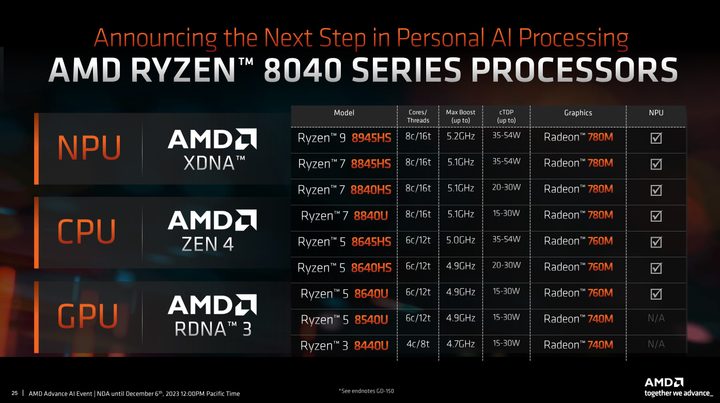
Keep all of those specs in your brain. Now look at the stack for Phoenix CPUs from Wikipedia below (no, I’m not sourcing from Wikipedia, each of the links here go to AMD’s product listing, but this illustrates the point well). Look familiar?
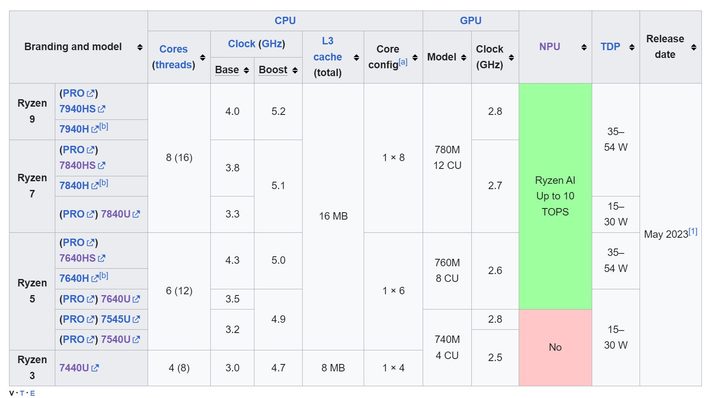
Every single spec is identical. The clock speeds are the same, the core counts are the same, and even the integrated graphics are the same despite speculation that AMD would bump the graphics power of these chips. All that’s changed is the number. AMD is also utilizing the fourth number in its naming scheme (more on that shortly) to segment some processors further. For instance, the Ryzen 7 8840HS is a 20W to 30W part, while the Ryzen 7 7840HS is a 35W to 54W part. You’ll now need the Ryzen 7 8845HS to get into that power range. Clear as day.
I reached out to AMD and ask if we could expect performance improvements in non-AI applications from these processors. AMD tells me it expects improvements due to “improved firmware and optimizations,” but it didn’t have any numbers to share. It also clarified that all of the specs are the same, including cache and GPU clock speed.
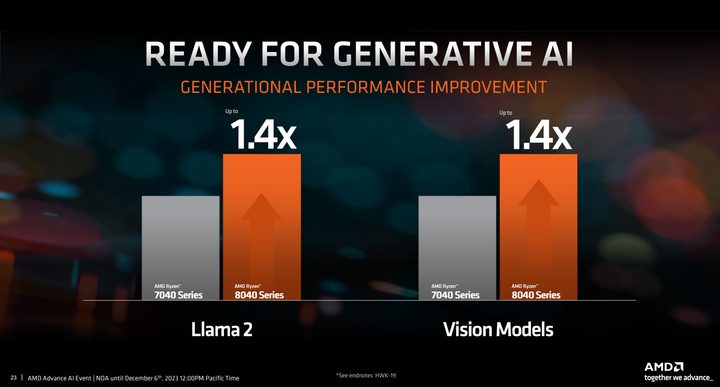
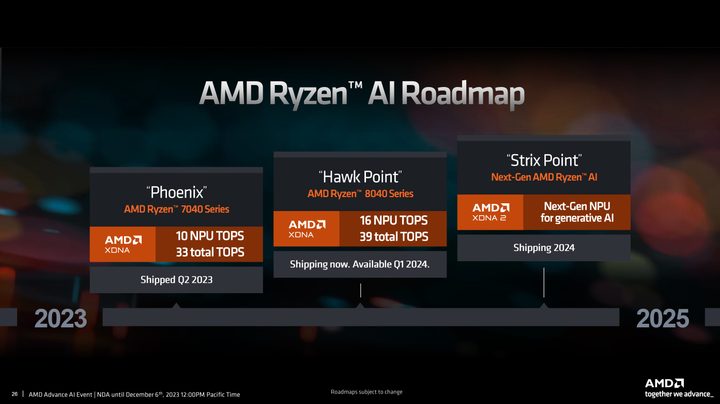
That brings us back to the NPU, which looks like the only difference in these chips. AMD announced Ryzen 8040 CPUs at an event titled “Advancing AI,” so we can’t discount the dedicated AI processor. AMD says these new chips provide a up to 1.4 times better AI performance than Ryzen 7040 chips.
Even that is a bit suspect, though. These new chips are capable of higher AI performance, but they’re just a boosted version of the XDNA architecture already available in Ryzen 7040 chips. In fact, AMD is including the dedicated AI processor on the same chips as it did in the previous generation.
AMD set itself up
It’s hard for Ryzen 8040 not to feel like a rug pull, but AMD set itself up for this situation toward the end of last year. At the time, it decided to change how it names laptop CPUs. You can see a breakdown of how that naming scheme works below.
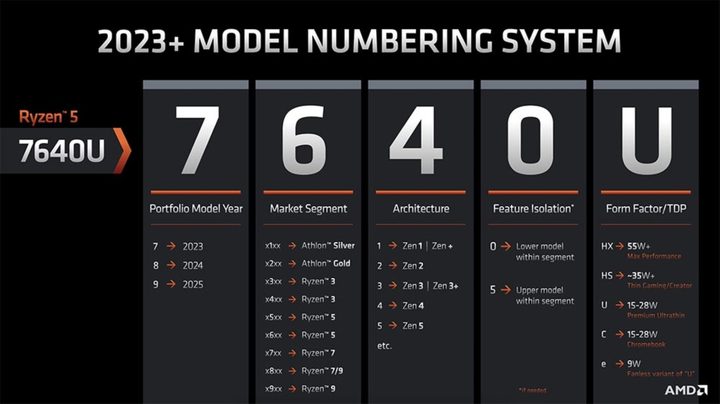
In some ways, it makes sense. Informed buyers can now pull more information from the name of the CPU rather than digging through spec listings and reviews to find out things like what architecture the processor is using. It’s with those uninformed buyers where there are issues. Most people have never seen an AMD marketing slide. When they go to buy a laptop and see one with a Ryzen 7040 chip and another with a Ryzen 8040, which do you think they’ll assume is better? The naming scheme works better for some buyers, but it’s awfully convenient that AMD is able to make older chips look newer under the new convention.
Even with Intel calling this branding “snake oil,” AMD hasn’t run into too much trouble with its naming convention up to this point. For the past year, it’s been mainly used to denote chips using an older architecture in budget laptops. There aren’t a ton of these laptops, and the architecture generally matches the performance expectations for the price of the machine.
That’s not the case here. Instead of wrapping up older architectures in the current generation, AMD is pushing out what looks like a new generation with the identical specs to what we already have. There isn’t so much as a clock speed boost. These are the same chips, just with a name that makes them appear newer.

It’s a problem. We can make up a set of mythical, helpless buyers who could be misled by just about anything, but with AMD’s naming convention, even decently informed buyers can fall victim. AMD says its Ryzen 9 tier is the fastest-growing out of its lineup, and it’s typically found in high-end gaming laptops. Even for that buyer, who probably knows a bit about the difference between Intel, AMD, and Nvidia, Ryzen 8040 CPUs can lead them to assume they’re getting something they’re not.
There was an outcry when AMD first announced its new naming scheme, which was a little overblown. A year and a “generation” on, though, Ryzen 8040 stands as living proof of how that naming scheme can obfuscate the product you’re buying.
Everything else
AMD didn’t focus much on Ryzen 8040 during its presentation, regardless of what they represent for buyers looking to pick up a laptop over the next year. The presentation did include some exciting announcements outside of chips. Chief among them is AMD’s Ryzen AI software stack.
This is a platform that allows you to take a model from PyTorch or TensorFlow, quantize it through AMD’s software, and deploy it with the Onnx runtime. This ecosystem should make it easier for developers to get apps up and running, and in that spirit, AMD is hosting three AI contests for robotics, generative AI, and PC AI for developers to enter.
In addition, the company confirmed that Strix Point chips will start shipping in 2024, and they’ll include an XDNA 2 chip. This is the second generation of AMD’s NPU, which the company says offers more than three times the generative AI NPU performance of current Ryzen AI offerings.


