
After four long years of waiting, Apple has finally transitioned its Mac Pro away from Intel processors. Now, the M2 Ultra is powering the workstation, and even without concrete benchmarks, there’s little doubt that the Mac Pro will clobber the previous generation. But it unfortunately also lacks everything that made the previous generation so impressive.
Apple has backpedaled on what made the previous Mac Pro such a monumental step forward for the company, and it’s hamstrung the Mac Pro by forcing it onto its own silicon. There’s no doubt the M2 Ultra will be impressive when it launches, but the flexibility afforded by the previous generation isn’t present this time around.
It will be powerful

If you’re not familiar with Apple’s Ultra chips, they’re pretty easy to understand: Take two Max models, stitch them together, and get nearly double the performance. The M2 Ultra is two M2 Max chips connected, offering up to 24 CPU cores and 76 GPU cores.
Apple says that the M2 Ultra is up to three times faster than the fastest Intel-based Mac Pro overall, and up to seven times faster than the starting configuration of the previous Intel-based Mac Pro. That’s not really saying much, though. Even the $600 M2 Mac Mini beats the previous-gen Mac Pro into the ground.
We don’t have concrete performance numbers, but we can extrapolate. Up to now, we’ve only seen the M2 Max inside the 14-inch MacBook Pro. In our testing, it reached around 15,000 in Cinebench’s multi-core test. Double that, and add a little extra to account for the fact that the M2 Ultra isn’t squeezed inside a 14-inch laptop, and you’re nearing CPU performance on the level of Intel’s Core i9-13900K.
Outside of theoretical performance, the M2 Ultra still looks impressive. In PugetBench for Premiere Pro, the M2 Max achieves a score of around 700, while an RTX 4090 rig with a high-end processor can reach up to 1,500. Double the M2 Max score, and you’re at that level.

There are exceptions, however. The median score for the 38-core M2 Max in Blender is 1,918. Double that, and you’re around 4,000, which is slower than even the RTX 4060 Ti. The RTX 4090, for reference, cracks 13,000.
Right now, the M2 Ultra competes with the best PC hardware on the market, even if it falls behind in some apps like Blender (where Nvidia cards are overwhelmingly faster). It even has some unique advantages, such as up to 192GB of memory and Apple’s Media Engine. The problem is that you don’t have a chance to upgrade your hardware in the Mac Pro.
One step forward, two steps back
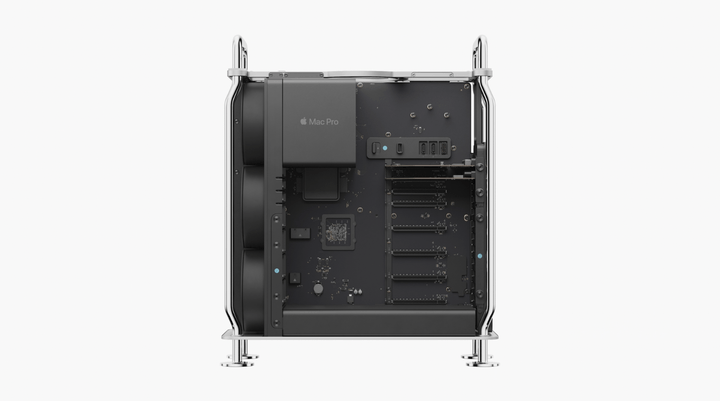
Following the announcement of the Mac Pro, Apple revealed that you wouldn’t be able to add a graphics card to any of the six open PCIe Gen4 slots. If you were hoping to upgrade it in the future, you’re out of luck. The M2 Ultra you buy is what you’re stuck with.
With the 2019 Mac Pro, you didn’t have the same flexibility to upgrade as a PC, but Apple made an effort with its MPX modules. These expensive upgrades would slot into open PCIe slots, allowing you to upgrade the graphics card or add a RAID array to your Mac Pro. You could even upgrade the RAM in the 2019 Mac Pro, which is an idea Apple has abandoned with the 2023 model.
It doesn’t look like these modules will work with the new Mac Pro. Apple only lists the 2019 Mac Pro on their compatibility list, and due to the fact that the M2 Ultra has a GPU on board, it probably won’t play nicely with a discrete GPU slotted into the system. The Mac Pro may compete with the PC hardware of today, but it will likely be outclassed by the end of the year, and certainly by next year.
That’s par for the course in the world of PC hardware, and especially so for Macs. Apple updates its other Macs on a nearly annual basis, though, allowing you plenty of opportunities to upgrade. Will we have to wait another four years for another Mac Pro revision? I don’t know, but that’s a gamble that will cost you between $7,000 and $12,000.

The days of Mac Pros dominating rendering bays have passed, starting in 2013 with the “trash can” design slip that it feels like Apple hasn’t fully recovered from. For extreme users, PC is and has been the way to go thanks to more extensive upgrade support and CUDA acceleration in many demanding apps, and the new Mac Pro doesn’t change that. And for those still using Apple workflows, the Mac Studio now provides the same power as the Mac Pro at a fraction of the price.
None of this should come as a surprise, though. Apple has always focused its attention on the much wider audience that buys MacBooks and Mac Minis over the smaller group that demands high-end performance out of a Mac Pro. The new Mac Pro isn’t a leap forward in the way it should have been, but if nothing else, it completes the transition over to Apple silicon. And that’s the most Apple could ask fir==or out of its storied workstation.


