
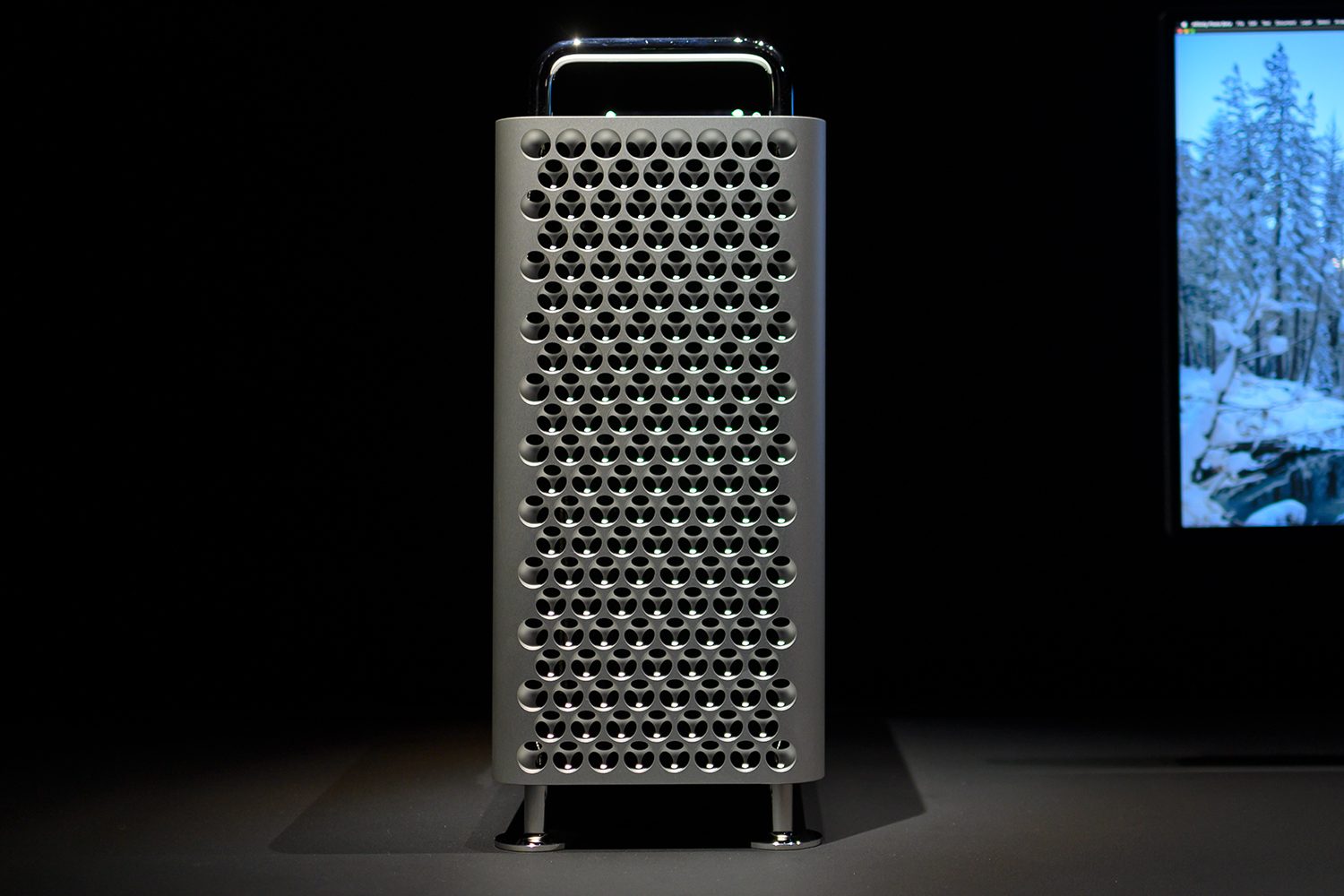

Apple is nothing if not a trendsetter. We’ve already established that the new Mac Pro isn’t something you’ll actually buy, but given Apple’s sway in the industry, it’ll likely have a big influence on the future of desktop design.
Beyond just the cheese grater case, there are a few tricks Apple has pulled here that could take the future of PC design down a new path.
The future of PC cases?
Beyond upgraded hardware that brings the Apple Mac Pro in line with, until now, much more capable homebrew hackintosh machines for high-end rendering tasks and similarly intensive applications, the new Mac Pro has some notable new features. The most obvious is its new chassis which blends an intriguing aesthetic with what Apple claims is an advanced airflow system. The 3D vents on both the front and back are said to maximize airflow beyond more traditional designs like hexagon grills, which have typically offered the greatest airflow while retaining chassis rigidity.
If this is indeed the case, we may see this sort of structural design making its way into more mainstream cases — although likely in a more limited form since the added material costs wouldn’t translate as well into more typical case markets. The cheese grater look may take some time to catch on too.
That wind tunnel-like effect of the case design, though, does present some intriguing additional benefits. Our close up look at the new Mac Pro suggested that it remains a quiet system and much of that is because of the use of large, low-turbulence heatsinks on both the CPU and GPU(s), which leverage case airflow directed immediately over those coolers, rather than additional active fans.
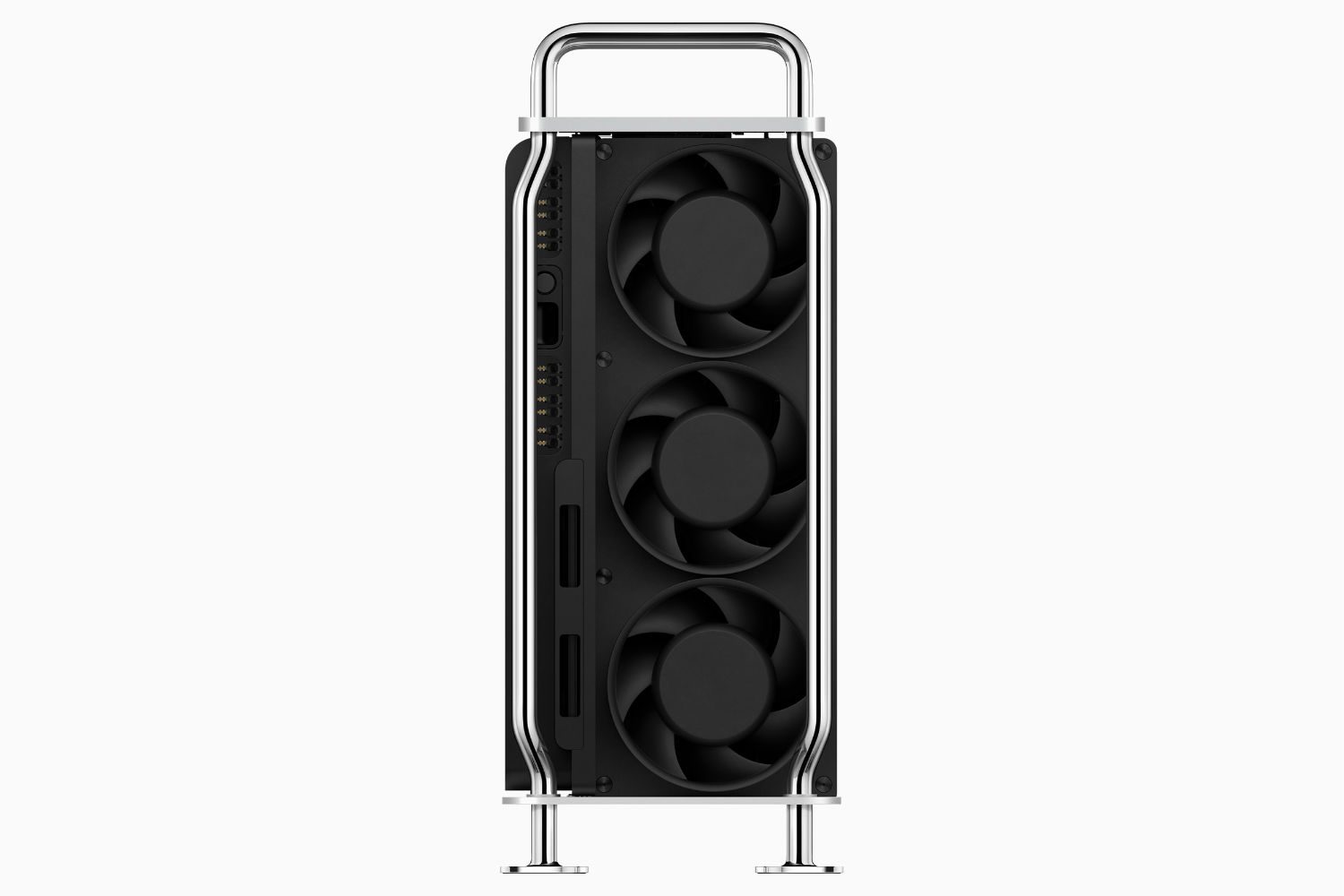
This shroud (which makes up part of the “MPX” graphics module) is a form of compartmentalization that we’ve seen in many high-end cases in recent years. Pushing the PSU into the base of the chassis with its own segmented airflow redirection, is one such example, but Apple’s system of reconfiguring the motherboard and components takes that to a new level. By opting for immediate passive coolers instead of active ones with their own dedicated fans, airflow can retain its singular direction. We’d have to run some benchmarks to be sure, but that seems like an efficient way of moving air around a system, rather than having various configurations of fans pushing and pulling in different directions.
While the Mac Pro is a unique case with some very specific hardware choices, we’d like to see PC motherboards and case manufacturers experiment a little more with layout and design to push for something similar in more mainstream hardware.
A more modular approach
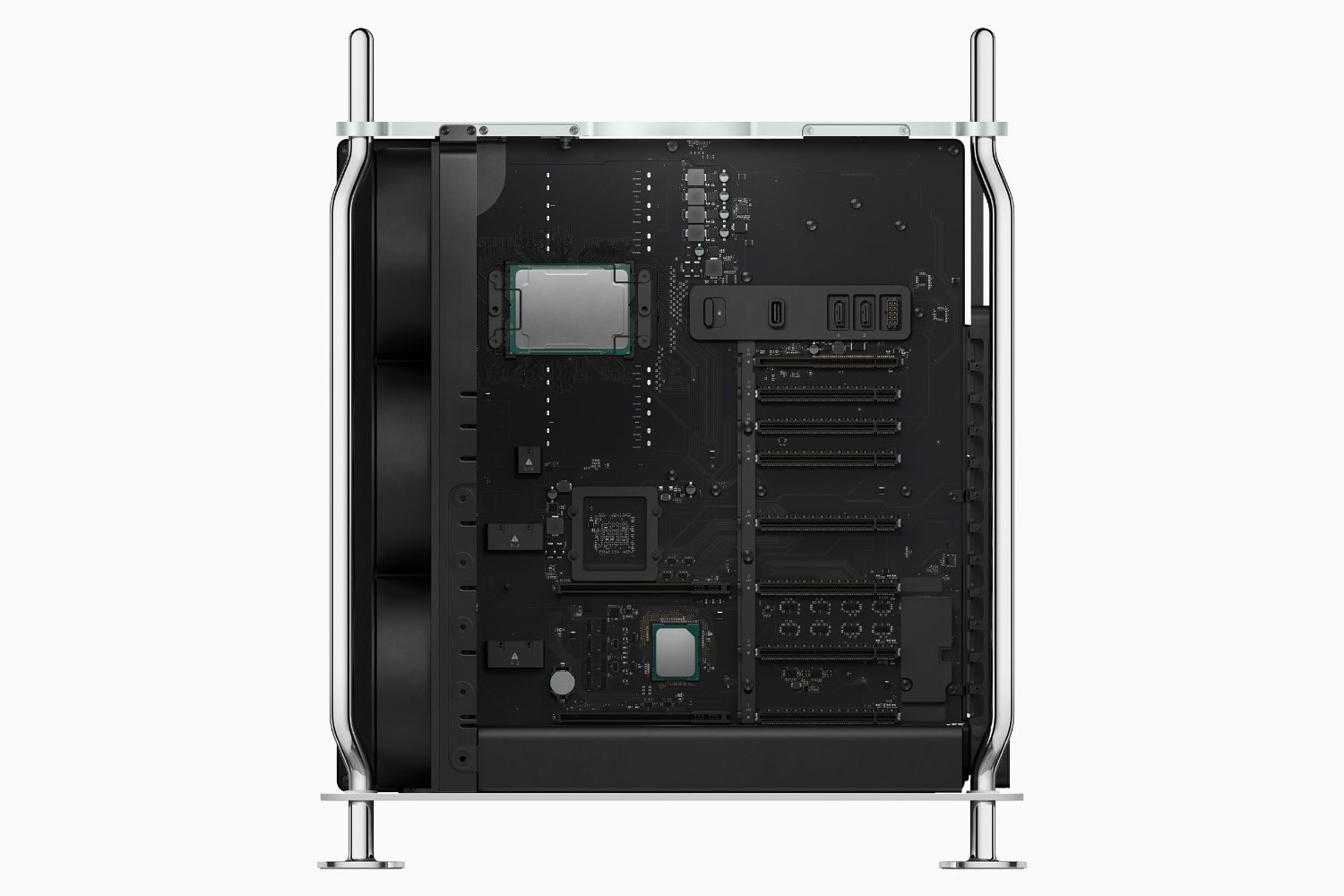
As for the components in the new Mac Pro, there’s nothing mainstream about it. The up to 28-core Xeon CPU is something that we don’t expect to see outside of monster workstations and extreme benchmarking machines. Likewise, with GPUs like the newly debuted “world’s most powerful graphics card,” in the form of the AMD Radeon Pro Vega II Duo. The dual-GPU on a single board design is based on a similar core to the Radeon VII. It’s an intriguing design and something we haven’t seen much of in the gamer space since the AMD 295X.
But of particular note is the new PCIExpress setup in the Mac Pro, which allows the card to draw up to 550 watts of power through the extra-long PCIExpress slot alone using an implementation of Thunderbolt. No external power connectors required. Custom PSU cable companies might hate the idea, but it would be interesting to see such a design make its way into motherboards to cut back on cables within minimalist or small form factor systems. It seems likely to be an Apple-only design for now though, so getting that out into third-party products seems unlikely in the near future.
The last treat for Apple fans considering a new Mac Pro is the Afterburner, a hardware add-in card that uses a field programmable gate array (FPGA) that enables fast decoding of video It’s a specific task with specific hardware — a bit like the ASIC chips found in Bitcoin mining rigs — that enables the decoding of up to three ProRes RAW video, or 12 4K streams in real time. That will be a godsend for video editors.
While that isn’t something we expect to see filter through to more mainstream PCs, the modular approach Apple is taking with its Mac Pro with its GPUs and add-in cards, as well as a large tower chassis with a clean and open design, suggests to us that Apple may support the Mac Pro more so than it has in the past. That’s not saying much, as Apple has a history of quickly abandoning its desktop platforms, but expansion and upgradeability beyond the initial hardware setup does make the Mac Pro a more attractive buy for workstation users. Updated hardware configurations beyond the initial buy is something that Windows PCs have typically enjoyed more readily.
Don’t get us wrong. Apple is still going to be Apple, and the hardware options and upgrade paths are still going to be decidedly proprietary. The prices are also going to remain sky high. But there are some features within the new Mac Pro which could nudge some PC manufacturers in certain directions — especially if it’s considered competitive once again with some high-end workstations.
Just as the “trash-can” Mac Pro of 2013 encouraged the creation and adoption of smaller scale systems without sacrificing power, perhaps the new Mac Pro will encourage larger, more modular ones in turn. If this could lead to cooler and quieter workstations with fewer point of failure fans included, we’d be all for it.


