  1. Home
  2. Computing
  3. News

Digital Trends may earn a commission when you buy through links on our site. Why trust us?

It’s finally happening: Apple may reverse stance on touchscreen Macs

Add as a preferred source on Google

Apple is reportedly walking back its infamous policy against bringing touchscreens to MacBooks. Yup, you read that right.

And we’re not talking about reviving the disastrous Touch Bar, either. If the report is to be believed, we’re talking about real touchscreens on MacBooks, much like the ones currently available on many Windows laptops.
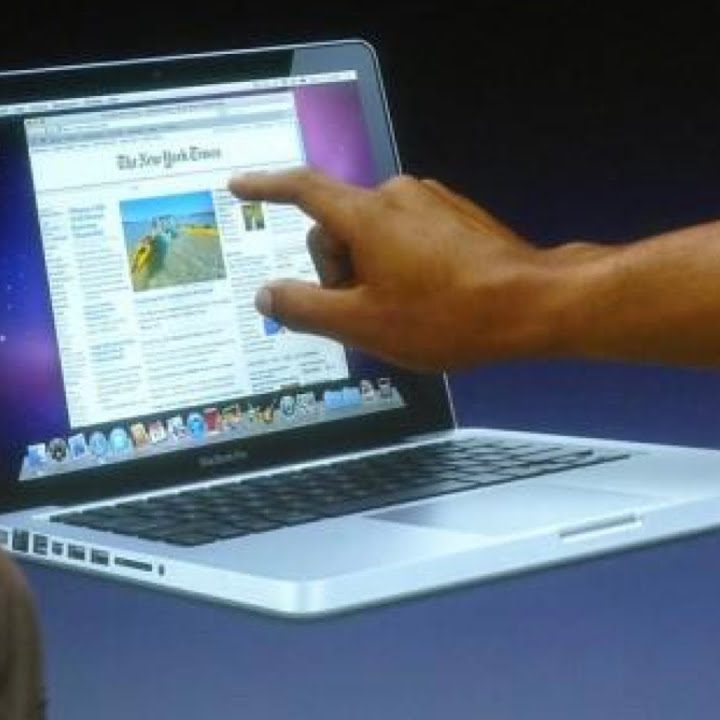
Steve Jobs in front of a graphic of a touchscreen MacBook.
Apple

According to the reliable Bloomberg reporter Mark Gurman, Apple is currently working on touchscreen MacBooks to release in 2025. Gurman says these touchscreens will also be Apple’s first OLED MacBooks as well.

Recommended Videos

This reverses the long-held position by Apple designers, originally put in place by Steve Jobs himself, who criticized the ergonomics of vertical touchscreens. It’s the reason MacBooks have kept touch surfaces on the keyboard deck, such as the trackpad and Touch Bar.

But let’s be real: Apple has been making products with vertical touchscreens ever since the iPad Pro with Magic Keyboard came out. So, that seemeingly makes it hard to stay committed to the idea that vertical touchscreens aren’t well-designed considering the popularity of that device.

It becomes even harder to explain when you consider that all these devices are made on the same system architecture — and in some cases, the same exact chips. You can even use iPhone apps on the M-series MacBooks, despite not having access to touch controls.

Apple has maintained that it is not merging the iPad and the MacBook, despite the fact that the lines between the two have become increasingly blurred.

Luke Larsen
Former Senior Editor, Computing
Luke Larsen is the Senior Editor of Computing, managing all content covering laptops, monitors, PC hardware, Macs, and more.
AI bots are a hit across the hotel biz, and if they feel creepy, you’re not alone: Study
Hotel booking chatbots are creeping out customers, but there's a simple fix that can make a difference.
Isometric Ai assistant and bubble speech, 3D illustration

If you have ever tried to book a hotel online and found yourself unsettled by the AI chatbot trying to help you, science has your back. New study from Texas A&M College of Agriculture and Life Sciences confirms that hotel booking chatbots are genuinely creeping people out, and it is actually hurting bookings.

What is giving hotel chatbots their creep factor?

Read more
Pope says AI must be disarmed and shouldn’t dominate humanity. We’re going the opposite way.
The Pope just dropped his first encyclical, and AI companies should probably read it.
Pope Leo XIV signing his first encyclical

Pope Leo XIV signed his first encyclical on May 15, the 135th anniversary of Pope Leo XIII's Rerum novarum. The document, Magnifica humanitas, was published on May 25 and addresses one of the defining challenges of our time: artificial intelligence and its impact on humanity.

The core message isn't anti-technology. The Pope is clear that technology is neither a threat nor inherently evil. However, he does say that technology is never neutral, because it takes on the values of those who build, fund, and control it. That's where things get interesting.

Read more
I built an offline Grammarly alternative and turned it into a Mac app without any coding
It lives in a browser tab. It's a Chrome extension. It's also a Mac app. Claude built it for me in all three flavors.
Grammarly alternative built using Claude.

I wrote this entire article while seated on an airplane experiencing unusually high turbulence. The software I used to spell-check and grammatically sanitize the draft was built at an airport. The language engine is running entirely on my Mac, fully offline, fixing all my typos and removing the double spaces while I mash the keyboard and sip a sugar-bomb coffee. 

Also, I don't know how to code. I didn't write a single line of code, and yet, the Mac software I am using right now looks classier and feels snappier than Grammarly ever did. Grammarly, if you don't know, is one of the most popular apps for spelling and grammar checking on the planet. So, how did I do it? I asked Claude. I narrated my wish, it asked my preferences, and in less than 30 minutes, I built myself a no-internet Grammarly replacement while also avoiding the "yet-another-subscription" curse.

Read more