

Twenty-two years ago, the first iMac hit the scene, and it was revolutionary. The iMac G3 the computing world and forever left a mark on the industry.
The iMac is again on the cusp of another revolution. No, not on the latest update to the 5K 27-inch iMac. I’m talking about the rumored relaunch of the line, complete with a visual redesign and a new Apple Silicon processor said to be just over the horizon.
It may sound strange, but the iMac G3 and the upcoming iMac revamp have a lot in common. Looking back the legacy of the iMac G3 just might give us ideas about what Apple has in store for the future of the iMac.
The design revolution

In the mid-1990s, Apple was a company lost in the computing wilderness. It churned out a succession of boring gray boxes, just like the rest of the competition. The company had done all-in-one computers before — the original Macintosh from 1984 was just such a machine — but on the eve of Steve Jobs’ return in 1997, it was making standard computer towers like everyone else. It was all a far cry from the days of the pirate-flag startup, the Apple that would later tell us to Think Different.
And then came the iMac G3. By the time it launched in 1998, personal computers had been around for two decades, yet were no closer to popular adoption, instead remaining the domain of the nerdy and the technically gifted. Jobs and his design guru Jony Ive sought to change that by making the iMac fun and approachable, with a bubble-shaped housing and bright, inviting colors.
The device had a handle on top, not because Apple expected you to carry it around a lot, but, in the words of Ive, “it makes a relationship possible. It’s approachable. It’s intuitive. It gives you permission to touch.”

Today, the iMac finds itself in a similar situation. It has kept the same design since 2012, and while the swooping back and razor-thin edges were supremely fashionable back then, the iMac’s huge bezels and oversized “chin” stick out like a sore thumb in today’s bezel-less world. Apple once again finds itself needing to restate its desktop credibility, showing the world that it still knows how to build an all-in-one machine that pushes the boundaries of design.
Judging by the leaks and rumors, the next iMac could do just that. Both leaker Sonny Dickson and the China Times have said a redesigned iMac with thinner bezels will launch imminently. That could see the current 21.5-inch and 27-inch iMac models bumped up to 23-inch and 29-inch sizes, with more screen space on offer to Mac fans.
While that would be a great start, an even more radical redesign could be in the offering — one that would make a similar splash as the iMac G3 did 22 years ago. According to a recent patent, we know Apple is considering making an iMac from a single piece of curved glass. This would be the perfect way to restate Apple’s design chops and give the iMac a much-needed boost. The current iMac design has done great, but it needs an overhaul.
Like Apple in 1998, we could be on the brink of seeing that happen.
Not just a pretty face
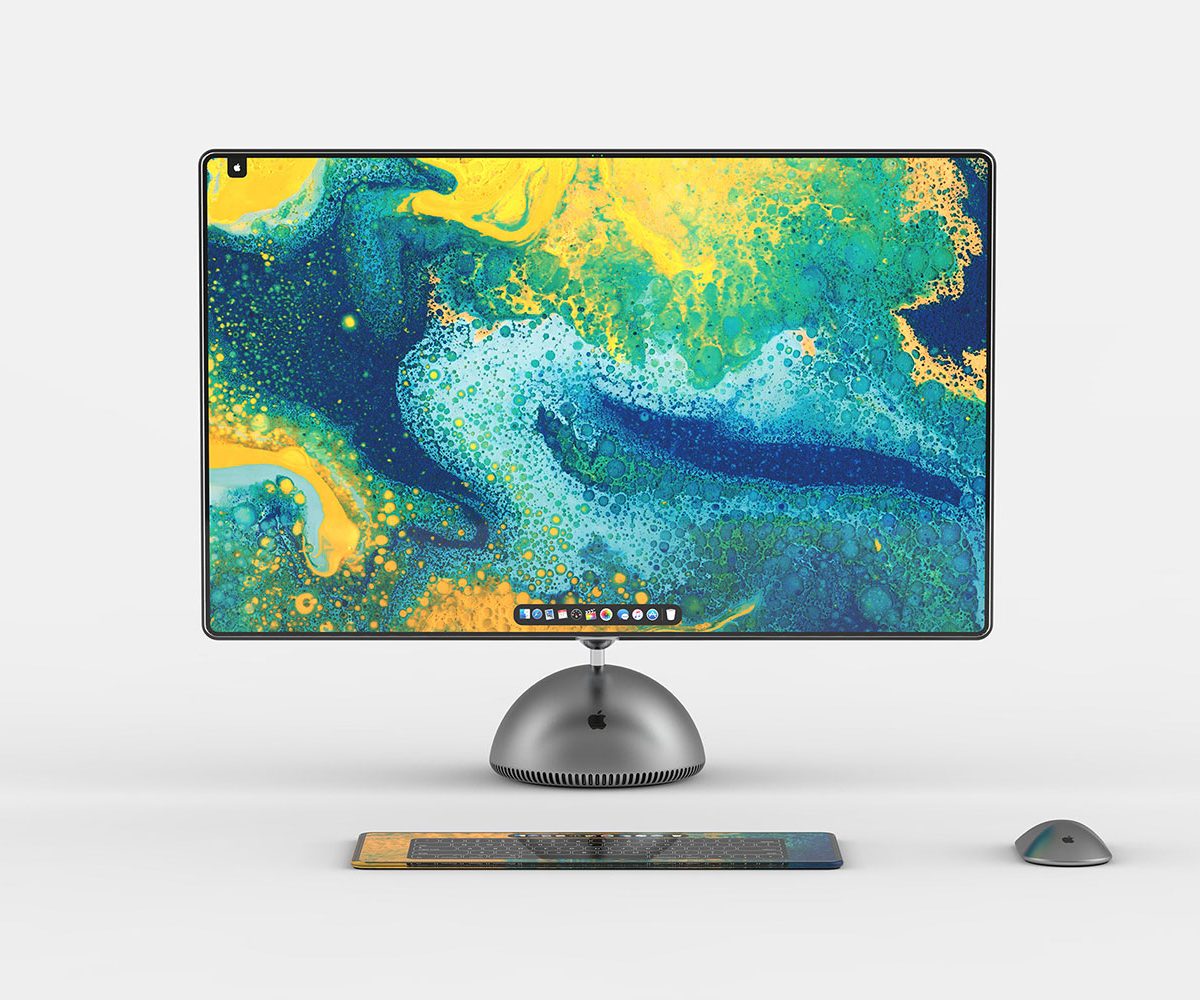
Design aesthetics were not the only thing revolutionized by the iMac G3. The internal components were just as important — and again, there are similarities with the future of the iMac.
One of the main reasons the iMac G3 was translucent was so that users could get a close-up glimpse of how the computer worked. Instead of being hidden inside an opaque box, the device’s parts were on show for all to see — and in doing so, they lost their mystery, their fear factor. They could be known and understood.
Those components were just as important as the external appearance of the computer. As Steve Jobs said at the time, “The iMac isn’t about candy-colored computers. The iMac is about making a computer that is really quiet, that doesn’t need a fan, that wakes up in fifteen seconds, that has the best sound system in a consumer computer, a superfine display. It’s about a complete computer that expresses it on the outside as well. And [competitors] just see the outside. They say, ‘We’ll slap some color on this piece of junk computer, and we’ll have one, too.’ And they miss the point.”
And what would a redesigned iMac have on the inside? Apple Silicon processors. At its Worldwide Developers Conference (WWDC) earlier in 2020, Apple announced that making its own chips in this way would allow it to improve its Macs’ performance while making them much more power efficient. The company has already been making its own processors for many years in its iPhones and iPads, and these chips simply blow away the competition. Apple has form here, and there is no reason to doubt its WWDC claim.
If Apple’s lucky, history just might repeat itself.
Like the iMac G3, Apple Silicon processors would show the world that the iMac is not just about looks — it is about revolutionary performance, too. Leaked benchmarks have already revealed it outperforming Microsoft’s attempt at an ARM processor, all while running in an emulated environment. When Apple Silicon chips run natively on MacOS, the results could be even more impressive.
Apple Silicon is not just about power and efficiency, though — it shows Apple can still innovate in ways its rivals cannot almost a decade after Steve Jobs passed away. Which of Apple’s competitors can claim to have a neural network as advanced as Apple’s Neural Engine built right into its hardware? Or how about the T2 Security Chip, which enables Face ID on iOS and helps power the industry’s best laptop speakers in the MacBook Pro 16? When Apple integrates the T2’s functionality into Apple Silicon processors, Face ID on the Mac will be a seamless way to log in with facial recognition tech that is far more secure than anything Apple’s rivals can offer.
In the same way the iMac G3 brought powerful computing components to a popular audience, the next iMac could bring many of Apple’s best advances to the Mac. Just like two decades ago, the iMac could to seriously shake up the computing industry. If Apple’s lucky, history just might repeat itself.


