  1. Home
  2. Computing
  3. News

Apple’s Vision Pro may help your eyesight in this genius way

Add as a preferred source on Google

There are still a ton of mysteries surrounding Apple’s Vision Pro headset, and one of them is how the device will work with prescription lenses. A new patent might have shed some light on that, and it reveals a pretty remarkable idea from Apple.

According to the recently published patent (number 20230258944), the Vision Pro could use lenses made out of liquid instead of glass. This would apparently allow them to be highly customizable, allowing you to fine-tune them to perfectly match your prescription and your vision needs. After we learned that the next Vision Pro could send you on a mood-altering trip, it’s another instance of Apple envisioning a wacky idea to elevate its headset.

A person tries on an Apple Vision Pro mixed reality headset in an Apple Store, with an Apple employee alongside them.
Apple

The latest patent states that “Each lens may have a lens chamber filled with liquid. The lens chamber may have rigid and/or flexible walls that form optical lens surfaces.”

Recommended Videos

It goes on to explain that “Actuators and/or pump and reservoir systems may deform the lens surfaces in response to control signals from a control circuit to tune the lens.” In other words, you’d press a button or rotate a dial on the headset and the device would morph the lenses accordingly.

The way this would work is a little technical. Apple describes how “Inorganic dielectric particles or other refractive- index-adjustment particles may be used to adjust the refractive index of the liquid in the lens chamber and thereby adjust the refractive index of the lens.”

Liquid gold
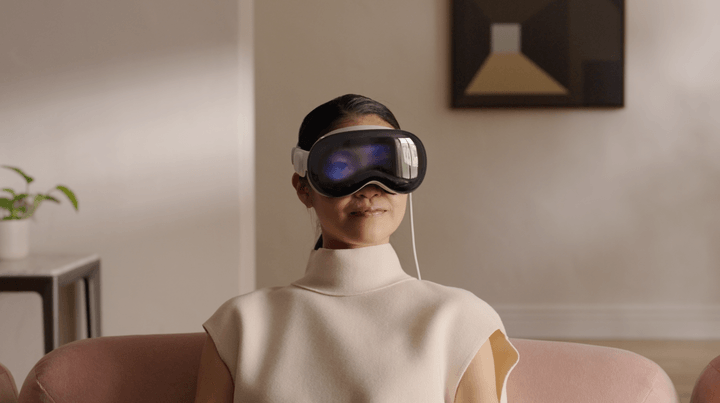
A woman wears the Apple Vision Pro headset while sitting on a couch.
Apple

Liquid lenses are not the only way the patent aims to improve the visual experience for headset wearers. To account for differences in users’ eyes, the Vision Pro could adjust the spacing between its eye modules so that they better align with your pupils.

This could be done by gathering information on the position and location of a user’s eyes using cameras, then providing a way to adjust the eye modules’ positioning (this could be done manually by yourself or automatically by the system).

The patent follows another that was published in July 2023, which outlined how a pair of augmented reality glasses may come with adjustable lenses that could be tweaked on the fly using the device’s Digital Crown.

While that revealed that Apple was working on implementing adjustable lenses into future products, the patent didn’t mention the possibility of using liquid instead of glass. The most recent patent has brought that idea to the surface.

It all suggests Apple is thinking carefully about how to account for users with different visual needs. We can’t know if its ideas are on the money just yet, but whether the company gets it right will come into sharp focus when the Vision Pro launches sometime in 2024.

Alex Blake
Alex Blake has been working with Digital Trends since 2019, where he spends most of his time writing about Mac computers…
Adobe’s new AI assistant could save you hours in Photoshop and Premiere
Premiere Pro users may never have to rename 500 video clips again
Adobe

Adobe is making one of its biggest bets yet on AI-powered creativity. The company has announced a major expansion of its creative agent across Firefly and Creative Cloud, introducing AI assistants capable of handling complex, multi-step workflows across applications, including Photoshop, Premiere Pro, Illustrator, InDesign, and Frame.io.

The move positions Adobe's AI agent as a central layer connecting every stage of the creative process, from brainstorming and content generation to editing and final production. Rather than simply generating images or text, Adobe's vision is to create an assistant that can understand a creator's goal and execute a series of actions across multiple tools.

Read more
Trump says Intel will make chips for Apple in a major win for U.S. manufacturing
Intel Foundry may have landed its most important customer yet
Logo

Intel’s efforts to rebuild its chipmaking business may have landed its biggest customer yet. U.S. President Donald Trump announced on Thursday that Apple has agreed to work with Intel to design and manufacture chips in the United States, a deal that could significantly strengthen Intel’s foundry ambitions.

The announcement does not come out of the blue. Earlier reports indicated that Apple and Intel had been discussing a manufacturing partnership for more than a year and had already begun working together on select chip production projects.

Read more
A harmless-looking ChatGPT prompt opened the door to gruesome AI images
The findings show how image safety systems can fail without explicit graphic instructions.
ChatGPT

A harmless-looking ChatGPT prompt pushed the latest public version of ChatGPT into generating sexualized and violent images, AI security researchers told the BBC. The finding puts new pressure on OpenAI’s image safety systems, since the request wasn’t described as plainly graphic.

Mindgard, a British AI security startup, said it reached the results by altering a widely shared instruction that had been used for comedy. OpenAI added safeguards after the BBC contacted it, but the researchers said small wording changes still produced concerning images.

Read more