1. Home
  2. Computing
  3. News

Google strikes back with its own lightweight AI model

Add as a preferred source on Google
Google Gemini on smartphone.
Google

Google announced Thursday that it is releasing Gemini 1.5 Flash, it’s snack-sized large language model and ChatGPT-4o mini competitor, to all users regardless of their subscription level.

The company promises “across-the-board improvements” in terms of response quality and latency, as well as “especially noticeable improvements in reasoning and image understanding.”

Recommended Videos

Google initially released Gemini 1.5 Flash in May as a lighterw-eight version of its flagship Gemini 1.5 Pro model. It’s designed to perform less resource intensive inference tasks faster and more efficiently than Pro does, much as Claude 3.5 Haiku, Llama 3.1-8B and ChatGPT-4o mini do for their respective parent models.

Flash’s context window is drastically expanding with this update, growing from a paltry 8K length to 32K (roughly 50 pages of text). Granted, that’s a 4x increase in size, but even at 32K, Gemini Flash’s context window is still just a quarter the size of GPT-4o mini’s 128K window (or, about a book’s worth).
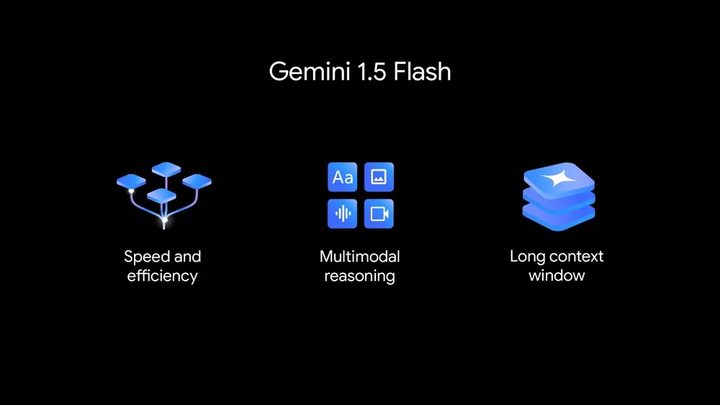
A slide showing Google Gemini 1.5 Flash features.
Google

What’s more, Google plans to “soon add” the ability to upload text and image files, either from Google Drive or the local hard drive, direct to the context window. This feature was previously restricted to the subscription tiers.

The company also announced updates on its efforts to reduce instances of hallucinations within its models. Google plans to include “links to related content for fact-seeking prompts in Gemini,” essentially providing links to the sources it cites.

The AI will do this for both traditional search and for associated Workspace apps as well. If the AI uses information gleaned through its Gmail integration, it will provide links back to the relevant emails.

These updates are available immediately to nearly all Gemini users on both web and mobile and in 40 languages. Teens who meet the minimum age requirements needed to manage their own Google accounts will receive access next week.

Andrew Tarantola
Former Computing Writer
Andrew Tarantola is a journalist with more than a decade reporting on emerging technologies ranging from robotics and machine…
Apple made Liquid Glass adjustable, which says plenty about Liquid Glass
The new slider is useful, welcome, and mildly hilarious after a year of Apple acting like transparent everything was the obvious future.
Text, Document, Business Card

Apple’s big glassy software future now comes with a way to make it less glassy. In iOS 27, users can adjust the translucency of the Liquid Glass effect, while macOS Golden Gate adds its own Liquid Glass controls under System Settings.

Liquid Glass is still alive across Apple’s platforms, still shimmering through menus and panels, still doing the elegant UI trick Apple clearly likes. The big visual bet has already earned a dimmer switch. After a year of treating translucency like the obvious next step, WWDC’s most revealing design update may be the one that lets people dial it back.

Read more
Windows 11 just fixed one of Search’s dumbest limitations, and you’ll wonder how you lived without it
One less character, one less annoyance every time you search your PC.
Person sitting and using a Windows Surface computer with Windows 11.

If you have ever typed two letters into the Windows 11 search box, paused, and watched nothing useful happen until you added more characters, you already know exactly why this Windows 11 update matters. 

Microsoft's June 2026 Patch Tuesday update, part of a release Windows Latest calls the biggest of the year (via Windows Latest), quietly fixes that. Windows Search can now find and prioritize files with as few as two characters, down from the old three-character minimum.

Read more
Brazil’s secret World Cup weapon taught the team when to ignore it
The data said he wasn't running enough. The footage said he was always in the “perfect tactical position.”
Soccer ball in net

Brazil has more World Cup titles than anyone, five of them to be precise, but after going through five straight tournaments without adding to that count, the team is leaning hard on data this time. 

Every player wears a sensor-packed "smart vest" tracking field position (via GPS), heart rate, and a stat called "player load," the same kind of numbers that your Whoop band or Apple Watch brags about, but tuned specifically for the sport.

Read more