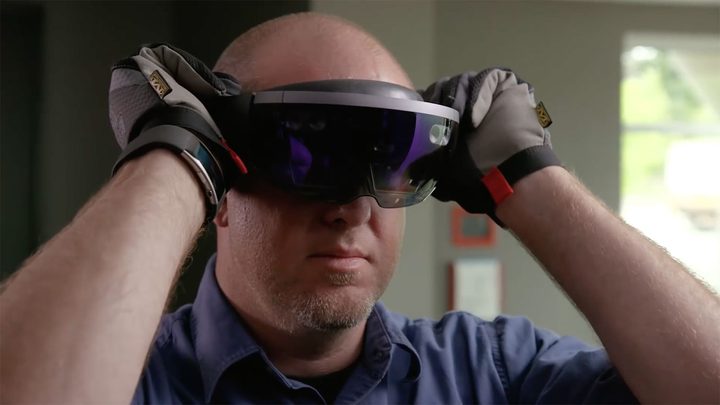
Microsoft’s next HoloLens headset is still in the works but according to leaks, it could feature some significant internal changes — including a new processor from an Intel competitor. According to Windows Central the new headset could sport some new hardware under the hood, as Microsoft contemplates replacing the HoloLens’ Intel processor with an ARM processor.
That’s interesting for a couple reasons, first because it means the HoloLens 2 — or whatever it ends up being called — could be built on Microsoft’s Always Connected PC platform, and could feature LTE connectivity. If you’re unfamiliar, Microsoft’s Always Connected PCs are Qualcomm-powered laptops designed for unparalleled battery life and mobile connectivity. That means the HoloLens’ new processor could be more powerful but consume less power overall. Which leads to another important development.
“HoloLens contains a custom multiprocessor called the Holographic Processing Unit, or HPU. It is responsible for processing the information coming from all of the on-board sensors, including Microsoft’s custom time-of-flight depth sensor, head-tracking cameras, the inertial measurement unit, and the infrared camera. The HPU is part of what makes HoloLens the world’s first – and still only – fully self-contained holographic computer,” said Microsoft’s Marc Pollefeys in a blog post describing the next-gen HPU.
So the next-gen HPU that lives in the HoloLens 2 will have the horsepower — and battery power thanks to that low-power ARM chip — to perform complex computing onboard without having to outsource compute-intensive tasks like voice recognition to cloud services.
“In addition to the new [holographic processing unit], we hear that the next HoloLens will be powered by an ARM processor and include LTE support for true-mobile holographic computing,” Windows Central reports. “Our sources suggest that the next HoloLens will be more mobile than ever, with longer battery life and an always-connected state. It is likely the HoloLens 2 will also include a wider field of view, something the original HoloLens caught a lot of flack for.”
Not only will these changes make the HoloLens 2 a much more capable device, but they have some far-reaching consequences as well. If Microsoft is going to replace the Intel chip currently in the original HoloLens with an ARM chip in the HoloLens 2, this would be the second high-profile company to reportedly plan for a jump to non-Intel processors for a flagship device.