
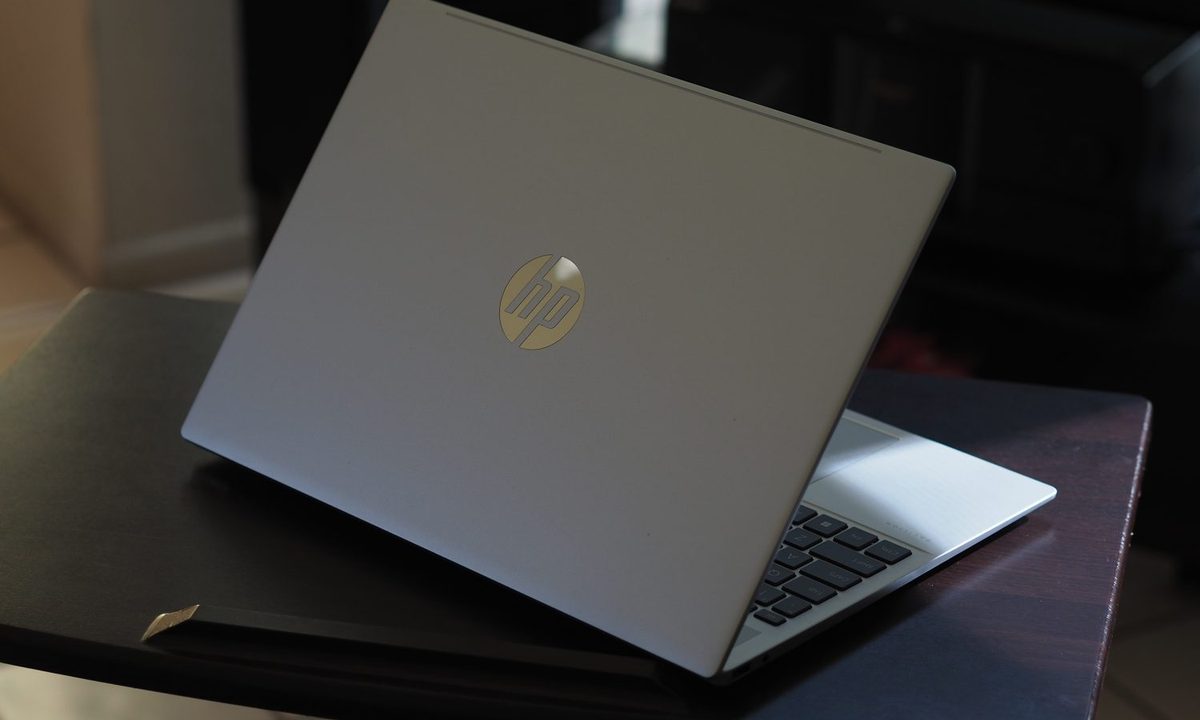

“The HP Pavilion 16 is a decent 16-inch machine, as long as you buy it on sale.”
- Reasonably solid build
- Good enough performance
- Attractive sale price
- Comfortable keyboard
- IPS display has poor colors
- Battery life is just okay

“Why you can trust Digital Trends – We have a 20-year history of testing, reviewing, and rating products, services and apps to help you make a sound buying decision. Find out more about how we test and score products.“
I’ve been reviewing more budget laptops lately, or at least those that are near-budget at $1,000 or less. That’s on purpose, because not everybody has $1,500 or more to spend on a laptop. HP’s Pavilion lineup, which will be transitioning to the budget version of its new OmniBook line that covers all the company’s consumer machines, has served that kind of consumer in the past.
Right now, the Pavilion Laptop 16 is a machine that people might look to for a large-format laptop that won’t break the bank. And it has a number of features that straddle the fence between premium and budget but aren’t quite midrange, either. The problem is, the Pavilion Laptop 16 starts at $1,100, where it seems like it should be offered at a few hundred dollars less.
Update: This review was originally written based on incorrect pricing information. When considering the more accurate price, the laptop is a lot more attractive.
Specs and configuration
| HP Pavilion Laptop 16 | |
| Dimensions | 14.08 x 10.03 x 0.70 inches |
| Weight | 3.92 pounds |
| Display | 16.0-inch 16:10 FHD+ (1920 x 1200) IPS, 60Hz, touch or non-touch |
| CPU | Intel Core Ultra 7 155U |
| GPU | Intel Iris Xe |
| Memory | 16GB 32GB |
| Storage | 512GB SSD 1TB SSD 2TB SSD |
| Ports | 2 x USB-C 2 x USB-A 1 x HDMI 2.1 1 x 3.5mm audio jack |
| Camera | 720p with infrared camera for Windows 11 Hello |
| Wireless | Wi-Fi 6E and Bluetooth 5.3 |
| Battery | 59 watt-hour |
| Operating system | Windows 11 |
| Price | Buy at HP Instant Ink (US) |
The Pavilion Laptop 16 starts at $650 for a Core Ultra 7 155U, 16GB of RAM, a 512GB SSD, and a 16.0-inch FHD+ IPS display (with or without touch). If you go by the standard HP configurator, the price starts at $1,100, and upgrades to 32GB of RAM and a 2TB SSD raise the price to $1,509.
At $650, the Pavilion Laptop 16 is a lot more attractive than its list price, which would be too too expensive. So, as long as you can get it at the sale price, you can feel comfortable in giving it some consideration.
Design
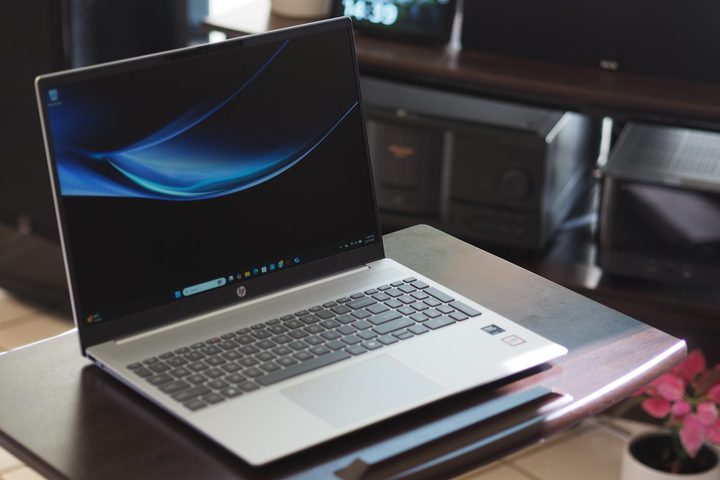
The Pavilion Laptop 16 is constructed of all aluminum, and it’s reasonably solid. There’s a little bit of bendiness in the lid and the keyboard deck depresses a little under pressure. But overall, the build quality is fine. HP’s OmniBook lineup is a lot more solid, though, and they’re not that much more expensive (or around the same price).
The machine is also fairly large, with plastic bezels that are thin along the edges but rather large on top and bottom. That makes the Pavilion Laptop 16 fairly side and deep, although it’s reasonably thin at 0.70 inches and it’s just under four pounds in weight. You can get smaller and thinner 16-inch laptops, with the Samsung Galaxy Book5 Pro 360 being a prime example at just 0.50 inches thick and 3.73 pounds.
Aesthetically, the Pavilion Laptop 16 is very plain, and that’s fine. Many laptops today have minimalist designs with no bling. I keep referring to HP’s own OmniBook lineup, because the company knows how to make elegant laptops that are also simple in design. This one is not the best example of that, though.
Keyboard and touchpad

HP makes some great keyboards, most notably the excellent version they used on their older Spectre lineup and most recently on the new OmniBook machines. This one isn’t quite the same. Its keycaps are a little small, and while there’s a lot of key spacing, the switches are too loose. It’s not a bad keyboard, exactly, it’s just that HP has done a lot better.
The touchpad is smaller than it could be given the available space on the palm rest, and it works well enough as a mechanical version with reasonably quiet button clicks. It’s not bad, either, but not as good as the excellent haptic touchpad HP uses on some of its machines.
Connectivity and webcam


The Pavilion Laptop 16 is a large laptop and so there’s plenty of room for connectivity. While there’s a large selection of ports, it’s disappointing that none are Thunderbolt 4. Once again, I’m reminded that this is a near-budget laptop in design, and at $650, some compromises are necessary. Wireless connectivity is just one step behind, which is fine.
The webcam is the first I’ve seen in a while that’s less than 1080p, at just 720p. Its image isn’t great, and the Core Ultra 7 155U chipset doesn’t have a fast Neural Processing Unit (NPU) to support any on-device AI features. There’s an infrared camera for Windows 11 Hello facial recognition, which worked well.
Performance

The Intel Core Ultra 7 155U is a 15-watt chipset that’s Intel’s previous generation chipset. It has 12 cores (two Performance, eight efficient, and two Low-Power Efficient) and 14 threads, running at up t0 4.8GHz. It’s been superseded by Intel’s Core Ultra Series 2 (Lunar Lake) and Qualcomm’s Snapdragon X chipsets that are aimed at much better efficiency. While you can get the newer chipsets for around twice the price, not everyone will be willing to pay that much.
The second problem is that the Pavilion Laptop 16’s performance doesn’t stand out. It’s considerably slower than Lunar Lake and even more so than Qualcomm’s latest chipsets. It’s okay for basic productivity tasks, but it’s not going to keep up with other contemporary laptops. As we’ll see, it also doesn’t have the efficiency benefits of Lunar Lake, so there’s no good reason for the compromise. And, its Intel Iris Xe integrated graphics aren’t very fast, meaning it’s not a great choice for gamers or creators.
| Handbrake (seconds) |
Geekbench 6 (single/multi) |
3DMark Wild Life Extreme |
|
| HP Pavilion Laptop 16 (Core Ultra 7 155U / Intel Iris Xe) |
123 | 2261 / 9729 | 2529 |
| Lenovo IdeaPad Flex 5i (Core i5-1235U / Intel Iris Xe) |
139 | 2228 / 8287 | 2971 |
| Asus Zenbook 14 OLED (Ryzen 5 7530U / Radeon graphics) |
121 | 1488 / 8207 | N/A |
| Acer Swift Go 14 AI (Snapdragon X Plus / Adreno) |
N/A | 2413 / 11388 | 3231 |
| Acer Swift 14 AI (Core Ultra 7 258V / Intel Arc 140V) |
92 | 2755 / 11138 | 5294 |
| HP OmniBook Ultra Flip 14 (Core Ultra 7 258V / Intel Arc 140V) |
99 | 2483 / 10725 | 7573 |
| HP Spectre x360 14 (Core Ultra 7 155H / Intel Arc) |
83 | 2176 / 11980 | N/A |
| Lenovo Yoga Slim 7i Aura Edition (Core Ultra 7 258V / Intel Arc 140V) |
88 | 2485 / 10569 | 5217 |
| Asus Zenbook S 14 (Core Ultra 7 258V / Intel Arc 140V) |
N/A | 2738 / 10734 | 7514 |
| HP OmniBook X (Snapdragon X Elite / Adreno) |
N/A | 2377 / 13490 | 6165 |
| MacBook Air (M3) |
109 | 3102 / 12078 | 8098 |
Battery life

The Intel Core Ultra 7 155U chipset is a member of the previous generation that wasn’t as focused on efficiency as newer chipsets like Intel’s Lunar Lake and Qualcomm’s Snapdragon X. But, it’s the lower-power version of its generation, so when combine with a low-resolution IPS display but only 59 watt-hours of battery capacity, I wasn’t entirely sure what to expect.
I’ve provided more than a few comparison laptops to give an idea of what to expect from the Pavilion Laptop 16. It didn’t do badly, exactly, compared to earlier laptops, but it’s nowhere near the current crop of machines. You won’t get nearly a day’s worth of battery life, even running basic tasks, compared to many other laptops that will get a full day and then some.
| Web browsing | Video | |
| HP Pavilion Laptop 16 (Core Ultra 7 155U) |
6 hours 9 minutes | 10 hours, 15 minutes |
| Lenovo IdeaPad Flex 5i (Core Ultra i5-1235U) |
4 hours, 47 minutes | 9 hours, 24 minutes |
| HP Spectre x360 14 (Core Ultra 7 155H) |
7 hours, 9 minutes | 14 hours, 22 minutes |
| Asus Zenbook 14 OLED (Ryzen 5 7530U) |
12 hours, 13 minutes | 17 hours, 19 minutes |
| Acer Swift Go 14 AI (Snapdragon X Plus) |
15 hours, 29 minutes | 21 hours, 38 minutes |
| Acer Swift 14 AI (Core Ultra 7 258V) |
17 hours, 22 minutes | 24 hours, 10 minutes |
| HP OmniBook Ultra Flip 14 (Core Ultra 7 258V) |
11 hours, 5 minutes | 15 hours, 46 minutes |
| Asus Zenbook S 14 (Core Ultra 7 258V) |
16 hours, 47 minutes | 18 hours, 35 minutes |
| Microsoft Surface Laptop 7 (Snapdragon X Elite X1E-80-100) |
14 hours, 21 minutes | 22 hours, 39 minutes |
| HP Omnibook X (Snapdragon X Elite X1E-78-100) |
13 hours, 37 minutes | 22 hours, 4 minutes |
| Apple MacBook Air (Apple M3) |
19 hours, 38 minutes | 19 hours, 39 minutes |
Display
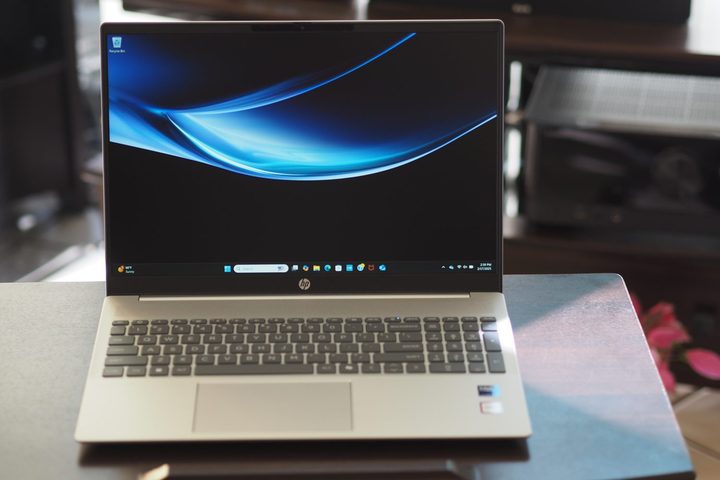
The Pavilion Laptop 16 has just one display option, a 16.0-inch 16:10 FHD+ (1920 x 1200) IPS panel running at 60Hz, which is available with and without touch. That’s not high enough resolution for me at this screen size, with text that comes across as quite pixellated. The display seems plenty bright and blacks aren’t too gray, so those are plusses. But, colors did seem muted to me.
My colorimeter confirmed those impressions. Brightness is definitely great at 404 nits, and contrast exceeds our 1,000:1 threshold at 1,210:1. That’s not OLED-level of inky blacks, but it’s good for IPS technology. Colors, though, weren’t very wide, at just 69% of sRGB, 49% of AdobeRGB, and 49% of DCI-P3, where average IPS displays today come in at 100%, 75%, and 75%, respectively. And color accuracy wasn’t very good at a DeltaE of 2.70, where productivity users want 2.0 or better.
Something has to give to fit a large-screen laptop below $700. Quite often, it’s the display.
A near-budget laptop that demands (and gets) a near-budget price
This entire review assumes that you can get the Pavilion Laptop 16 at a sale price, such as when this review is written at $650. It’s fast enough for most productivity users, and it’s built well enough. But its battery life isn’t great and its display just isn’t colorful enough to spend a lot more money.
But, if you need a large laptop and don’t have a lot of money, then the Pavilion Laptop 16 is well worth considering. You’ll get a laptop that’s reasonably pleasant to use and won’t break the bank. But make sure to wait for a sale, because the laptop won’t be worth it at list price.


