  1. Home
  2. Computing
  3. News

Humanoid robot teleoperator manages to kick himself where it hurts

You have to be careful when doing martial arts!

Add as a preferred source on Google
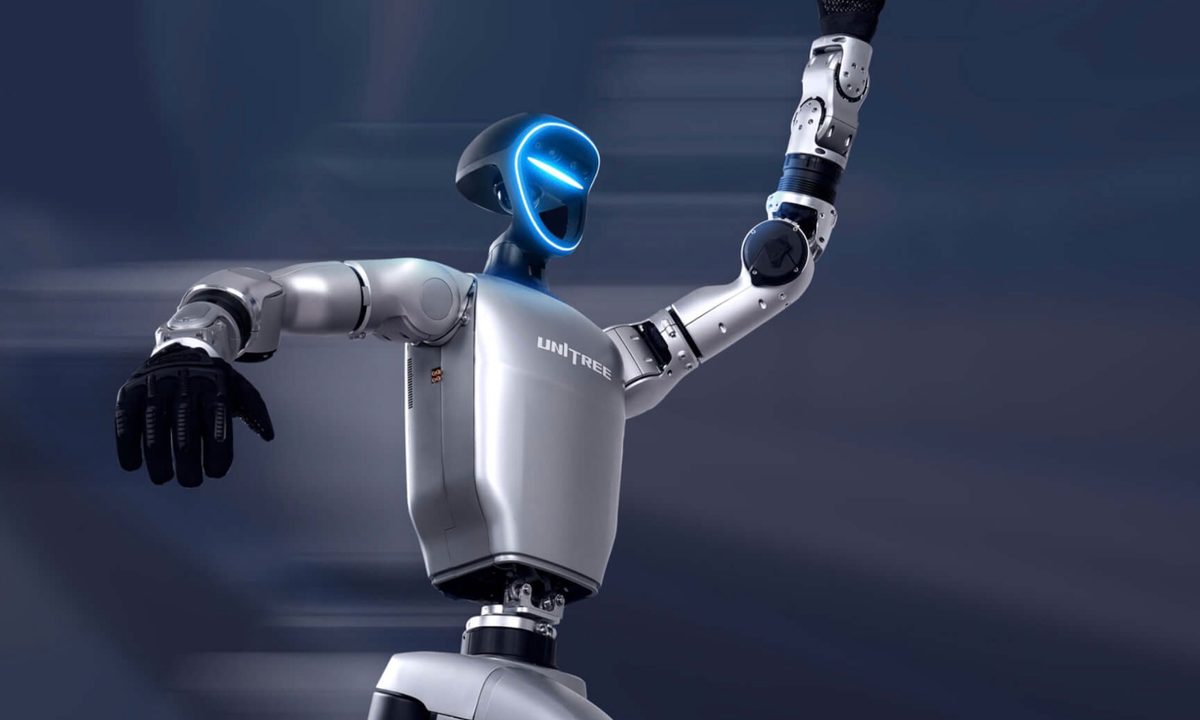
Unitree's G1 robot.
Screenshot Unitree

Humanoid robots have come on leaps and bounds in recent times, and much is expected of the advanced machines in the coming year.

The process of training humanoid robots can take various forms. Unitree’s G1 robot for example, is trained partly through teleoperation whereby a human operator wears a motion-capture suit or uses controllers to perform particular movements or entire tasks, with the robot mirroring the movements in real time.

Recommended Videos

The process generates data that feeds into imitation learning algorithms, providing the robot with new autonomous skills. Additional reinforcement learning hones the model to make the movements smoother and more effective.

But teleoperation clearly carries some risks, especially if you get too close to the robot you’re training.

Take this recent viral video (below), which appears to show Unitree’s G1 robot in a training session. The teleoperator is performing a number of martial arts moves as he moves around a small space that includes the humanoid robot.

“How was your 2025?”

“Me:…”

———
(Motion capture lag, Unitree G1 kicked the tester in the balls) pic.twitter.com/xoFRJdnwxy

— CyberRobo (@CyberRobooo) December 29, 2025

Everything appears to be going smoothly as the robot mirrors the teleoperator’s kicks with great precision.

But the teleoperator then turns slightly to perform a big kick. Unfortunately for the teleoperator, the robot, mimicking his movements, performs the same kick, catching the guy right where it hurts.

He drops to the ground, letting out a yelp of pain as he falls. Of course, the robot falls to the ground too. If it’d been equipped with speech capabilities, we’d have likely heard a yelp, as well.

The teleoperator learned the hard way that training a humanoid robot using this method has to be done with great care and attention. One wrong move and you could find yourself writhing on the ground in agony.

Unitree unveiled the impressive G1 humanoid robot in 2024 and made it available to purchase in early 2025 for around $13,000. The Chinese company is targeting research institutions, universities, and businesses for R&D in humanoid robotics and AI.

Trevor Mogg
Contributing Editor
Not so many moons ago, Trevor moved from one tea-loving island nation that drives on the left (Britain) to another (Japan)…
Apple’s M6 chip isn’t even here yet, but you’ll see M7 Macs early in 2027
Apple is reportedly already accelerating its next-generation silicon roadmap, even before the M6 has launched.
Apple MacBook

The M6 chip is still expected to debut later this year, but Apple may already be preparing for what comes next. According to Mark Gurman's latest report for Bloomberg, the company is aiming to introduce its first M7-powered devices as early as the first half of 2027, hinting at a much faster silicon refresh than many expected.

M7 could arrive alongside new Macs and iPads

Read more
The entry-level MacBook Pro could get a design refresh in 2027, and it’s about time
Five years on the same chassis, and now both tiers of the MacBook Pro are getting a new look at once.
MacBook Pro in space grey sitting on a desk.

Apple has a new MacBook Pro lined up for launch early next year, according to Bloomberg. The company will introduce a 14-inch laptop in the first half of 2027. 

The biggest surprise, however, will be a brand-new design language. The outlet describes it as "a revamped entry-level MacBook Pro, code-named K104."

Read more
Study finds humans will talk to AI ghosts of the dead as reincarnations, and it’s pretty grim
The first AI ghost study is in. The results are about as complicated as you'd expect.
VR Headset, Person, Face

A new study from the University of Colorado Boulder confirms something that sounds both impressive and concerning. People find interacting with AI simulations of their dead loved ones deeply meaningful, and most will come away wanting to do it again.

The researchers call it a "generative ghost," which is a clear reference to generative AI, but I’d still prefer to call it unsettling.

Read more