“Seagulls,” said Andy Stanford-Clark, excitedly. “They’re quite a big obstacle from an image-processing point of view. But, actually, they’re not a threat at all. In fact, you can totally ignore them.”
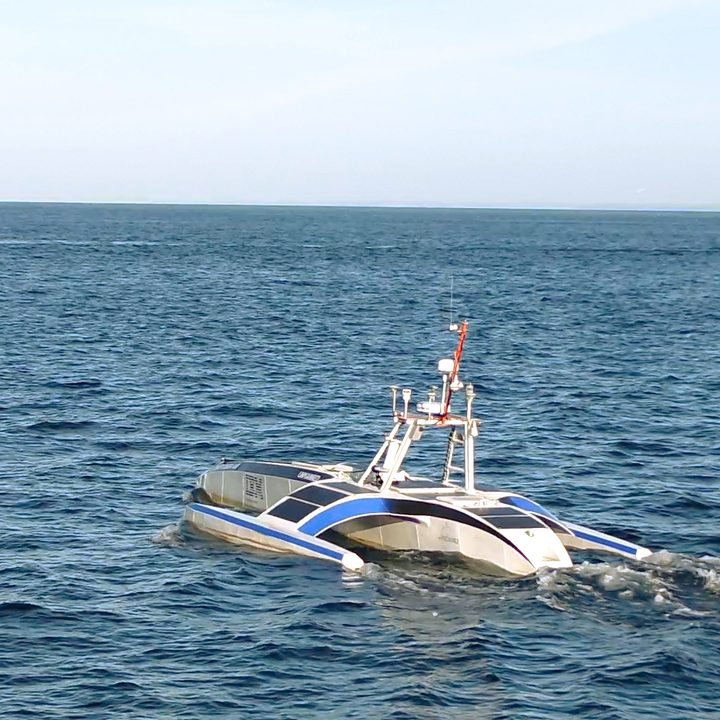
Stanford-Clark, the chief technology officer for IBM in the U.K. and Ireland, was exuding nervous energy. It was the afternoon before the morning when, at 4 a.m. British Summer Time, IBM’s Mayflower Autonomous Ship — a crewless, fully autonomous trimaran piloted entirely by IBM’s A.I., and built by non-profit ocean research company ProMare — was set to commence its voyage from Plymouth, England. to Cape Cod, Massachusetts. ProMare’s vessel for several years, alongside a global consortium of other partners. And now, after countless tests and hundreds of thousands of hours of simulation training, it was about to set sail for real.
Stanford-Clark was running through the potential risks. Seagulls, he pointed out, were something of a false alarm. From an image-recognition perspective, they were a challenge because they had a tendency of getting right up in the camera lens so that they looked like enormous winged obstacles that needed to be avoided at all costs. But they had a tendency to fly away as soon as the futuristic, five-ton triple-hulled ship got close. The biggest headache seagulls posed was that they were an extremely common obstacle that the Mayflower had to be instructed to totally ignore — against all its obstacle-avoiding instincts.
The challenge of sailing a ship autonomously isn’t the same as driving an autonomous car. An autonomous car means steering down predefined streets, watching out for other cars, buses, cyclists, and pedestrians, all while interpreting road scenes at high speed. In the open ocean, lanes are wider, population density is lower, and events happen far more slowly (although turning circles and stopping distance are also significantly worse). There is little risk of loss of life when an A.I. pilots a robot ship across the Atlantic Ocean compared to a self-driving car driving through your average American city during rush hour.

But there is nonetheless a big challenge here: Namely that the Mayflower Autonomous Ship will be performing its three-week autonomous crossing, which commenced June 15, with zero in the way of human interference. Everything is being carried out autonomously. While the course has been set, any deviation on that course — from responding to weather conditions to avoiding obstacles larger than a seagull, is carried out by the ship’s A.I. Captain, built by startup MarineAI, based on IBM’s A.I. and automation technologies. Any big mechanical failure (all too easy when you’re sloshing around in the open ocean) and suddenly one of the world’s biggest autonomous vehicles becomes as useful as a laptop left overnight in a full bathtub.
For folks like Stanford-Clark, it’s a source of stress. For fascinated onlookers, who can tune in to watch every step of the Mayflower Autonomous Ship’s progress via a livestream dashboard built by IBM iX – the company’s digital agency — it’s just another part of the intrepid adventuring fun.
Alone together

The late comic Patrice O’Neal once joked that he liked to be alone, but not lonely. That same sentiment could be applied to the Mayflower: It’s carrying out its cross-ocean voyage solo, but fans from around the world can tune in to watch its progress. Thanks to IBM’s MAS400 dashboard, it’s possible to get a livestream taken from the vessel’s onboard cameras. There are six cameras in all, and these swap in and out to provide a few of the ship’s surroundings.
In 2021, livestreaming is no big deal, of course. The ability to instantly stream video around the world with minimal latency is so commonplace that we likely don’t stop to marvel at it. But livestreaming from the middle of the ocean is very different from livestreaming from your backyard.
“What people don’t realize is once you get more than just a handful of miles offshore, there’s no cell phone signal,” said Stanford-Clark. “Then all bets are off. All the solutions [at that point] become very expensive and low bandwidth from that point on.”
Today, low bandwidth could just mean a YouTube video that takes a few seconds to load on 360p. No such luck here, though. While the onboard cameras record 1080p video, this feed is then transcoded in real time via ultralow bit rate encoding techniques to allow it to be transmitted in bandwidth that, at times, can be as paltry as 6kbps. That would be minuscule as data transfer speeds on a 1995-era modem. The low bandwidths are due to satellite connectivity, which, at best, tops out at 200kbps and also has to include the telemetry data.
To help make this crazy dream a reality, ProMare and IBM teamed up with Videosoft, a company that specializes in developing the technology that makes it possible to livestream in incredibly challenging environments with minimal bandwidth. “Making sure that video gets through in the worst possible [environments is what we do],” Stewart McCone, CEO of Videosoft, told Digital Trends.
Videosoft has long developed algorithms and other tools for transmitting video in scenarios in which any video dropout could potentially be fatal. This includes clients like the police and military. The company’s technology is able to not only stream in low-bandwidth situations, but also to automatically adapt to available bandwidth to encode and transmit it at the highest possible quality.
McCone likened the overall challenge of streaming video from the middle of the ocean to trying to stream video footage from space. “It’s a very, very, very similar challenge,” he said.
In some ways, it’s even tougher, though. While there is no expectation that video from, say, a Mars rover will be in real time due to the distances involved, in the case of the Mayflower Autonomous Ship, the footage is intended to be live with a latency of a couple of seconds at worst. This negates the ability to do slow data transfers at a higher quality.
Capturing the public imagination

The Mayflower Autonomous Ship isn’t IBM’s first bold televised challenge, of course. Its 1997, the Deep Blue series of chess matches with grandmaster Garry Kasparov captured the public’s imagination more than any other public A.I. demonstration of the last century. This century, its 2011 Jeopardy! showdown between question-answering A.I. Watson and show champions Brad Rutter and Ken Jennings was a ratings winner, garnering the show’s highest audience numbers in more than half a decade.
Will ProMare’s robot ship be a similar triumph of A.I. like both of those previous milestones? Or will it sputter to a halt somewhere in the middle of the ocean? Whatever happens, thanks to IBM’s dashboard — and some very smart compression technology — you’re able to tune in to follow along.
You can check out IBM’s Mayflower Autonomous Ship dashboard at MAS400.com.