  1. Home
  2. Computing
  3. News

World’s first 2nm chip could quadruple battery life with a quarter of the energy

Add as a preferred source on Google

IBM Unveils World's First 2 Nanometer Chip Technology

IBM unveiled the world’s first 2nm chip technology on Thursday, setting a new bar for the semiconductor industry. The new design can fit up to 50 billion transistors on a chip the size of a fingernail, which Darío Gil, SVP and Director of IBM Research, says is  “essential to the entire semiconductor and IT industry.” IBM claims the new design can achieve 45% high performance and 75% lower energy use compared to chips using a 7nm process.

Recommended Videos

In real-world use, that could mean quadrupling cell phone battery life, requiring a charge only every four days, speeding up object detection in self-driving cars, and improving the speed and efficiency of laptops. IBM was able to achieve this new process by utilizing Gate-All-Around (GAA) stacked nanosheets, helping push beyond the typical FinFET manufacturing process.
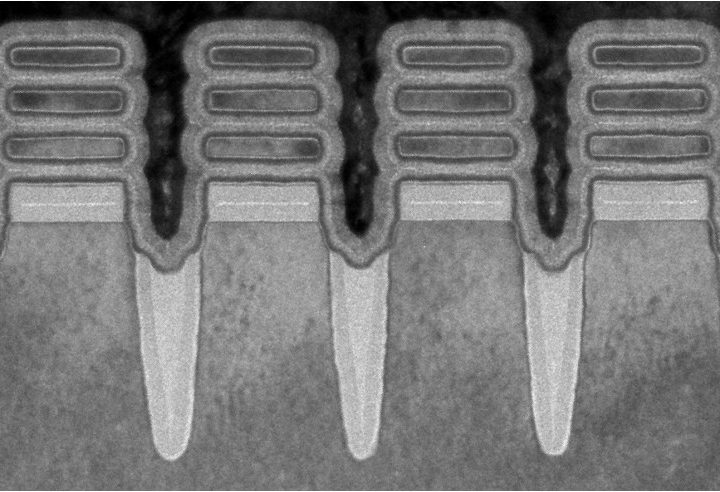
2nm technology as seen using transmission electron microscopy. 2nm is smaller than the width of a single strand of human DNA. Courtesy of IBM. Image used with permission by copyright holder

2nm is a new low (in a good way) for the semiconductor industry. Manufacturer TSMC offers a 5nm process currently and is currently researching 2nm production, and Samsung showed off a 3nm chip earlier this year. Unlike TSMC and Samsung, though, IBM doesn’t manufacture anything. This “breakthrough” comes from IBM’s Albany Nanotech Complex in Albany, NY, where the company researches future semiconductor technology.

That said, IBM has a few strategic partnerships. In 2014, the company signed a 10-year manufacturing agreement with the New York-based GlobalFoundries. More recently, IBM announced partnerships with Samsung and Intel. Although the new design will benefit the semiconductor industry as a whole, it could help bolster U.S. manufacturing, especially as Intel tries to expand its production capacity.
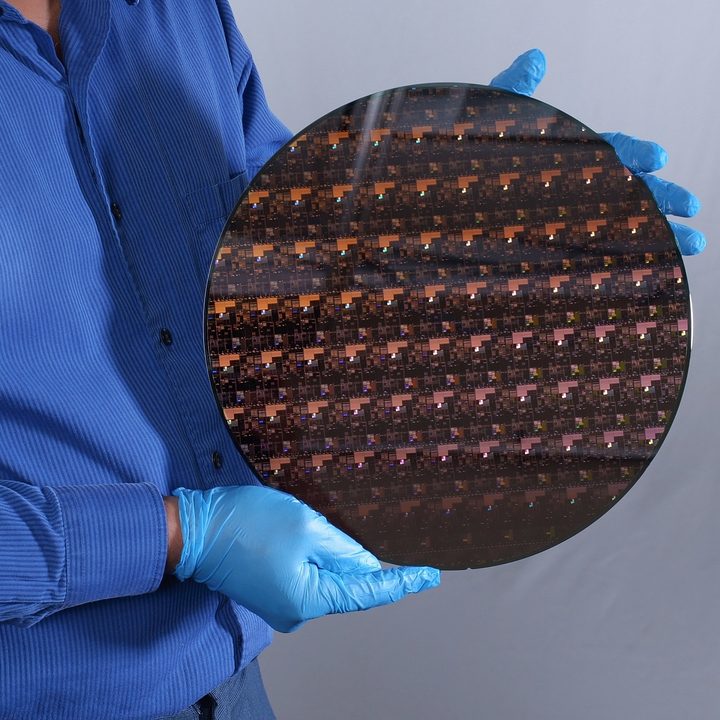
A 2nm wafer fabricated at IBM Research’s Albany facility. The wafer contains hundreds of individual chips. Courtesy of IBM Image used with permission by copyright holder

From IBM’s view, the collaborative effort is what made this achievement possible. “It is the product of IBM’s approach of taking on hard tech challenges and a demonstration of how breakthroughs can result from sustained investments and a collaborative R&D ecosystem approach,” Gil said.

You shouldn’t expect to see chips using the 2nm process anytime soon, however. The energy-efficient design will likely make its way into manufacturing plants and data centers first. First, maybe, but not soon. IBM’s achievement still comes amid a disastrous global semiconductor shortage that may not fully recover until 2023.


Jacob Roach
Former Lead Reporter, PC Hardware
Jacob Roach is the lead reporter for PC hardware at Digital Trends. In addition to covering the latest PC components, from…
Microsoft Edge is about to get more frequent updates, but don’t expect more features
Starting with Edge 152 on August 27, Microsoft is cutting its release cycle in half, with smaller but more frequent updates for Stable channel users.
Microsoft Edge illustration official

Microsoft is accelerating updates to its Edge browser, switching from a monthly release schedule to a biweekly one. The change takes effect with Edge 152, due on August 27, and puts the browser on the same cadence as Google Chrome.

More updates, not more features

Read more
What makes a laptop good for both work and entertainment?
Computer, Electronics, Laptop

This post is brought to you in paid partnership with HP.

The HP OmniBook X Flip is designed as an all‑day AI PC that adapts seamlessly from productivity to entertainment without switching devices.

Read more
Your Windows 11 PC can now natively run AI workloads, even if it lacks the Copilot+ badge
Windows 11 laptop on a table

For the better part of a year, Microsoft has been telling us that the future of AI on Windows belongs to Copilot+ PCs. If you wanted Microsoft’s most advanced local AI features, you needed a machine with a dedicated Neural Processing Unit (NPU). That was the deal. Now, Microsoft appears to be rewriting the rules.

According to updated documentation, Windows 11’s local Language Model APIs can now run on non-Copilot+ PCs, provided they have an Nvidia GeForce RTX 30-series GPU (or newer) with at least 6GB of VRAM. On the surface, this sounds like a developer-focused update. In reality, it could be one of the most significant shifts in Microsoft’s AI PC strategy since Copilot+ PCs launched last year. More importantly, it raises a question that has been lingering ever since the AI PC era began: Did we really need NPUs for all of this in the first place?

Read more