

Dual-screen laptops may become a reality sooner than you think. Intel has been working on a few reference designs for dual-screen laptops for about two years, and it recently showed off a prototype code-named Tiger Rapids. According to Intel, Tiger Rapids was provided to select PC manufacturers, and Lenovo and Asus will show their own spin of Tiger Rapids at the Computex trade show this week.
“Conceptually, it’s not a one-size-fits-all world,” Intel Senior Vice President of the Client Computing Group Gregory Bryant told PC World. “You’re going to see secondary products of different shapes and sizes, people are going to do secondary displays, obviously we’re going to work on longer-term things like bendables and foldables.”
Intel’s goal in creating new and sometimes experimental form factors is to create a PC to suit the needs of individual users. In the past, Intel’s Compute Card packed desktop computing powers into a form factor that is as small as a credit card. For its part, Tiger Rapids maintains a profile that is thinner than an iPhone 8 at just 4.85mm thick.
Designed for digital artists and notetakers, Tiger Rapids took inspiration from paper Moleskin notebooks. Unlike traditional laptops, Intel’s concept is outfitted with a smaller main display 7.9-inch display, while a secondary display on the right side utilizes electronic paper display technology with a textured coating to make it feel similar to regular paper. Going with an E Ink display means that the secondary screen will consume minimal power, and Intel is touting up to 15 hours of battery life. When it is adopted by Asus, Tiger Rapids will be transformed into an artificial intelligence-based PC, Intel said, with a Movidius processor for deep learning.
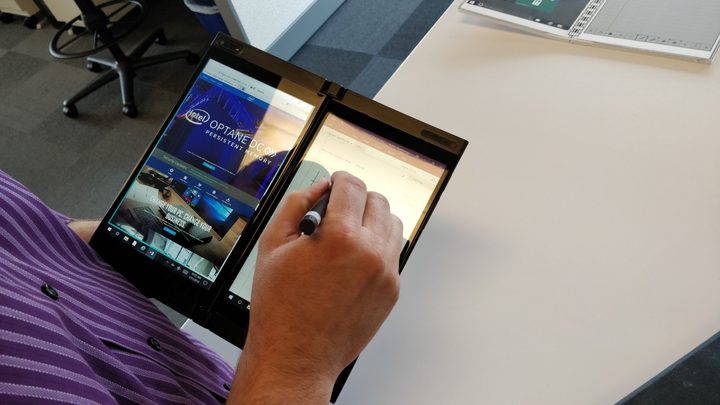
Intel’s second prototype uses the secondary display like a regular screen, rather than the digital inking focus of Tiger Rapids. This second vision for dual-screen computing involves two screens that can be used to simultaneously display content. The downside is that as a laptop replacement, you’ll have to resort to typing on glass, rather than on a physical keyboard. “That’s the idea behind the second dual-screen device, which Intel didn’t identify by code name,” PC World reported. “This second device might be called the future of dual-screen displays, but Intel executives didn’t indicate that any hardware makers planned to bring it to market at the present time.”
Tiger Rapids’ debut comes at a time when chip designs from ARM Holdings are encroaching on Intel’s silicon business. Qualcomm, which uses ARM’s reference silicon design on its mobile-optimized processors, debuted the Snapdragon 850 processor that is designed for dual-screen devices using Microsoft’s Always-Connected PC platform. Always- Connected PCs essentially allows Microsoft’s Windows operating system to work with ARM processors, and it’s been rumored that Dell is working on a dual-screen device with a Snapdragon 850 chipset.


