
Foldable screens on laptops had their moment in the spotlight. But Lenovo brought a laptop to CES 2023 that has a similar use case and form factor, but an entirely different approach.
Rather than a large, foldable screen, the Yoga Book 9i has two 4K OLED screens that fold together. It’s quite similar to Microsoft’s Surface Neo device, which was unceremoniously canceled in 2020.
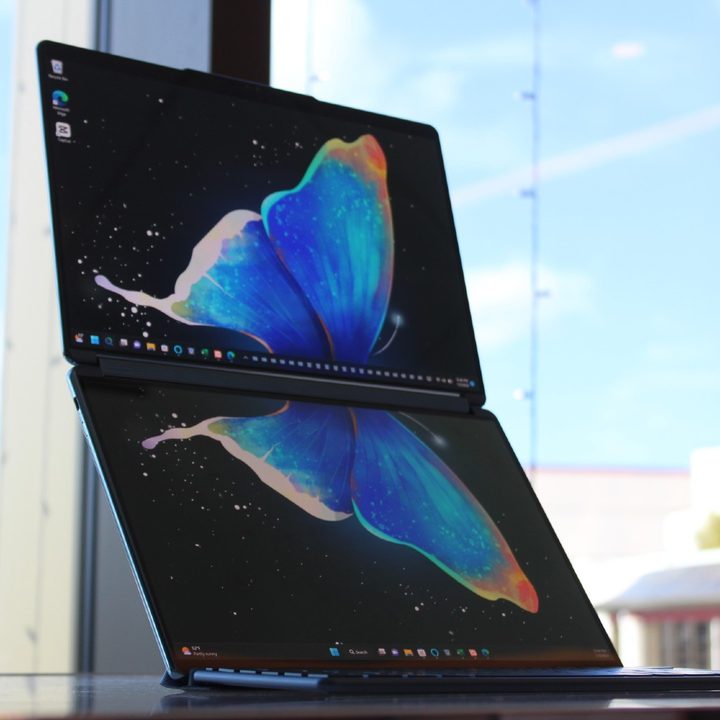
But with the Yoga Book 9i, the concept is alive and well — and it’s every bit as fascinating as I’d always hoped it would be.
Not unlike the ThinkPad X1 Fold, the Yoga Book 9i can be used in a variety of different postures and modes, all of which required some unique engineering solutions to make work.
The key to unlocking all of its capabilities is this origami stand, which magnetically folds together and allows the Yoga Book 9i to be positioned in some unique ways. The magnets all feel strong, allowing it to fold all the way down into the size of a pencil pouch. No doubt some things the designers learned from working on the ThinkPad X1 Fold, I’d assume.


Once you have the origami unfolded, you can prop the device up in portrait mode, where both screens are facing you. Considering these are both 16:10 13-inch screens, that’s a lot of vertical screen real estate — and it’s certainly the most visually striking way to set this thing up.
Just as easily, you can flip the screens vertically for some side-by-side multitasking. Windows handles having two screens seamlessly, of course, letting you manage separate windows just as you would an external monitor.
Either way, the detachable keyboard magnetizes to the stand, of course. My only complaint about these modes? I felt like I needed a wireless mouse or something to really take advantage of controlling both screens independently. You can’t just drag a window from one screen to another, so the idea of multitasking in this mode seems impractical.
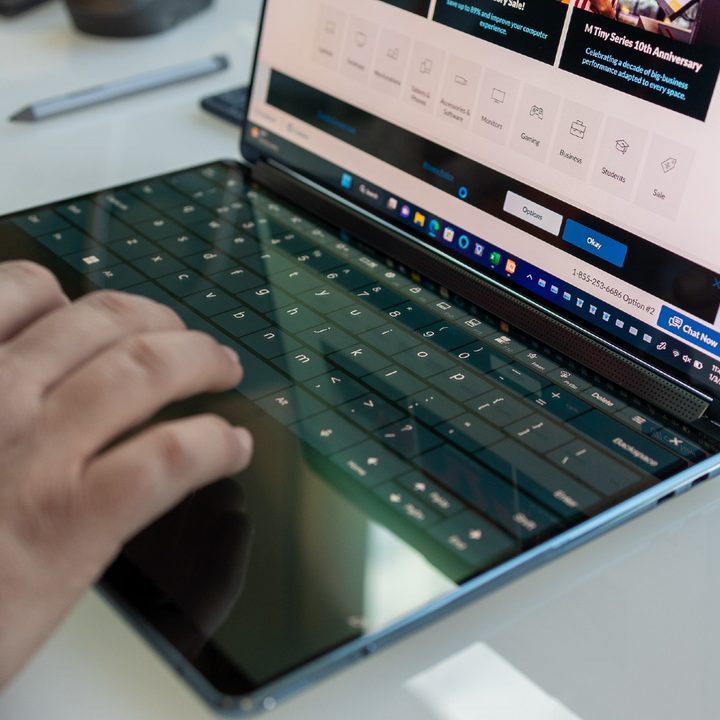
But don’t worry. The Yoga Book 9i offers ways to use it for better control too. For example, you can put it in laptop mode and slide the magnetic keyboard right on top of the bottom screen. From there, you’ll get either some freestanding widgets or a digital touchpad. This gives you a full laptop experience when you need it.
Lenovo even designed a digital keyboard that can be used, and surprisingly, it wasn’t horrible. Each of the keys has some haptic feedback, creating a surprisingly tactile feel. It’s not perfect, but it might be the best virtual laptop or tablet keyboard I’ve ever used. The left and right click buttons on the digital touchpad give some feedback too. That, more than anything, left me impressed.
The whole thing is a really sleek package, too. Where the ThinkPad X1 Fold and Asus Zenbook Fold 17 felt a bit janky with their thick bezels and highly-layered (and reflective) screens, the Yoga Book 9i looks like a modern piece of kit.
It’s quite thin at 0.63 inches thick and weighs just three pounds. That’s not much more than a standard 13-inch laptop, despite the extra screen.
Under the hood, the Yoga Book 9i has a lot of what you’d expect in a modern laptop too. A 13th-gen Intel Core i7 processor, 16GB of RAM, and either 512GB or 1TB of storage.
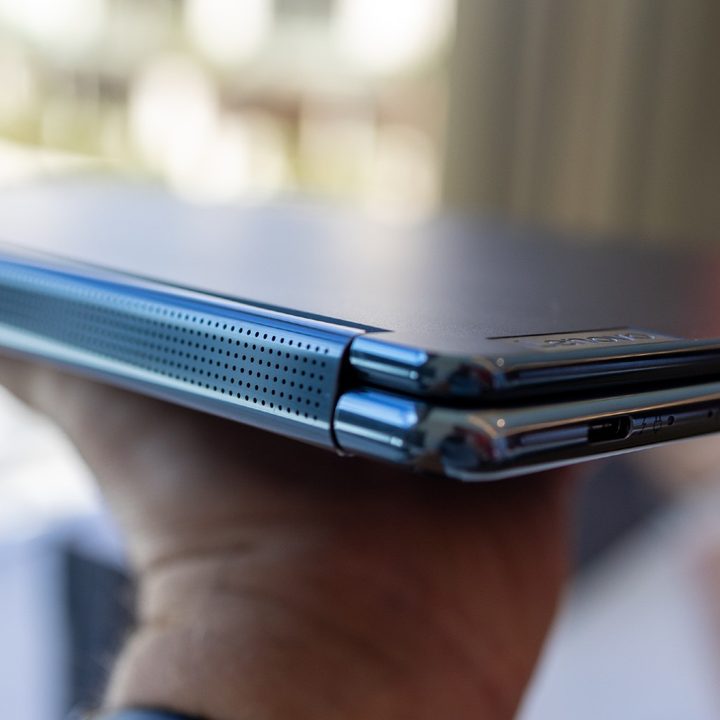
Other important features include a 1080p webcam up top and four speakers. The Yoga Book 9i brings over the hinge soundbar from the Yoga 9i 14. It turns out to be a great location for the speaker, especially with this screen in vertical mode — however, I wasn’t too impressed by the audio necessarily.
The laptop also comes with an 80-watt-hour battery, and it’s entirely charged by USB-C. And sorry, it doesn’t have a headphone jack.
The Yoga Book 9i will be available starting in June 2023 at $2,100.


