  1. Home
  2. Computing
  3. News

Watch Meta demonstrate full-body VR tracking with just a Quest headset

Add as a preferred source on Google

Meta Reality Labs is making big strides in avatar rendering with the latest advances combining machine learning (ML) with sensor data from Quest VR headsets to show your full body, including arms, legs, torso, and head. The result is a very realistic and accurate representation of the poses and movements of a person wearing a Quest 2 headset.

QuestSim: Human Motion Tracking from Sparse Sensors with Simulated Avatars

This is quite amazing since only the positions and orientations of the Quest VR headset and its two controllers were used to estimate leg motion and position. There are no tracking bands placed on the legs and no external cameras used for this remarkable system. Meta Research Scientist Alexander Winkler shared several videos on Twitter along with links to the scientific paper on arXiv and a YouTube video with more detail.

Recommended Videos

In a scientific sense, this is known as motion tracking from sparse sensors and ML is particularly adept at extracting meaningful information from very little, if there are enough dependencies between what is known and unknown. Since we swing our arms for balance when walking and running, arm movement is a good indicator of what the legs are usually doing. Combined with head tilt and direction, the ML system can predict most human motion very accurately.
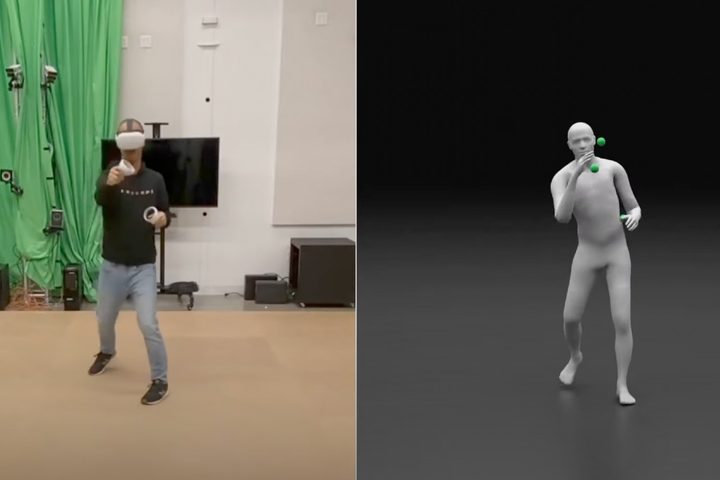
Body tracking in VR using a Quest headset.
Image used with permission by copyright holder

More traditional approaches to tracking limbs rely on extra hardware, such as reflective markers placed on your legs and torso that are identified by external cameras, or bands with wireless beacons worn at various locations on your legs to transmit position and motion data.

While these methods work, those are typically sold as accessory items that cost more and aren’t well supported in most apps and games. If Meta can achieve such good results with a Quest 2 headset, developers will be more likely to build body tracking in their games and apps.

Despite these significant advances, Meta Reality Labs admits that more work needs to be done. If you move fast enough, the ML model fails to correctly identify your pose. Unusual stances are difficult for the computer to estimate and if the virtual environment has obstacles that don’t exist in reality, the movement won’t match. The overall effect seems to be very good, however, and it would be a nice upgrade to be able to see a full body instead of floating torsos when chatting with friends in VR.

Hopefully, this technology will be ready for launch soon. With Meta’s Quest Pro headset announcement expected in just a few weeks, the timing for full-body avatars seems perfect. The Meta Quest Pro can track eye movement and facial expressions, providing an improved sense of presence to your friends, family, and coworkers might be greatly enhanced in the near future.

Alan Truly
Alan Truly is a Writer at Digital Trends, covering computers, laptops, hardware, software, and accessories that stand out as…
I thought budget Windows laptops were dead, but Computex gave me new hope
I went to Computex for the powerful machines, but found a new budget surprise
Dell XPS 13 at Computex 2026

Budget Windows laptops have had a stale reputation for a while now. While the best part is their affordable pricing, the notebooks are often a little depressing to hold. You know exactly what I’m talking about if you haven’t been exclusive to the Apple ecosystem. Plastic bodies that flex too much, dim screens, and mushy keyboards. The spec sheet might look fine for the price, but the actual machine rarely excites.

During my recent trip to Taiwan for Computex 2026, I was looking forward to the most powerful gaming rigs and all the cool new tech at the event. You expect to see the best of the best from tech giants, so you’re not really looking out for budget announcements. But this year, the most interesting laptop story was not only about monster gaming rigs, AI workstations, or ultra-expensive creator machines.

Read more
ChatGPT is recommending scam websites that will steal your credit card info
The chatbot is surfacing fraudulent clones of defunct retail brands, and scammers are deliberately engineering sites to game its recommendations.
ChatGPT running on a laptop.

Scammers have found a new way to reach shoppers: getting ChatGPT to do their marketing for them. According to The Guardian, scam-checking service Ask Silver found that OpenAI's chatbot is recommending fraudulent retail websites built to harvest payment details from unsuspecting buyers. The sites mimic real storefronts and use official-looking URLs, making them difficult to spot without scrutiny.

Defunct brands are a prime target

Read more
McDonald’s new AI drive-thru has to prove it can handle hungry people
After its earlier ordering bot became a punchline, McDonald’s is testing a new system that promises fewer human handoffs.
Architecture, Building, Hotel

McDonald’s is bringing AI back to the drive-thru with a new Google-backed system called ArchIQ, also known as Archy. It’s starting in five locations under the company’s broader “> NEXT” technology push, with a franchisee claiming the system has already handled more than 1 million orders.

The bigger number is the one McDonald’s needs people to trust. About 90% of those orders reportedly needed no human intervention. That sounds promising, but this is not a clean reset. Its earlier IBM-backed AI drive-thru experiment ended after viral mistakes turned automated ordering into a public punchline.

Read more