


Since the introduction of Nvidia’s Deep Learning Super Sampling (DLSS), the company has done an excellent job getting the feature in as many games as possible. As the standout feature of Nvidia’s best graphics cards, most major game releases come with the feature at the ready.
That’s only become truer with the introduction of DLSS 3 and its Frame Generation feature, showing up in recent releases like Ghost of Tsushima and The First Descendent. But one DLSS feature has seen shockingly low representation.
I’m talking about Ray Reconstruction. It’s only available in five games, despite releasing over a year ago. It’s available in so few titles that I’d forgive you if you’ve never even heard of it. Ray Reconstruction isn’t as flashy as upscaling or frame generation, but it does wonders to improve the image quality of a game. And its absence became all too obvious on my recent adventures in Black Myth: Wukong.
A big miss

Nvidia likes to latch onto certain games as flagship releases for its graphics tech. At one point it was Atomic Heart, and at another, it was Cyberpunk 2077. For the past few months, it’s been Black Myth: Wukong, a gorgeous retelling of Journey to the West brought to life by path tracing — or, as Nvidia calls it, “full ray tracing.” Path tracing is extremely demanding, so much so that it can bring even the RTX 4090 to its knees. It’s also beautiful, bringing unparalleled realism to games like Alan Wake 2 and Cyberpunk 2077.
Although I played both Alan Wake 2 and Cyberpunk 2077 with path tracing on, I left the feature off for my journey in Black Myth: Wukong. You can see the difference path tracing makes in the game in the video above. There’s a difference, no doubt, but it’s massively outweighed by the performance drop path tracing brings, even on an RTX 4090. The image quality difference here isn’t enough to justify the performance loss, which wasn’t the case in Alan Wake 2 or Cyberpunk 2077.
It’s not the game’s fault — it’s the lack of Ray Reconstruction. Ray Reconstruction has flown under the radar for more than a year now, but Black Myth: Wukong is living proof that if more games want to experiment with path tracing, they need to back up the feature with Ray Reconstruction on PC.
Why Ray Reconstruction works
In games, ray tracing or path tracing leads to a noisy image. By noise, I’m talking about the grainy bits that show up when you, for example, shoot a photo on your phone in extremely low light. Instead of bouncing endless rays for each pixel, which would be far too demanding, games take a sampling of rays for each pixel. That leads to some pixels never getting hit with a ray (the light), which makes up the digital noise you see.

That’s where a denoiser steps in. It smooths over the rough edges by filtering and blurring the area around the noisy bits to create an image that looks cohesive. That’s what Ray Reconstruction is. It’s a denoiser, but it’s powered by AI. In fact, Nvidia says it was trained on far more data than even DLSS Frame Generation. AI really makes a massive difference when applied to denoising, as you can see in the screenshots of Alan Wake 2 above.
The more you look at the image, the more details you can pick out. Denoising is like putting a filter over the hard work that path tracing is doing. It still looks better than not path tracing, but it’s not giving you the full effect. Ray Reconstruction cheats its way to showing that full effect. The reflections are clearer, the shadows are crisper, and light reflects off colored surfaces to bring life to each object in a scene. And Ray Reconstruction is able to deliver this without any performance loss — in some cases, there’s even a minor performance bump.
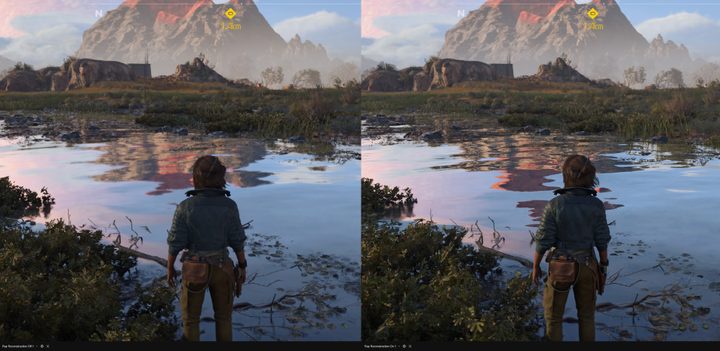
I love this diner scene in Alan Wake 2 because it really shows how Ray Reconstruction reproduces so many tiny details. If you want something more direct, look at Star Wars Outlaws above. It almost looks like two completely different graphics modes between the two images, but the only difference is Ray Reconstruction. Yes, it makes that big of a difference.
There’s the massive reflection in the middle of the scene, but you can see Ray Reconstruction at work in the fine details, too. The grass on the other side of the pond has better definition because of the specular highlights that show up clearly, framing each blade. In the jacket of our character, you can see soft shadows between the subtle ripples, making the version with Ray Reconstruction off look completely flat by comparison. Finally, in the leaves poking out of the pond near the bottom right of the image, you can see how Ray Reconstruction reproduces the transparency of the shallow water, which is completely lost with the feature turned off.
Ray tracing’s best friend

I’ve been spoiled with the few looks at Ray Reconstruction I’ve gotten, so much so that I went against even using path tracing in Black Myth: Wukong because the game didn’t support the feature. Each time I see Ray Reconstruction in action, it becomes more clear that it’s an essential feature for games that lean heavily on ray tracing for photorealism.
Without Ray Reconstruction, it’s like putting a puffy jacket over your fancy clothes. Your PC is doing all the hard work of tracing those rays, but the built-in denoiser is covering up the fruits of its labor. It’s a shame, too, because Ray Reconstruction, unlike DLSS Frame Generation, isn’t restricted to Nvidia’s latest GPUs. You can use it on older RTX graphics cards.
Nvidia has made it clear that Ray Reconstruction works best in games that use ray tracing heavily, so I don’t expect the feature to show up in every game. In titles like Black Myth: Wukong, however, it makes perfect sense. As more games push for heavy ray tracing implementations, I hope that Ray Reconstruction can keep pace because it unlocks why these features are so visually impressive in the first place.


