What’s happened? Earlier this year, reports suggested Nvidia’s next-gen GPUs might ship with major VRAM upgrades. But in just a few months, the AI boom has pushed both RAM and GDDR prices into the stratosphere, to the point where AMD and Nvidia are reportedly considering cutting entry-level and budget GPUs altogether. Now, things might be getting even more complicated. Facing a deepening global memory shortage, Nvidia is rumored to be changing how it supplies GPUs. Instead of shipping fully populated boards (die + VRAM), it may start sending only the GPU die, leaving board partners to source GDDR or HBM on their own. And if that happens, it could seriously impact how flexible vendors are and how many cards actually make it to shelves.
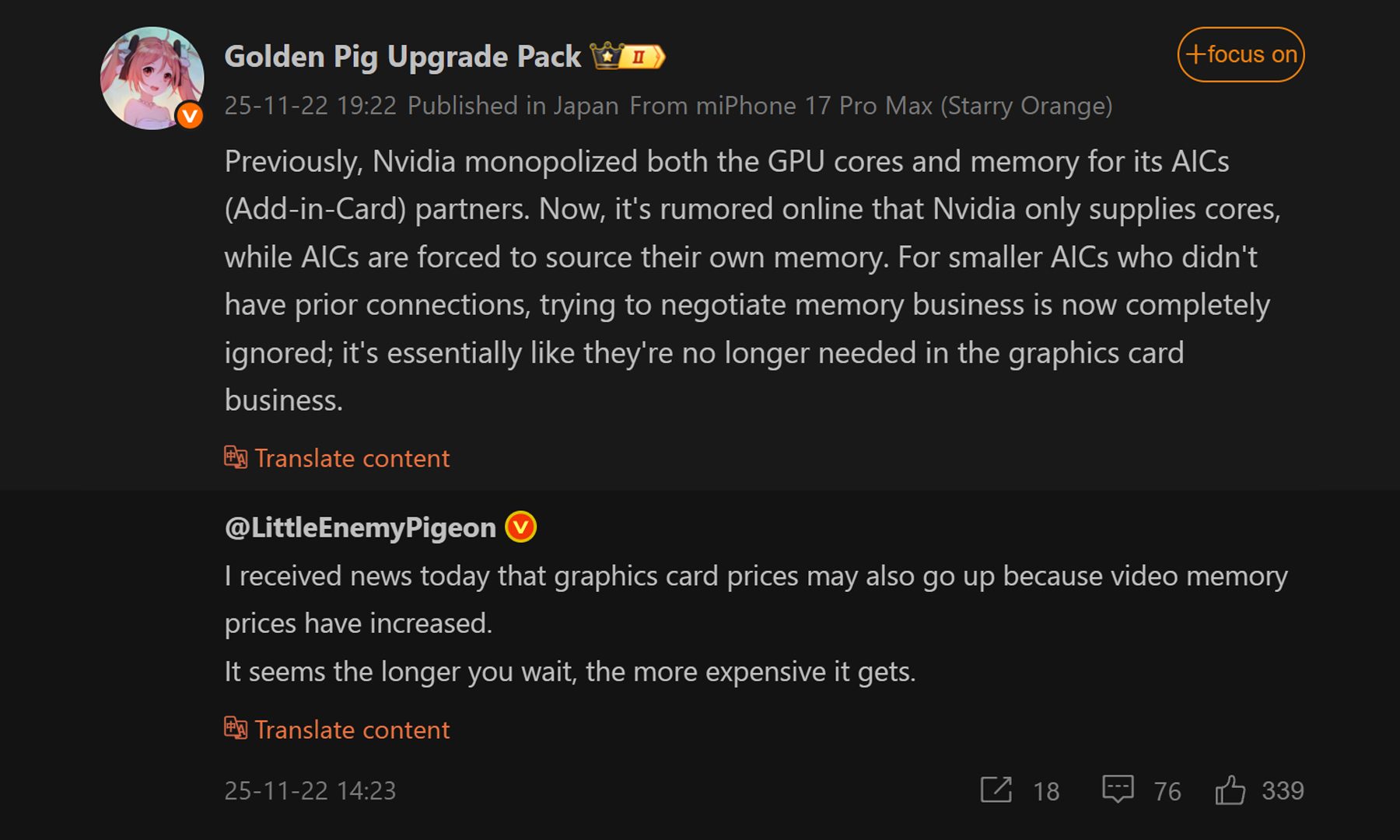
- Leakster Golden Pig Upgrade Pack claims Nvidia will stop bundling VRAM with its GPUs to protect supply chains and reduce initial costs.
- Vendors like ASUS, MSI, and Gigabyte would now be responsible for securing their own memory chips before building and shipping a GPU.
- This may cause delays, price hikes, and a reduction in budget-friendly card variants, as memory becomes the critical bottleneck.
- It also creates a challenge for smaller brands like Inno3D and Gainward, which would now need to build their own supply-chain relationships to secure the memory chips.
Why this is important: If this rumor proves true, it could throw the GPU market into a whole new level of chaos. You see, Nvidia doesn’t make VRAM on its own; companies like Samsung, Micron, and SK Hynix do. And while big AIBs already buy memory directly, smaller partners rely on Nvidia’s usual “die + VRAM” bundle to stay competitive. If that bundle disappears, the memory shortage becomes their problem, not Nvidia’s. Larger vendors will manage, but smaller ones could struggle to source chips at scale, tightening supply and driving prices up across the board. Here’s what that could mean for you:
- Fewer affordable or mid-tier GPUs as smaller board partners get squeezed out.
- Higher pricing on “premium” models since only big vendors can secure enough VRAM.
- Longer wait times and fewer variant options as memory becomes the real bottleneck.
- Older GPUs will become more attractive, or more expensive, as new-stock scarcity grows.
Why should I care? If you’ve been saving up for a GPU upgrade or piecing together a build budget, this news could throw a wrench in your plans. The card you hoped to grab for a reasonable price might now cost a lot more, or be delayed until vendors find memory chips. Even for casual gamers or upgrade-minded PC users, this affects decisions around building vs buying. If you’re flush with cash and chasing high-end hardware, this could be a chance to strike early before prices spike. Otherwise, it’s a risk-versus-timing gamble you may want to sit out.
Okay, so what’s next? For now, don’t panic-buy a GPU unless you’ve got cash to burn. This is still a rumor, even if it feels suspiciously plausible. As such, the smart move is to watch for official word from Nvidia or its board partners, some of whom might push back or quietly work around the issue. Also, keep an eye on mid-range GPU pricing and memory-chip trends (DRAM, GDDR, HBM), because that’s where any trouble will show up first. If you’re planning a build and don’t absolutely need to upgrade right now, waiting a bit or padding your budget might save you some pain. Alternatively, if you do need a card soon, grabbing one before the market shifts could be safer. And if your current GPU still holds its own? Maybe give it a little more love and ride this wave out. If not, cloud gaming is on the rise, too, so you might want to check that out.