
You wouldn’t suspect that a mod like Portal: Prelude RTX would debut such a major piece of kit for the future of PC gaming. But lo and behold — it’s the first game we’ve seen with Nvidia’s new RTX IO, a feature that was announced nearly three years ago.
It’s not as flashy as ray tracing or DLSS, operating in the background and offering a slew of benefits without drawing attention to them. But according to my testing, RTX IO may have a bigger impact on PC gaming than any other RTX features.
What is RTX IO?
First, let’s talk about what RTX IO even is. It’s GPU-accelerated asset loading and decompression that promises faster load times, smaller install sizes, lower CPU utilization, and less texture pop-in. It does this by offloading some work your CPU does to the GPU, taking advantage of the massive core counts available on graphics cards.
When games typically load, assets are taken off the SSD and loaded into system memory. They cycle out of memory onto your CPU for decompression before returning to the memory. Once the full asset is ready, it’s sent to the graphics card. This system worked for a long time, but there’s a problem with it now: the PS5 and Xbox Series X.
As I’ve written about previously, both the PS5 and Xbox Series X have dedicated decompression hardware that cuts the CPU entirely out of this process. Assets are decompressed faster, and therefore, arrive at the GPU faster. The storage inside PCs these days is fast enough to keep up with this level of streaming, but they lack the dedicated decompression hardware to make it work. That’s where RTX IO comes in.
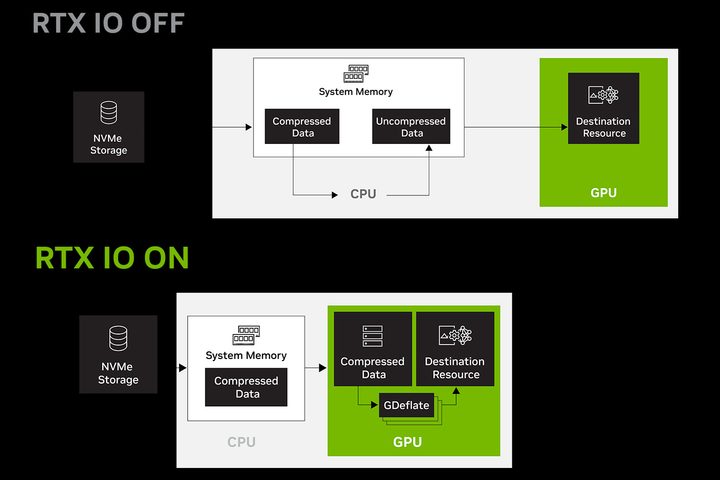
Compressed data comes off the SSD into system memory and it goes straight to the GPU. It’s passed through GDeflate, Nvidia’s open-source data compression scheme built for GPUs, and it’s immediately ready at the GPU.
If you keep up with this tech, you can probably spot the similarity to Microsoft’s DirectStorage. RTX IO works on top of DirectStorage, and it even supports Vulkan extensions, allowing it to work in games like Portal: Prelude RTX. None of this is proprietary, either; there’s been plenty of finger-wagging at Nvidia over its (now open-source) Deep Learning Super Sampling, but RTX IO works on any DirectX 12 graphics card.
But does it work?
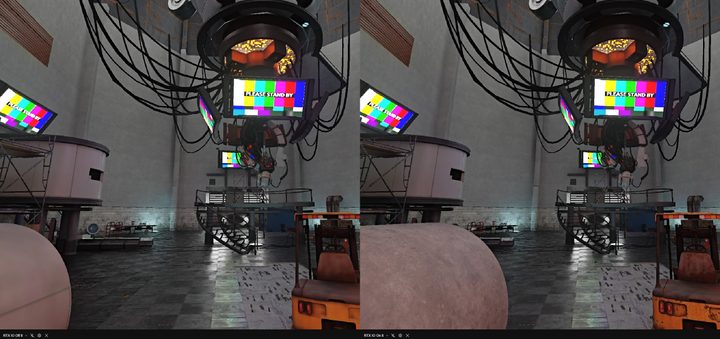
This is all great in theory, but GPU decompression is uncharted territory on PC — even with games like Forspoken that support DirectStorage. You don’t need to look further than the install size to see that RTX IO is working. If you were to download Portal: Prelude RTX right now, you’ll see it’s around 24GB (exactly 24.29GB at the time of writing). With RTX IO off, the total install size is 39.16GB. That’s a 38% reduction in install size for the exact same game.
Texture loading was much faster, too. In one scene, it took 3.13 seconds for textures to load in with RTX IO off, seeing a noticeable pop-in. With RTX IO on, they arrived in 1.36 seconds. In the most demanding scene I looked at, it took 6.34 seconds for textures to load with RTX IO off. Turned on, they arrived in only 2.51 seconds.
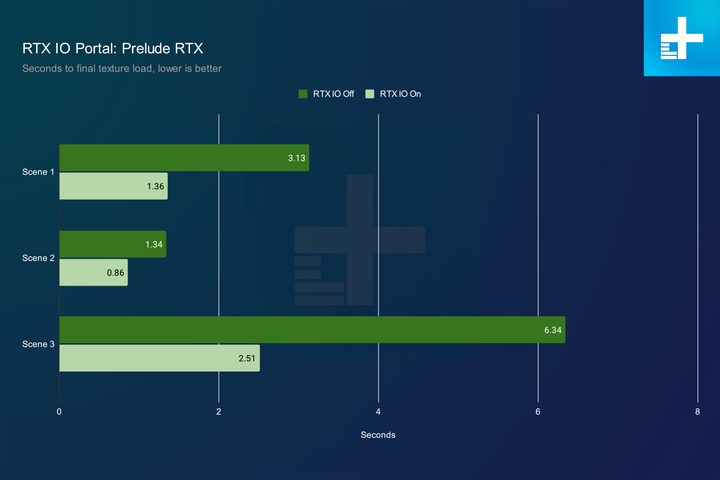
Keep in mind the scope of Portal: Prelude RTX, as well. It’s a game that goes deep, not wide, offering full-on path tracing and highly detailed materials for every corner of a scene. In a larger game, it’s not hard to see the benefits of RTX IO for texture streaming. With the right optimization, and RTX IO cutting roughly two-thirds of the time it takes to stream textures, there are some clear applications in large, open-world games.
CPU utilization dropped, too. In the demanding scene I mentioned above, the utilization peaked at 37% (and that was with the monstrous 24-core Intel Core i9-13900K). Turn RTX IO on, and it dropped to 22%. From what I could tell, it seemed like Portal: Prelude RTX scaled to eight cores. Some games, particularly those built in Unreal Engine, could see a larger benefit if they’re limited to a few cores.
What this means for PC games

Make no mistake: Portal: Prelude RTX is an appetizer for what games with the tech could look like in the future. Thankfully, we won’t have to wait too long to see what it can do in other games. Nvidia confirmed Ratchet & Clank: Rift Apart will support RTX IO on PC, allowing that game’s storage-intensive design to operate.
What makes me most excited is the optimization benefits that RTX IO (and DirectStorage, for that matter) can bring. I’ve been vocal about the fact that it’s a bad time to be a PC gamer and that largely boils down to persistent stuttering across major AAA releases. Hardware-accelerated decompression doesn’t solve the stuttering woes on PC, but it can help.
As we’ve seen in games like Star Wars Jedi: Survivor, Dead Space, and Redfall, traversal stutter is still a very real problem on PC. It’s particularly problematic when games are designed to run on only a few CPU threads (as is the case with Unreal Engine titles like Star Wars Jedi: Survivor and Redfall). Taking some work away from those cores in the decompression department can free them up to, well, run the game, hopefully avoiding some of the major traversal stuttering issues we’ve seen this year.
If that’s the case, RTX IO and GPU decompression is a huge swing to help PC games. Faster loading times and smaller install sizes don’t hurt, but the real benefit of something like this hopefully lies in its ability to reduce stuttering in games that are streaming massive assets in and out of the game world.
It seems that will be the case. Here’s how Nvidia explained it: “RTX IO alone cannot completely remove stutter, but it can be an aiding technology to help reduce stuttering. It can do so by scaling down the dependence on CPU compute when the need to load textures and geometries ‘faster’ is the cause of stuttering, and freeing up the CPU to work on other tasks.”
For now, we just have to wait until we see more games with RTX IO and other branded GPU decompression tech. Ratchet & Clank Rift Apart kicks that off on July 26, but hopefully, we’ll see more games sporting the tech throughout the rest of the year.


