The Raspberry Pi Foundation is celebrating the fifth anniversary of its original product’s launch by introducing the Raspberry Pi Zero W board. Costing a mere $10, the new addition builds upon the vanilla Raspberry Pi Zero by adding Wireless N and Bluetooth 4.0 connectivity. In the United States, it can be purchased now through Adafruit, CanaKit, and Microcenter.
If you’re not familiar with the Raspberry Pi, it’s an inexpensive credit card-sized computer that can be used as the foundation of applications that require computing power, or simply slapped into a small case and used as a very capable PC. The first model, the Raspberry Pi 1 Model B, arrived in 2012 and was followed by numerous refreshes over the years.
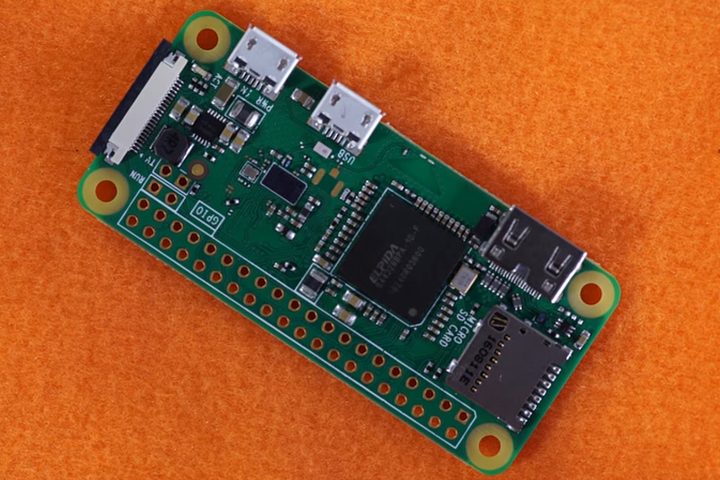
The first entry-level Raspberry Pi Zero board landed during the end of 2015 for a mere $5. This version is smaller than the main Raspberry Pi product, packing fewer ports and general purpose input/output capabilities. According to the foundation, it’s “half the size of a Model A+ with twice the utility.” Features include a single-core processor clocked at 1GHz, 512MB of system memory, can more.
Here are the specs of the new Raspberry Pi Zero W compared to the full-size Raspberry Pi 3 Model B:
| Raspberry Pi Zero W | Raspberry Pi 3 Model B | |
| Processor: | Single-core CPU @ 1.0GHz | Four-core CPU @ 1.2GHz (64-bit) VideoCore IV 3D graphics core |
| Memory: | 512MB | 1GB RAM |
| Storage: | MicroSD card slot | MicroSD card slot |
| Connectivity: | Wireless N Bluetooth 4.0 |
Wireless N Bluetooth 4.1/BLE |
| Ports: | 1x Mini HDMI 1x Micro USB On-The-Go1x Micro USB (power) |
1x Full HDMI 4x USB 1x Ethernet 1x audio/video combo jack |
| Connectors: | 1x HAT-compatible 40-pin header 1x Composite video and reset headers 1x Camera interface (CSI) |
1x GPIO 40-pin header 1x Display interface (DSI) 1x Camera interface (CSI) |
| Price: | $10 | $35 |
According to founder Eben Upton, the first Raspberry Pi Zero board saw the addition of the camera connector sometime after its initial launch. That led to its use in many projects that required computing power ranging from miniature arcade cabinets to electric skateboards. But many projects needed wireless connectivity, forcing users to connect an ugly, wireless dongle to the board’s USB port.
“Users often end up adding a USB hub to allow them to connect a keyboard, a mouse and a network adapter, and this hub can easily cost more than the Zero itself,” Upton said. That pushed the team to add the same Cypress CYW43438 wireless chip used in the Raspberry Pi 3 Model B.
The launch of the Raspberry Pi Zero W also sees the release of an official injection-moulded case created by the foundation along with Kinneir Dufort and T-Zero. It’s similar to the case designed for the Raspberry Pi 3 (albeit smaller), and comes with the following components:
- A set of rubber feet
- A short camera adapter flexi
- One blank lid
- One lid with an aperture for accessing the GPIOs
- One lid with an aperture and camera mounting point