I don’t mean to brag, but my Steam library is looking pretty good these days. No, it’s not the number of games I own, my Steam level showing how much money I’ve throw into the digital void, or a string of Counter-Strike 2 skins that I hold like securities. My Steam library looks good because I spent just a little bit of time tweaking the artwork for games that I have installed.
You might already know that Steam allows you to set custom artwork for your games. Hover over any game in your library, right-click, and follow Manage > Set custom artwork to apply just about anything to the grid, hero, and icon images of your Steam library. Even with a few dozen games — most PC gamers I know have a library in the hundreds — it could take you hours doing this for every game in your library as you hunt down artwork, organize it on your PC, and set it within Steam.
There is a better a way that’s not only much faster but also a lot easier. And it’s called SGDBoop.
Boop your artwork

If you own a Steam Deck and have experimented with emulation, you’ve probably heard of SteamGridDB. If you haven’t, let me introduce you. It’s a library of custom assets for games with hundreds of thousands of grids, hero images, logos, and icons for both Steam and non-Steam games and applications. In addition to the original assets for a game, SteamGridDB takes community submissions for custom artwork, and there are a ton of options — particularly for popular games like Elden Ring.
I’ve used SteamGridDB in the past, but mainly for adding custom artwork to non-Steam apps. I used it to add artwork to games I was emulating, as well as artwork for games I owned on other platforms like Diablo IV and Alan Wake 2. I knew I could download artwork for other games and set everything up manually, but that was too much of a hassle to even consider. Then, I discovered SGDBoop.
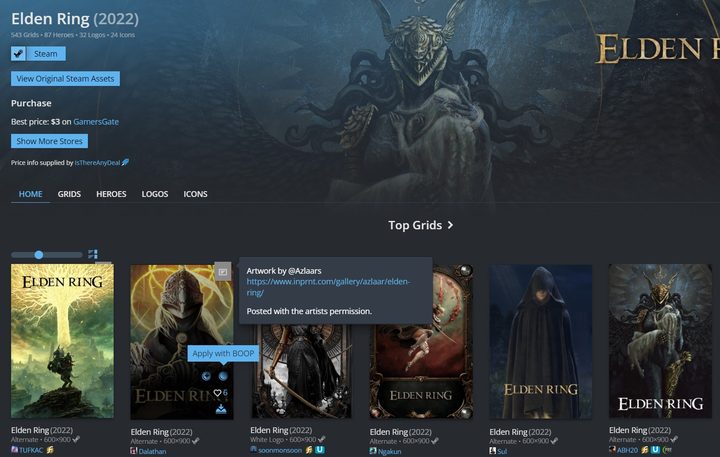
SGDBoop is an application built by the SteamGridDB team that works shockingly well. Instead of manually downloading each image, right-clicking through your library, and setting the custom artwork, SGDBoop allows you to set custom art for Steam and non-Steam apps with the press of a button. Even better, it organizes all of the custom art into a folder within your Steam installation, allowing you to apply the custom artwork to other devices (more on that later).
The app — if you can call it that, it’s more of a tool than anything — is available for Windows and Linux, and it’s worked flawlessly for me in Chrome. All you need to do is run the installer, choose the Show a test popup button on SteamGridDB’s website, and you’re off to the races. From there, you can search for any game on the SteamGridDB website and click one of two buttons when hovering over it. One applies the custom art with Boop, and the other pulls up a dialogue allowing you to choose where to apply the custom art if it’s for a non-Steam game.

It’s a huge timesaver, and you can see your changes reflected in real time. On Windows, whenever you apply custom artwork with Boop, you’ll see it show up in your Steam library in a matter of seconds. SteamGridDB even has animated artwork you can apply to your Steam library. Did you know Steam allowed you to display animated artwork? I sure didn’t.
More clever than you think
SGDBoop would be a great way to save time if all it did was download the custom artwork and apply it to your Steam library through its automated script. It’s a little more clever than that, though. Instead of manually setting the artwork, SGDBoop ties the artwork to the Steam app ID of the game you’re customizing.

Every app on Steam has its own ID, and that’s how Steam references different apps within the application. Halo: The Master Chief Collection, for example, has the app ID of 976730. Valve names folders within your program files after the game you’re looking for now, but previously, it would only organize games by their app ID. Even though you never interact with the ID, it’s still the way that Steam ties all of the information to a particular title within your library.

SGDBoop uses that to its advantage. If you apply custom artwork with the tool to a Steam game, it downloads the file and organizes it under the proper app ID. That’s what allows SGDBoop to be so fast. Moreover, it allows you to experiment with different artwork. I can sit and apply different grid images to Halo: The Master Chief Collection all day long without worrying. Instead of downloading a ton of files I’ll have to sift through later, SGDBoop just replaces the proper artwork file with the 976730 app ID.
These files are stored within your Steam installation, as well. If you’re like me and haphazardly download files to random folders, you’ve probably encountered a situation where you set custom artwork — such as your desktop wallpaper — only to delete the folder later and have your artwork go along with it. With SGDBoop, you don’t have to worry about that. It only keeps the files you’re actually using, and it stores them within your Steam installation.
The big deal for tying artwork to the app ID, however, is flexibility. You can set all of your custom artwork and carry it with you to any installation of Steam. Maybe you’re moving from one PC to another, or you have a laptop and PC you want to apply your artwork across. All you need to do is go to Program Files (x86)/Steam/userdata/[UserID]/config and copy the Grids folder to another Steam installation. Restart Steam, and all of your custom artwork will show up tied to the proper games.
You can even transfer everything over to the Steam Deck. It’s a bit of a hassle tracking down the right folder on SteamOS, but I was able to transfer my grids folder over without any issues.
If you’re looking to spruce up your Steam library a bit, particularly for games that you always have installed, give SGDBoop a shot. It’s free and extremely easy to use, and it will save you literal hours if you’re trying to update your full library with custom artwork. For me, I’m slowly updating games that I have installed as I go, and I love booting up Steam now to feel like I have something that I can call my own.