  1. Home
  2. Computing
  3. News

The 3 futuristic gaming monitors TCL just announced look insane

Add as a preferred source on Google
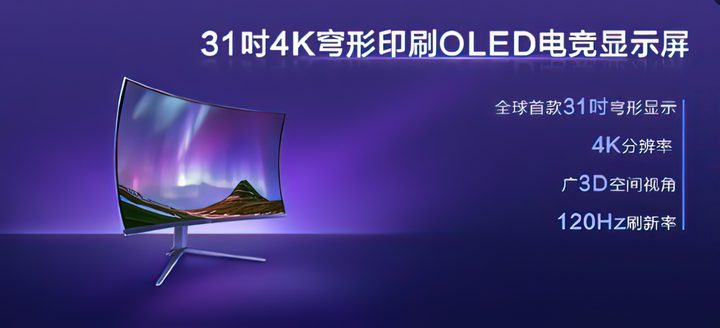
Announcement banner of the TCL dome-shaped 31-inch monitor.
TCL

If curved monitors do not satisfy your need for immersion, then TCL might have something for you. The company has come up with the world’s first dome-shaped display, essentially creating a monitor that is curved at the edges horizontally as well as vertically.

Announced at DTC 2023 in Wuhan, China, the 31-inch display uses an OLED panel type with a 4K resolution and a 120Hz refresh rate. TCL believes that this unique concave-style monitor offers a 3D-like experience while gaming. The company hasn’t shared full specifications, but it is one of the most unique products we have seen lately.

Recommended Videos

On paper, the concept is sound as it tries to mimic how one would create a simulation using multiple monitors that surround one. But at just 31 inches, I am not sure how it can compete with a high-end curved, ultrawide gaming monitor.

TCL's upcoming 65-inch 8K OLED panel.
TCL

TCL has also announced a new 65-inch 8K curved (1800R) OLED panel and the first 14-inch 2.8K IJP hybrid OLED panel for notebooks. Beyond OLED technology, the company showcased the first 27-inch 8K panel with a dynamic 120Hz refresh rate. It is said to come with a “2D/3D switchable light field display,” allowing seamless switching between a standard (2D) display and an immersive glasses-free 3D experience.

Announcement banner of TCL's new 57-inch dual-4K mini-LED monitor.
TCL

The company also gave a preview of its forthcoming 57-inch curved (1000R) panel equipped with Mini-LED technology boasting over 11,000 dimming zones, a 240Hz refresh rate, and a swift 1-millisecond response time. It is said to offer a 32:9 aspect ratio and dual 4K resolution, which sounds similar to the Samsung Odyssey Neo G9 that made its debut earlier this year.

Other additions to TCL’s upcoming display portfolio include an 85-inch WHVA panel with a 144Hz refresh rate covering 90% of the BT2020 color gamut, the world’s first 150-inch MLCD zero seam display, and a 2.1-inch authentic RGB LTPO-VR LCD boasting an impressive 1,727 pixels-per-inch density.

It’s important to mention that these improvements are only in the form of panels, and not an actual display. It’s uncertain whether other companies will choose to adopt them in their upcoming products.

Kunal Khullar
Kunal Khullar is a computing writer at Digital Trends who contributes to various topics, including CPUs, GPUs, monitors, and…
Your Windows 11 PC can now natively run AI workloads, even if it lacks the Copilot+ badge
Windows 11 laptop on a table

For the better part of a year, Microsoft has been telling us that the future of AI on Windows belongs to Copilot+ PCs. If you wanted Microsoft’s most advanced local AI features, you needed a machine with a dedicated Neural Processing Unit (NPU). That was the deal. Now, Microsoft appears to be rewriting the rules.

According to updated documentation, Windows 11’s local Language Model APIs can now run on non-Copilot+ PCs, provided they have an Nvidia GeForce RTX 30-series GPU (or newer) with at least 6GB of VRAM. On the surface, this sounds like a developer-focused update. In reality, it could be one of the most significant shifts in Microsoft’s AI PC strategy since Copilot+ PCs launched last year. More importantly, it raises a question that has been lingering ever since the AI PC era began: Did we really need NPUs for all of this in the first place?

Read more
The Windows 11 June update makes your Start menu and Search feel much more snappier
Low Latency Profile is the first targeted fix Microsoft has shipped for shell responsiveness, and the June update brings it to every eligible PC rather than just Insider preview testers.
Windows 11 Laptop

If you’ve ever clicked on the Start button and watched the menu appear after a second or two, you already understand the problem Microsoft is trying to solve with its June 2026 Windows 11 update. 

The update (KB5094126) rolled out on June 9, 2026, for WIndows 11 24H2 and 25H2, and targets the shell responsiveness issues that have quietly frustrated users since its launch in 2021. The headline change is the broad rollout of the Low Latency Profile.

Read more
OpenAI teams up with Visa to enable secure payments through AI agents
ChatGPT could soon buy things on your behalf thanks to OpenAI's new Visa partnership
openai-chatgpt-visa-payment

Imagine telling ChatGPT to reorder your paper towels or find the best wireless headphones in your budget, and it just handles the purchase without you lifting a finger. That is exactly what OpenAI and Visa are now building toward.

The two companies announced a strategic partnership at the Visa Payments Forum, with plans to bring Visa's global payment infrastructure directly into OpenAI's AI agent experiences, including ChatGPT and the Atlas browser.

Read more