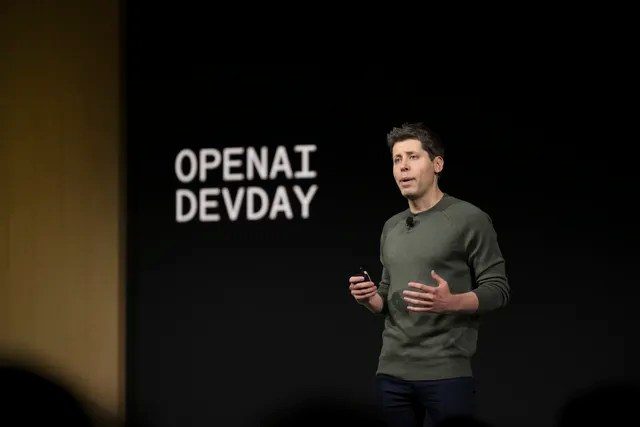
Shortly after taking office, Donald Trump touted a new private business venture, led by OpenAI, which plans to spend half a trillion dollars over the next four years building the data centers and power production plants that America’s growing AI industry relies on.
“It’s big money and high-quality people,” Trump said during a January 21st press announcement alongside Sam Altman from OpenAI, Larry Ellison from Oracle, and Masayoshi Son from SoftBank. The project is “a resounding declaration of confidence in America’s potential” under his administration, Trump continued, despite the federal government not actually having anything to do with the project.
Announcing The Stargate Project
The Stargate Project is a new company which intends to invest $500 billion over the next four years building new AI infrastructure for OpenAI in the United States. We will begin deploying $100 billion immediately. This infrastructure will secure…
— OpenAI (@OpenAI) January 21, 2025
“This infrastructure will secure American leadership in AI, create hundreds of thousands of American jobs, and generate massive economic benefit for the entire world,” OpenAI’s announcement post reads. “This project will not only support the re-industrialization of the United States but also provide a strategic capability to protect the national security of America and its allies.”
Here’s what we know so far about Stargate, the $500 billion AI infrastructure bet.
What is the Stargate Project?
“The Stargate Project” is technically the name of a new company tasked with building 500 billion dollars worth of AI data centers and green energy production sites across the U.S. over the next four years — with $100 billion to be spent immediately — for OpenAI’s benefit. Details on where the company plans to install these facilities remain to be seen, though the company has already broken ground on its first of ten data centers situated in Abilene, Texas, about 200 miles west of Dallas.
The 1,000-acre project, which is registered with the Texas Department of Licensing and Regulation (TDLR) as “Project Ludicrous,” is expected to cost $1.1 billion and be completed by the end of 2025. Once it is online, each data center should employ just under 60 people, though the company estimates it will create 100,000 jobs in total over the next four years. The initial project broke ground in June 2024, starting with a $292 million, 482,000-square-foot one-story “data hall,” which is slated for completing in May 2025. Additional structures, as well as another $140 million in “tenant improvements,” should be finished by this September.
According to TDLR filings, the first site will be powered by a 360MW natural gas turbine. The project’s application to install another nine turbines (for the remaining nine data centers) as “primary and backup power” for the data center under Title V of the Clean Air Act is still under review. Solar and battery systems from SoftBank subsidiary SB energy will be installed onsite as well, to supplement the turbines’ production. OpenAI CEO Sam Altman has previously put forward plans to construct data centers up to 5GW in size.
“This will be the most important project of this era,” Altman recently told the AP. He (along with Ellison and Son) credited Trump with making the project possible, despite Stargate already having launched and broken ground on its first build last year.
Who is involved in the Stargate Project?
The Stargate Project is financially backed by SoftBank, OpenAI, Oracle, and UAE-based investment firm MGX. Arm, Microsoft, Nvidia, Oracle, and OpenAI will serve as the initial technology partners. Oracle, Nvidia, and OpenAI will collaborate to operate the various data centers as they come online.
Controversies surrounding the Stargate Project
Stargate had barely been announced before Tesla CEO Elon Musk started trolling the project’s idea, its backers, and long-running legal opponent Sam Altman in particular. “They don’t actually have the money,” Musk wrote in an X post, suggesting that the entire endeavor was actually a sham. “SoftBank has well under $10B secured. I have that on good authority.”
wrong, as you surely know.
want to come visit the first site already under way?
this is great for the country. i realize what is great for the country isn't always what's optimal for your companies, but in your new role i hope you'll mostly put 🇺🇸 first.
— Sam Altman (@sama) January 22, 2025
This set off a frenzy of posts and replies between himself and Altman, who initially deferred to Musk’s “accomplishments,” stating “you are the most inspiring entrepreneur of our time” before needling him with “I realize what is great for the country isn’t always what’s optimal for your companies,” he added, “but in your new role i [sic] hope you’ll mostly put [America] first.”
Petty squabbles between petulant oligarchs aside, Stargate faces significant challenges in actually coming to fruition — one only need look at the heavily-hyped Foxconn-Wisconsin disaster that occurred during the first Trump administration as an example. In 2017, the Taiwanese electronics manufacturer promised a $10 billion investment in Wisconsin along with the creation of 13,000 jobs. The state legislature then passed a $2.85 billion tax incentive package (and dropped $150 million in sales taxes) to help sweeten the deal, costing the state around $3 billion in total, only for Foxconn to abruptly change its business plans and largely abandon its production plants in the state.
We have no reason to believe that OpenAI and its partners will be any less mercurial in their actions, especially with the American AI industry in crisis over the release of DeepSeek’s generative AI models, which offer performance equivalent to OpenAI’s state of the art models, but at a small fraction of the training, energy, and operating costs. If the capabilities of DeepSeek’s models prove legitimate — thereby proving that the American strategy of just throwing money and resources at AI development is both wasteful and unnecessary — the Stargate consortium would have little reason to continue investing in infrastructure.