I have a confession to make: I have one of the most powerful GPUs you can buy, the AMD RX 6950 XT, and I deliberately make it underperform. Let me explain.
I appreciate that off the back of a GPU pricing crisis, which saw almost everyone unable to find a card like this (let alone afford it), that sounds super wrong. I’m lucky that one of the perks of this job is getting to test out the kind of high-end components that I wouldn’t otherwise shell out the cash for. But even then, I can’t bring myself to unleash the full power of this awesome GPU.
It’s sad to say, but in my day-to-day living with this graphics card, I found myself valuing a quieter, cooler system more than the extra performance GPUs of this kind can provide.
Taming the beast

The 6950 XT is a power-hungry card. It’s the same GPU as the 6900 XT but pushed to its limit, so of course, it runs hot. When put in an mATX case it runs loud, too, even with a big cooler. It’s not necessarily the kind of GPU I would have bought myself, but now that I have one, what am I going to do, not use it?
But that was a very real prospect after a few days of retreating to headphones after the testing was done. How could I continue to enjoy high frame rates and detail settings in games, but not have to listen to its fans hitting 2,200 RPM as soon as the game menu appears? The solution, it turns out, was the make the card run worse.
The PowerColor Red Devil 6950 XT has a BIOS switch, ostensibly for backup purposes in case you brick one of them trying a heavy overclock. But the secondary Silent BIOS also lowers clock speeds and undervolts the GPU. Enabling that got me halfway there. With that, we were only hitting around 1700 RPM on the fans, and the junction temperatures dropped by around five degrees, resting under 100 at load for the first time since I’d gotten the card up and running.
This was an exciting development. Maybe there was a way to have my PCB cake and eat it too. But it still wasn’t quite quiet enough for my sensibilities and temperature thresholds.

Next, I played with the settings in AMD’s Adrenaline driver application and made further headway. The automated undervolting had a minor effect of its own, but a few extra RPM and a single-degree drop in temperatures wasn’t going to cut it. I could have manually adjusted the fan curves myself, but ultimately, setting the tuning profile to Quiet was enough.
Clock speeds dropped a little more, and fan speeds followed suit. Suddenly I had a card that even with a 4K Furmark run wasn’t going over 265W, with a maximum junction temperature of just 80 degrees. Just as important? Fan speeds never went over 1,500 RPM, keeping the card cool and quiet enough that it only just registered over the whir of the system fans.
No, performance isn’t the same. The core clock now barely breaks 1,900MHz, and my Time Spy score isn’t quite as good, but I don’t care. I have a near-silent 6950 XT that still performs better than almost any other GPU out there, and it didn’t require a custom cooler or heavy tweaking. Now, I can game in relative peace, and it takes far, far longer for my little home office to heat up. I’m living the dream.
It turns out I’m not alone
I know this post reads like the most whiney of first-world problems — believe me, I’ve read it through multiple times before posting. I’m also aware that there are other ways around this problem without tamping down on the card’s performance, such as better system cooling, or gaming with the air conditioning on.
I would have been too ashamed to write about it myself if I hadn’t found out that my fellow DT writer and high-end GPU owner, Jacob Roach, is also a sacrilegious downclocker. His daily driver gaming PC has an RTX 3090 inside, and it’s stupendously powerful (although my card’s better). But according to him, it’s often a bit much and, frankly, more than he needs.
“I’ve been limiting the frame rate with my 3090 for a while,” he said when I mentioned how I felt bad for making my RX 6950XT perform worse than it can. “I just can’t handle the noise and heat, even if the card is capable of more.”
This is something that both of us have had to deal with as our respective countries grapple with heat waves. There might be a case of gaming with one of the best graphics cards pulling over 300W if you live somewhere tepid or it’s not the middle of summer, but when the temperatures rise outside and you want to hide inside playing games, switching on a miniature space heater to do it doesn’t feel very comfortable once temperatures start rising.
It also doesn’t sound comfortable, because just as gaming with a hot PC next to your legs or on your desk can make you hot and bothered, they can get really loud too. My mATX case does not give this 6950 XT enough room for its triple fans to cool it effectively, so even if I do run it full tilt, I run into some thermal throttling after extended use. The longer I play, the worse it gets, for both the card and me.
The future looks warm
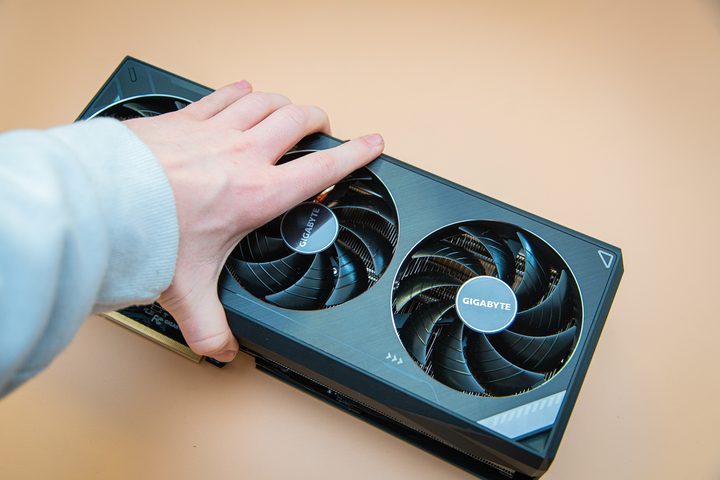
While Jacob and I might not use our GPUs to their full potential, there’s no denying that the RTX 3090 and the RX 6950 XT are incredibly power-hungry and hot GPUs, and they’re not alone. The entire lineup of modern graphics cards from both camps has had a bump in TDP this generation, and if the rumors are to be believed, the next generation will only exacerbate this problem.
And it is a problem. Jacob and I are prime examples that if you don’t have a larger space with plenty of ventilation or capable A/C running all the time, playing games with some of these top graphics cards is decidedly uncomfortable, both from a noise and heat perspective. I’m not all that excited about a graphics card that’s even hotter and potentially louder, even if it is much more performative.
It’s not that I wouldn’t keep it if I was given one. But don’t be surprised if you find me downclocking it to oblivion to make my gaming sessions cooler and quieter.