

Razer has just unveiled its most powerful gaming laptop, the 2024 Razer Blade 18, and it features a fascinating new spec that just might be more interesting than the laptop itself. As teased in January during CES, the new 2024 Blade 18 is the world’s first notebook equipped with Thunderbolt 5.
Having the latest Thunderbolt version means that you now get three times the bandwidth of Thunderbolt 4, going from 40Gbps to 120Gbps. This should ensure minimal lag while working with multiple high-resolution displays and, in some ways, open up the possibility of hooking up desktop-class GPUs via external docks.
External GPUs have fallen out of fashion recently; Intel has been hoping to spark a resurgence in their popularity ever since Thunderbolt 5 was announced. More than that, Intel has implied that even “external AI accelerators” could come in the future, which might bring an extra boost for local AI performance.
The additional bandwidth also means you can now power an external monitor with a refresh rate of up to 540Hz.
Beyond Thunderbolt 5, though, there’s a host of updates to specs across the board for the Razer Blade 18. Razer says that it is the slimmest laptop in its size category powered by an Intel HX-series CPU, specifically the Core i9-14900HX.
The laptop also comes with premium display options. It can be configured with a factory-calibrated 4K (3840×2400) resolution display capable of 200Hz refresh rate, 3.0ms response time, 100% DCI-P3 color gamut, as well as Calman verification. The other option is equally enticing. The Blade 18 will also be available with a QHD+ 300Hz mini-LED option with 1000-nits peak brightness, 2K dimming zones with a new toggle on/off feature, and similar DCI-P3 100% color gamut coverage, Calman verification, and factory calibration.

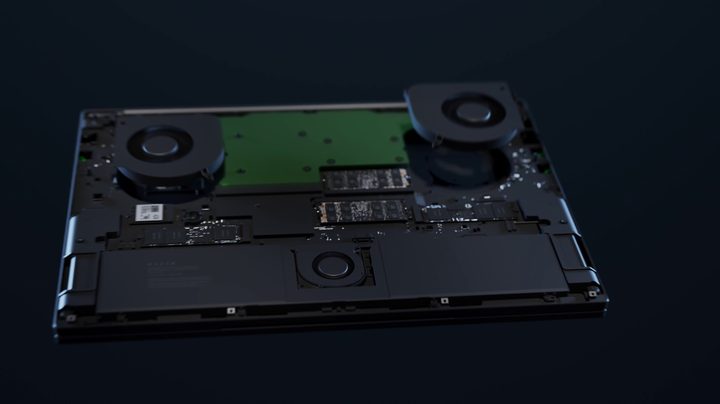
Powering the graphics is the latest Nvidia GeForce RTX 40-series available right from the 4070 to the 4090 with up to 175W TGP. There’s a new cooling system too, with thinner exhaust fins and a vapor chamber system paired with three cooling fans. Notably, one of the cooling fans is placed between a unique dual battery. It seems that the manufacturer is taking every precaution possible to avoid battery swelling issues, which has been a consistent issue with Razer gaming notebooks.
There’s also a 5-megapixel webcam with Windows Hello support, a 6-speaker array with THX spatial audio, Wi-Fi 7, and a 330W GaN charger, which is said to be 60% smaller than traditional charging bricks.
In terms of storage and memory, the laptop can be configured with dual 2TB NVMe drives and up to 64GB of DDR5 RAM. There’s a plethora of ports, too, including three USB 3.2 Gen 2 Type-A ports, two USB Type-C ports, one of which supports Thunderbolt 5, a 2.5-gig Ethernet port, HDMI 2.1, and a UHS-II SD card reader.
The new Razer Blade 18 is available for purchase from the company’s online store. The starting price tag for the mini-LED model is $3,100 . However, the 4K 200Hz display is currently unavailable, but is listed with the highest configuration for $4,800.
The Razer Blade 18 might be among the first to debut Thunderbolt 5, but it won’t be the last. We’ll have to wait and see if the broader shift to the new port standard will lead to an embrace of external GPUs, as Intel hopes it will.


