  1. Home
  2. Emerging Tech
  3. News

Boeing’s Starliner capsule attached to Atlas rocket ahead of first test flight

Add as a preferred source on Google

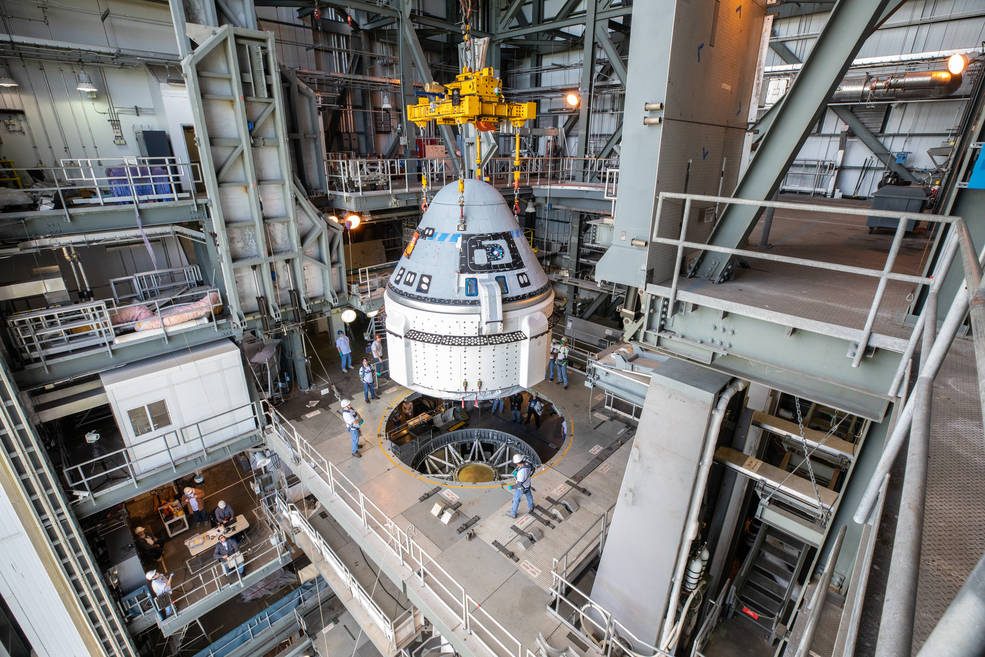
The Boeing CST-100 Starliner spacecraft is guided into position above a United Launch Alliance Atlas V rocket at the Vertical Integration Facility at Space Launch Complex 41 at Florida’s Cape Canaveral Air Force Station on Nov. 21, 2019. NASA/Cory Huston

Things are heating up in Cape Canaveral, as Boeing’s new Starliner capsule is connected to the rocket which will launch it on its first orbital test flight in a few weeks’ time. The capsule will carry astronauts to the International Space Station as part of NASA’s commercial crew program.

Recommended Videos

You can get an idea of the complexity of infrastructure required for a launch by looking at the photo below, showing an alternative angle of the Starliner sitting atop the United Launch Alliance Atlas V rocket. United Launch Alliance is a joint venture between aeronautics companies Lockheed Martin and Boeing which provides launch services using either the smaller Atlas rocket or the larger Delta Heavy. The smaller rocket is no slouch though, with the Atlas V generating about 1.6 million pounds of thrust at launch.

On Nov. 21, 2019, the Boeing Starliner space vehicle was mated to its United Launch Alliance Atlas V rocket at Cape Canaveral, Florida. Boeing and United Launch Alliance

One of the reasons that the commercial crew program has generated so much interest in the U.S. is that it will mark the first time crewed missions have launched from the country since the retirement of the Space Shuttle program in 2011. This makes it an important marker of international status as well as being an issue of national security.

“This is critical to our future as a nation,” Bob Cabana, director of NASA’s John F. Kennedy Space Center and himself a former NASA astronaut, said in a statement. “We’ve got to get astronauts flying on U.S rockets from U.S. soil, and this is just a huge step forward.”

Despite the enthusiasm on show from NASA officials, however, the commercial crew program has had its share of difficulties. The Starliner capsule has faced considerable delays, and SpaceX’s crewed capsule, the Crew Dragon, actually exploded during testing in April. Still, NASA remains optimistic that partnerships with private companies can help fund space exploration through commercial habitation programs in addition to the commercial crew and commercial resupply programs.

The next big day for the Starliner is December 17, when it will launch on its first-ever orbital test flight, which will be uncrewed.

Georgina Torbet
Georgina has been the space writer at Digital Trends space writer for six years, covering human space exploration, planetary…
Google wants Gemini to help build the next big scientific breakthrough
Gemini for Science pushes agentic AI deeper into real research workflows
gemini for science

Google is building Gemini deeper into the research workflow, starting with ideas, tests, and scientific literature.

At Google I/O 2026, the company announced Gemini for Science, an experimental suite built around agentic AI science. It targets the manual work behind discovery, including hypothesis building, computational testing, and literature review.

Read more
You can now walk through AI versions of real places with Google’s Project Genie
Text, Logo

Google is pushing its experimental AI world-building project into surprisingly realistic territory. The company announced that Project Genie can now use real-world imagery from Google Street View to generate interactive virtual environments, blending real locations with imaginative AI-generated styles.

At its core, Genie is what Google calls a “world model” — an AI system capable of creating explorable digital environments where AI agents, robots, or even users can interact naturally. Until now, those worlds were mostly synthetic. But with this new update, Genie can anchor itself to real places pulled directly from Street View imagery. This is actually where things start feeling like a glimpse into the future of simulation.

Read more
Google wants to reinvent your TV remote with Gemini and pointer controls
Computer Hardware, Electronics, Hardware

Google is making a bigger play for the living room, and this time, it is not just about what you watch — it is also about how you interact with your TV. At Google I/O 2026, the company revealed a fresh batch of updates for Google TV and Android TV developers, all centered around one idea: TVs are no longer passive screens sitting in the corner of your house. With more than 300 million monthly active devices across Google TV and Android TV, Google clearly sees the television as its next major AI battleground. And Gemini is now at the center of that strategy.

The company says Gemini is already helping users discover content through natural voice interactions. But Google now wants the experience to feel more dynamic and conversational, almost like searching the web — except on your couch. Instead of only surfacing static results, Gemini on Google TV can now respond with a combination of visuals, videos, and text snippets to answer queries. So if someone asks for a thriller with a strong female lead or a documentary about space exploration, Gemini pulls contextual recommendations directly from streaming apps and their metadata.

Read more