1. Home
  2. Emerging Tech
  3. Computing
  4. Smart Home
  5. News

DIY backyard security system turns on the sprinklers when it sees a trespassing cat

Add as a preferred source on Google

What’s the best way to stop cats from pooping in your garden? Depending on who you ask, answers might include ultrasonic cat repellents, chicken wire, or the use of certain plants to protect your lawn from feline defecation.

For Nvidia Systems Software Engineer Robert Bond, however, there was only ever one possible solution: training a deep learning neural network to turn on his garden sprinklers whenever it recognized a cat in his front yard.

Recommended Videos

“I mounted a camera on the garage that looks out over the garden,” Bond tells Digital Trends. “The camera is set to send images to an [Nvidia Jetson TX1] whenever something changes. The [TX1] then uses deep learning to decide whether the thing that moved is a cat or something else. If it’s a cat then it activates the sprinkler system.”

catsprinkler1
Image used with permission by copyright holder

Bond says that he started training his neural network with a data set of around 1.2 million pictures gathered from the internet. These included plenty of pictures of cats, but most of them turned out to be cutesy close-ups portraits, rather than the kind of pictures he was looking for. “It was almost worthless for what I needed to do, because I was hunting for pictures of cats slinking around in my bushes,” he explains.

Bond notes that at this point his neural network was only successfully classifying around 30 percent of the cats that came into his garden. He decided to modify the neural network’s training examples by adding pictures he had taken himself. Recognition scores immediately jumped to around 90 percent.

catsprinkler2
Image used with permission by copyright holder

The system hasn’t been perfect, however. For one thing, during the training process shadows were regularly classified as cats because they represented dark shapes moving across Bond’s lawn. Even Bond wasn’t immune from being classified as a feline. “I went to mow my lawn and the system somehow decided that the combination of me and my lawnmower counted as a cat,” he says. “I wound up getting pretty thoroughly sprayed.”

But for the most part the deep learning network has been a resounding success — and Robert Bond’s garden is now virtually cat free.

It’s simple when you know how, right?

Luke Dormehl
I'm a UK-based tech writer covering Cool Tech at Digital Trends. I've also written for Fast Company, Wired, the Guardian…
Bacteria could be the secret sauce to keeping your computers cool
Scientists find bacteria can grow thermal materials that outperform current cooling tech.
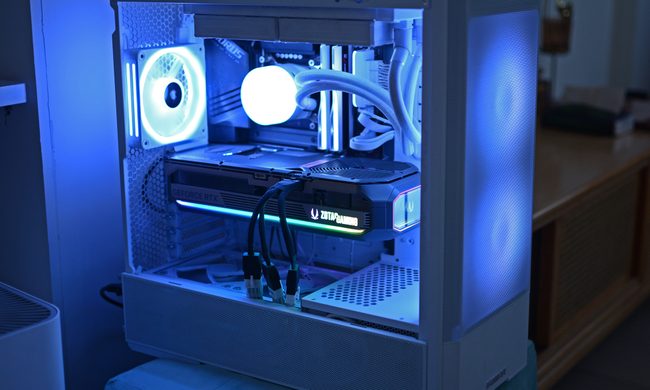
The Zotac RTX 5070 Ti Amp Extreme Infinity plugged into a white gaming PC

Your PC and laptop runs hotter every year, especially now that AI tools and heavy software push it harder than ever. Heat is a real bottleneck for performance, which is why people have gone to wild lengths to solve it, like strapping an actual ice machine to an RTX GPU. A new study points to a far less extreme fix for this problem, and it involves bacteria (via TechXplore).

Researchers have developed a new way to grow thermal interface materials, the substances that sit between a chip and its cooling system to help heat escape faster. The process involves feeding bacteria sugar and metal ions, letting the microbes build the material naturally instead of relying on traditional chemical manufacturing.

Read more
Bored of reading papers? This AI tool turns them into TikTok-like videos
PaperTok brings academic papers to people with short attention spans
Head, Person, Face

Academic papers aren't what you'd consider a fun read. For the average person, the dense, long, and field-specific language-filled papers can be quite intimidating to get into. These are usually packaged as PDFs that look like they were designed to test your willpower. A group of University of Washington researchers thinks there may be a better way to get that work in front of regular people. They are turning the papers into short-form videos.

The tool is called PaperTok, and it uses AI to help researchers convert academic papers into short, social-friendly videos. Think TikTok, except the idea is to explain research instead of sharing brain-rotting content. The best part? PaperTok is building a platform around scientists and researchers who are involved in the process, rather than simply using AI to summarize these papers.

Read more
As AI voices get harder to spot, ElevenLabs adopts Google’s SynthID to help you sniff the fakes
Artificial Intelligence

There was a time when spotting AI-generated content was almost a game. Images came with extra fingers, chatbots wrote like overly enthusiastic interns, and synthetic voices had an unmistakable robotic edge. Those days are disappearing fast.

Today, AI voices can laugh, whisper, pause naturally, and even sound emotional enough to fool many listeners. That’s exciting for creators, but it’s also creating a growing trust problem. If you can’t tell whether a clip is real or AI-generated, how do you know what to believe?

Read more