
You don’t actually need to share your location for your city to figure out where you are. Every call you make and every message you send, quietly connects to a nearby network antenna. Now multiply that across millions of people doing the same thing every day, and what you end up with isn’t just data — it’s a living, moving picture of how a city really works. That’s exactly what researchers at the University of Córdoba have managed to tap into with a new tool designed to interpret those patterns.
The tool that watches without really watching
MAPLID (Multi-label Approach for Place Identification) doesn’t track individuals. It actually looks at patterns — aggregated, anonymized signals that show how places actually behave over time. It can reveal when a neighborhood shifts from residential to commercial, when roads leading into industrial zones reach peak traffic, or how a single large event can quietly disrupt the rhythm of an entire district.

What makes it stand out is that it doesn’t force a place into just one definition. A university campus, for example, isn’t only a workplace. Depending on the time of day, it can be a home, a social space, or a transit route. Most mapping tools tend to pick one label and stick with it. MAPLID, on the other hand, captures all of those layers at once.
How the research actually works
The model was developed as part of doctoral research by Manuel Mendoza Hurtado, along with colleagues Juan A. Romero del Castillo and Domingo Ortiz Boyer from the Department of Computer Science and Artificial Intelligence.
Rather than working with raw location traces, the system builds its understanding in layers. It starts with geolocated call and message metadata — not the content itself, but the connection points that register when devices interact with network antennas. From there, it tracks how these signals repeat over days and weeks, helping distinguish steady routines from one-off movements. That behavioral layer is then mapped against OpenStreetMap, an open-source geographic database. This adds real-world context like street types, landmarks, and building categories, turning abstract signal patterns into something far more grounded and usable for urban analysis.
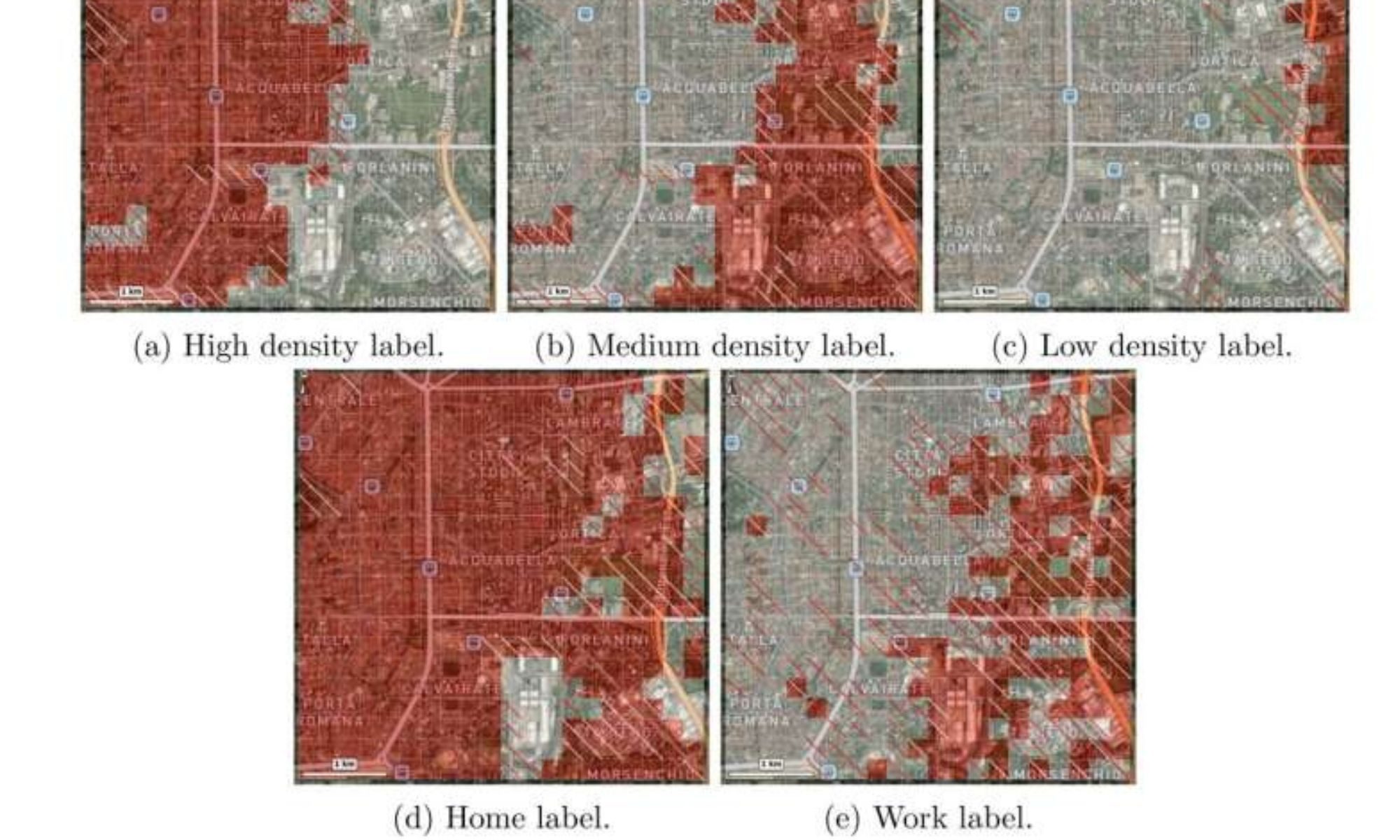
What comes out of this process is a time-lapse. The same street block, when viewed at different hours, can tell completely different stories — 7am looks nothing like 7pm. To test the model, the team ran it across Milan and Trento, two Italian cities that differ significantly in size and structure, making them ideal for comparison. Due to privacy restrictions, Spanish mobile data wasn’t available, so the researchers instead used a dataset released by Telecom Italia for scientific research. Even with millions of daily data points being layered onto urban maps, the model held up consistently across both cities, suggesting it isn’t limited to a single type of urban environment.
The study has been published in the International Journal of Geographical Information Science.
So, who’s actually watching?
Right now, no one is officially using it yet. The researchers’ next step is to bring the tool directly to local governments and city planners. And the use cases are fairly clear — adjusting bus schedules based on real movement patterns, improving traffic flow where it actually builds up, and even sending cleaning crews to places that genuinely need them, rather than relying on outdated assumptions.
The interesting part is that cities have always been producing this kind of information. It was never missing. What’s been missing is a way to actually interpret it in a meaningful, usable way. This tool might just be the step that changes that.