  1. Home
  2. Emerging Tech
  3. Features

Google Gemini’s new thinking level lets you dial up the brainpower

Add as a preferred source on Google
Gemini Intelligence
Google

With Google I/O 2026 almost here, Google seems unable to stop Gemini leaks from slipping out early. Every other day, something new appears inside the app, and this time it looks like Google is experimenting with giving users more control over how much “thinking” Gemini actually does before responding.

According to a report from 9to5Google, some users are now spotting a new “Thinking Level” option inside the Gemini app. The feature reportedly appears within Gemini’s existing model picker, where users already choose between options like Fast, Thinking, Pro, or Google AI Plus.

Things are getting a little more nuanced

Instead of simply choosing which model you want, Google also appears to be testing how deeply that model reasons through a task. The report says the new Thinking Level option currently shows up when selecting Fast (Gemini 3 Flash) or Gemini 3.1 Pro with thinking enabled. For now, the rollout seems extremely limited.
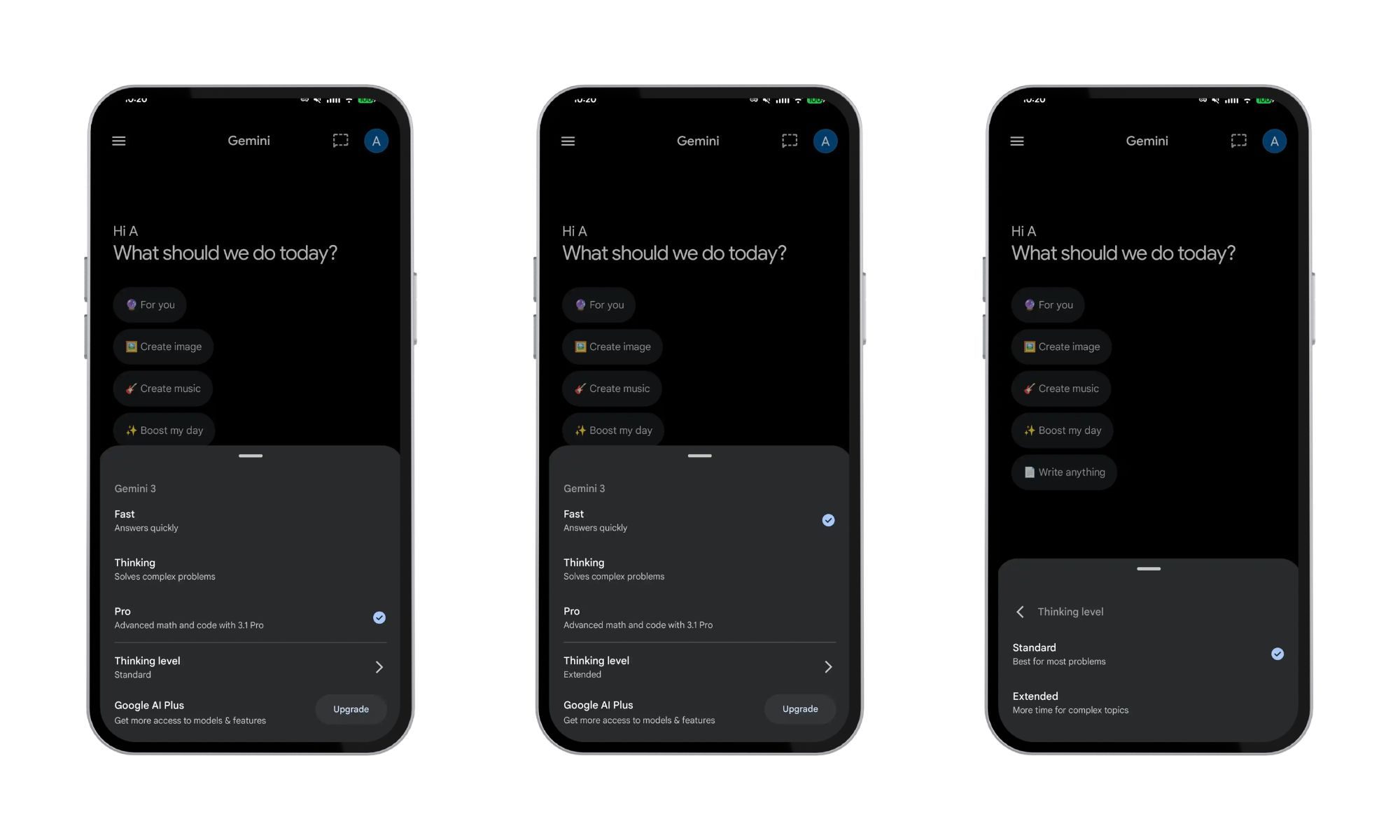
If this sounds familiar, that is because Google AI Studio already offers similar controls with Low, Medium, and High reasoning levels. Bringing that flexibility into the regular Gemini app feels like the next obvious step, especially as AI companies increasingly compete on how “thoughtful” or agentic their assistants can feel.

Honestly, I feel this could be more useful than it sounds

Not every AI request needs maximum reasoning power. Sometimes you just want a quick answer without waiting several extra seconds while the model overanalyzes your grocery list, as if it were preparing a PhD thesis. Giving users control over that balance between speed and deeper reasoning could make Gemini feel much more flexible day to day.

Recommended Videos

Google also appears to be expanding Gemini’s growing ecosystem of third-party app integrations. Right now, Gemini already works with apps and services like GitHub, OpenStax, Spotify, and WhatsApp.
However, support documentation reportedly hints that integrations for Canva, Instacart, and OpenTable are also on the way. None of these integrations appears to be live yet, but the timing makes sense. Google I/O is usually where the company shows off Gemini becoming less of a chatbot and more of a proper digital assistant that can actually do things across apps and services.

At this point, Gemini’s evolution feels less about smarter answers alone and more about turning the app into something that quietly handles parts of your digital life in the background — ideally without making everything feel unnecessarily complicated.

Shimul Sood
Shimul is a contributor at Digital Trends, with over five years of experience in the tech space.
The best new ChatGPT feature is one most people will never use
Logo, Emblem, Symbol

For years, the biggest conversation around AI has been what these tools can do. They can browse the web, analyze documents, connect to your apps, conduct research, and increasingly act on your behalf. But as AI systems become more capable, another question has become harder to ignore: what happens when an AI assistant is tricked into handing over information it shouldn’t?

OpenAI’s new Lockdown Mode is its latest answer to that problem. Available across all ChatGPT account types, Lockdown Mode is an optional security setting designed for people and organizations handling sensitive information. The trade-off is that you get stronger protection against certain forms of data theft, but you lose access to some of ChatGPT’s most powerful features.

Read more
An app that lets anyone control a robot from their phone, no coding required
Sounds cool, right? Forget doomscrolling, now your phone can operate a robot arm instead
Representative Image

A team of researchers at Georgia Tech has developed a new smartphone-based system that could dramatically simplify how people interact with robots. Called COBALT, the platform allows users with little to no computing experience to remotely control robot arms from virtually anywhere in the world using just a phone and an internet connection.

The project, developed at Georgia Tech’s People, AI & Robotics (PAIR) Lab, transforms smartphones into motion controllers for robotic arms. Users simply move their phones in different directions, and the robot mirrors those movements in real time. Basic tasks such as grabbing, moving, and releasing objects can be performed through simple on-screen controls, making the experience feel more like playing a mobile game than operating industrial machinery.

Read more
Coursera wants users to learn through shorter, faster content
Coursera wants online learning to feel more like TikTok
Coursera

Online learning platform Coursera is taking a page straight out of TikTok’s playbook. The company has launched a new AI-powered feed designed to serve short-form educational content in a scrollable, personalized format, signaling a major shift in how digital learning platforms may try to keep users engaged.

The feature introduces bite-sized video lessons, clips, and explainers curated through artificial intelligence based on a user’s interests, learning habits, career goals, and previous course activity. Instead of committing to hour-long lectures or full certification programs upfront, users can now discover short educational snippets designed to make learning feel more casual, accessible, and addictive.

Read more