  1. Home
  2. Emerging Tech
  3. Computing
  4. Smart Home
  5. News

Not your average table: Genetic algorithms and 3D printing set this furniture apart

Add as a preferred source on Google

Do you enjoy good design? Like algorithms and 3D printing? Enjoy sitting down at tables? If you’re in the overlapping section of this particular three-pronged Venn diagram, you’ll probably enjoy the work of U.K. design studio Studio Integrate, which was shown off at this month’s London Design Fair.

Designing for British furniture brand Morgan, Studio Integrate has created a new table that uses 3D printing and genetic algorithms to create its unique sculptural latticework.

Recommended Videos

A genetic algorithm is computer programming capable of generating multiple evolutions of an idea, similar to what you would find in the natural world. The result is a creation that not only looks organic, but spawns unique items containing the same individual quirks you would find in a handmade object.

“I like the idea of using evolution to drive design forward to create new, novel objects,” Mehran Gharleghi, director of Studio Integrate, told Digital Trends. “The concept of using genetic algorithms was not to just imitate nature in terms of design, but actually to learn from it.”

The so-called Rio table isn’t the first time Gharleghi has used genetic algorithms in his work. In an earlier collaboration with the Morgan furniture brand, he used 3D printing and smart computer code to come up with Rio chairs, which use a similar design language and philosophy.

“With the chairs, I was able to use 3D printing to make them very light and flexible, while also strong enough to hold the weight of a person,” he said. “In that case, I used algorithms to calculate the geometry to find a balance between strength, weight, and flexibility. The table had a different set of criteria, because while the chairs needed to be flexible, the table had to be rigid — although we wanted all the pieces to look like they shared the same design.”

It’s an original concept that reminds us that, in the digital age, mass-produced items no longer have to all look the same. If you fancy filling your home with furniture that looks like it belongs together, but still has originality in each piece, Gharleghi’s work represents the perfect solution.

“It brings a bit of personality,” he said. “Think about a population of people. From a distance, we might broadly look the same, but up close we all have our unique differences. It’s the same with this work.”

Luke Dormehl
I'm a UK-based tech writer covering Cool Tech at Digital Trends. I've also written for Fast Company, Wired, the Guardian…
Bacteria could be the secret sauce to keeping your computers cool
Scientists find bacteria can grow thermal materials that outperform current cooling tech.
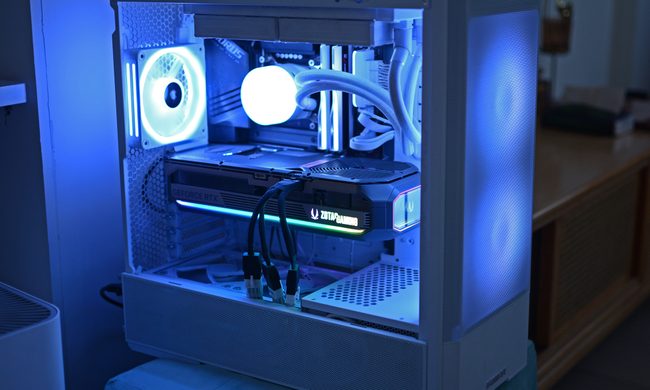
The Zotac RTX 5070 Ti Amp Extreme Infinity plugged into a white gaming PC

Your PC and laptop runs hotter every year, especially now that AI tools and heavy software push it harder than ever. Heat is a real bottleneck for performance, which is why people have gone to wild lengths to solve it, like strapping an actual ice machine to an RTX GPU. A new study points to a far less extreme fix for this problem, and it involves bacteria (via TechXplore).

Researchers have developed a new way to grow thermal interface materials, the substances that sit between a chip and its cooling system to help heat escape faster. The process involves feeding bacteria sugar and metal ions, letting the microbes build the material naturally instead of relying on traditional chemical manufacturing.

Read more
Bored of reading papers? This AI tool turns them into TikTok-like videos
PaperTok brings academic papers to people with short attention spans
Head, Person, Face

Academic papers aren't what you'd consider a fun read. For the average person, the dense, long, and field-specific language-filled papers can be quite intimidating to get into. These are usually packaged as PDFs that look like they were designed to test your willpower. A group of University of Washington researchers thinks there may be a better way to get that work in front of regular people. They are turning the papers into short-form videos.

The tool is called PaperTok, and it uses AI to help researchers convert academic papers into short, social-friendly videos. Think TikTok, except the idea is to explain research instead of sharing brain-rotting content. The best part? PaperTok is building a platform around scientists and researchers who are involved in the process, rather than simply using AI to summarize these papers.

Read more
As AI voices get harder to spot, ElevenLabs adopts Google’s SynthID to help you sniff the fakes
Artificial Intelligence

There was a time when spotting AI-generated content was almost a game. Images came with extra fingers, chatbots wrote like overly enthusiastic interns, and synthetic voices had an unmistakable robotic edge. Those days are disappearing fast.

Today, AI voices can laugh, whisper, pause naturally, and even sound emotional enough to fool many listeners. That’s exciting for creators, but it’s also creating a growing trust problem. If you can’t tell whether a clip is real or AI-generated, how do you know what to believe?

Read more