1. Home
  2. Emerging Tech
  3. News

‘Mars, here I come!’ NASA’s InSight launches on a six-month journey

Add as a preferred source on Google
NASA Mars InSight Overview

NASA’s newest Mars mission lifted off in the fog atop an Atlas V rocket from Vandenberg Air Force Base at 4:05 a.m. local time Saturday morning. It was a rare treat for space enthusiasts in California, as it’s the first interplanetary mission ever to launch from the West Coast.

Recommended Videos

And we have liftoff! #Mars, here I come! 6 months and counting to the Red Planet. pic.twitter.com/wBPYdZVUlt

— NASA InSight (@NASAInSight) May 5, 2018

InSight (short for Interior Exploration using Seismic Investigations, Geodesy, and Heat Transport) will travel more than 300 million miles on a six-month journey to Mars. It’s scheduled to land on the red planet on November 26.

Previous Mars missions have studied the topography and atmosphere of the planet in depth, but nothing like InSight has ever been done before. Equipped with an array of sophisticated monitors, the car-sized mobile laboratory will probe deep beneath the surface of Mars, explained JPL Director Michael Watkins. It will collect data on “marsquakes,” monitor heat flow deep beneath the surface, and measure how the planet wobbles as it rotates. The mission was delayed for two years after leaks were found in the seismometer.

“InSight will help us unlock the mysteries of Mars in a new way, by not just studying the surface of the planet, but by looking deep inside to help us learn about the earliest building blocks of the planet,” Watkins said.
NASA

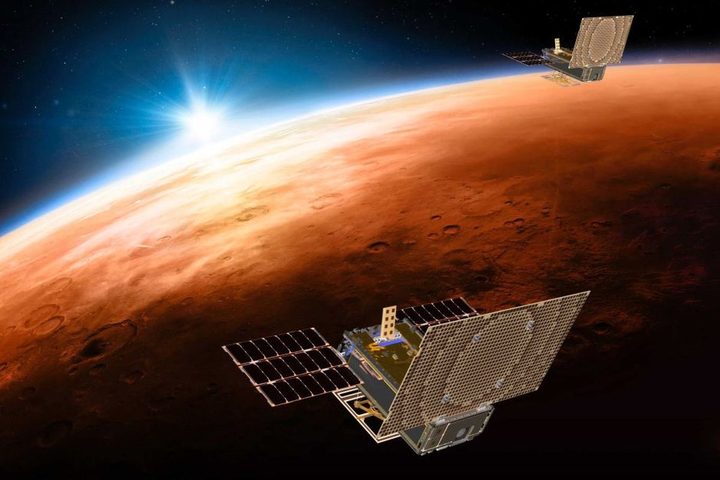
A couple of tiny hitchhikers will also be going along for the ride. Two CubeSat satellites nicknamed “Wall-E” and “Eva” will follow the spacecraft all the way to Mars. Officially named Mars Cube One, or MarCO, the duo is an experimental addition to the mission that’s designed to send data back to Earth as InSight lands on the planet’s surface. This is the first time the laptop-sized CubeSats will be used outside of an Earth orbit.

“These are our scouts,” said JPL engineer Andy Klesh. “CubeSats haven’t had to survive the intense radiation of a trip to deep space before, or use propulsion to point their way towards Mars. We hope to blaze that trail.”

The satellites are named after the animated Pixar characters because they use compressed gas commonly found in fire extinguishers for propulsion.

Once it arrives at Mars, the 1,340-pountd InSight will enter the thin atmosphere at 13,200 miles per hour. After deploying a supersonic parachute to slow itself down, it will jettison the heat shield and the lander itself will finally emerge. Its 12 descent engines will then guide the lander to a safe touchdown just a few minutes later.

Bruce Banerdt of JPL has been waiting a long time for this moment. “Scientists have been dreaming about doing seismology on Mars for years,” he said. “In my case, I had that dream 40 years ago as a graduate student, and now that shared dream has been lofted through the clouds and into reality.”

Mark Austin
Former Digital Trends Contributor
Mark’s first encounter with high-tech was a TRS-80. He spent 20 years working for Nintendo and Xbox as a writer and…
The best new ChatGPT feature is one most people will never use
Logo, Emblem, Symbol

For years, the biggest conversation around AI has been what these tools can do. They can browse the web, analyze documents, connect to your apps, conduct research, and increasingly act on your behalf. But as AI systems become more capable, another question has become harder to ignore: what happens when an AI assistant is tricked into handing over information it shouldn’t?

OpenAI’s new Lockdown Mode is its latest answer to that problem. Available across all ChatGPT account types, Lockdown Mode is an optional security setting designed for people and organizations handling sensitive information. The trade-off is that you get stronger protection against certain forms of data theft, but you lose access to some of ChatGPT’s most powerful features.

Read more
An app that lets anyone control a robot from their phone, no coding required
Sounds cool, right? Forget doomscrolling, now your phone can operate a robot arm instead
Representative Image

A team of researchers at Georgia Tech has developed a new smartphone-based system that could dramatically simplify how people interact with robots. Called COBALT, the platform allows users with little to no computing experience to remotely control robot arms from virtually anywhere in the world using just a phone and an internet connection.

The project, developed at Georgia Tech’s People, AI & Robotics (PAIR) Lab, transforms smartphones into motion controllers for robotic arms. Users simply move their phones in different directions, and the robot mirrors those movements in real time. Basic tasks such as grabbing, moving, and releasing objects can be performed through simple on-screen controls, making the experience feel more like playing a mobile game than operating industrial machinery.

Read more
Coursera wants users to learn through shorter, faster content
Coursera wants online learning to feel more like TikTok
Coursera

Online learning platform Coursera is taking a page straight out of TikTok’s playbook. The company has launched a new AI-powered feed designed to serve short-form educational content in a scrollable, personalized format, signaling a major shift in how digital learning platforms may try to keep users engaged.

The feature introduces bite-sized video lessons, clips, and explainers curated through artificial intelligence based on a user’s interests, learning habits, career goals, and previous course activity. Instead of committing to hour-long lectures or full certification programs upfront, users can now discover short educational snippets designed to make learning feel more casual, accessible, and addictive.

Read more