  1. Home
  2. Emerging Tech
  3. News

ISS receives new hardware for the coolest experiment in the universe

Add as a preferred source on Google

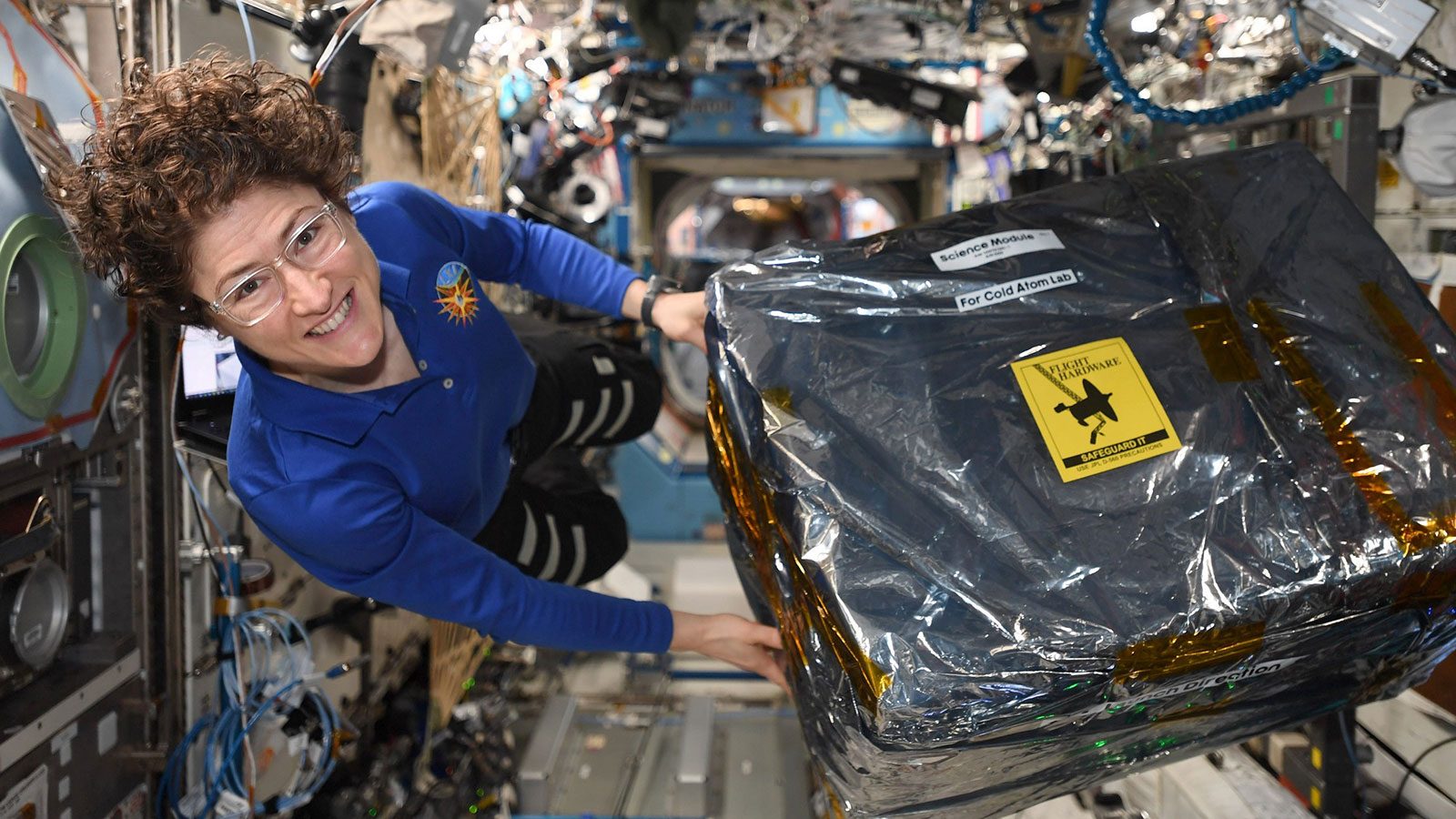
ISS astronaut Christina Koch unloads new hardware for the Cold Atom Lab.
Astronaut Christina Koch unloads new hardware for the Cold Atom Lab aboard the International Space Station the week of Dec. 9, 2020. NASA

The International Space Station (ISS) is the site of research into all sorts of topics, from whether microbes can survive in space to how building materials respond to low gravity to whether robots can assist astronauts in space missions. But some of the most intriguing work being done there is in the area of particle physics, as particle detectors in space can detect cosmic radiation which would be blocked by the Earth’s atmosphere.

Recommended Videos

Now, the ISS has taken custody of new hardware for another particle physics experiment: The Cold Atom Lab, which NASA says “conduct[s] a variety of experiments to help answer questions about how our world works at the smallest scales.”

The lab is the size of a mini-fridge and has been in operation on the ISS since July 2018. It chills atoms almost down to absolute zero, or minus 459 degrees Fahrenheit (minus 273 degrees Celsius), which is the lowest temperature possible at which particles essentially stop vibrating.

Using the lab, researchers are able to investigate topics like superfluidity, in which a fluid has zero viscosity and flows without losing kinetic energy, and superconductivity, when a material is cooled so much it has no electrical resistance.

The advantage of working with extremely low temperatures is that atoms normally move extremely fast — faster than the speed of sound — which makes them difficult to study. When the atoms are chilled to near-absolute zero temperatures in the Cold Atom Lab, they move at a literal snail’s pace, making them much easier for scientists to observe.

The new hardware for the lab includes an atom interferometer, which can measure gravity with high precision and help researchers examine fundamental theories of gravity.

In a blog post, NASA say this could lead to breakthroughs which would benefit both space exploration and our understanding of Earth: “Further development of this technology in space could lead to improved inertial-force sensors, which could be used to design tools for enhanced spacecraft navigation, to probe the composition and topology of planets and other celestial bodies, and to study Earth’s climate.”

Georgina Torbet
Georgina has been the space writer at Digital Trends space writer for six years, covering human space exploration, planetary…
You can now generate images with Gemini’s memory without paying a dime
Study guide created by Gemini

Google has made one of Gemini's most interesting AI tricks a lot easier to try. The company is rolling out its personalized image generation feature to eligible U.S. users for free, removing a paywall that previously kept it exclusive to Gemini's paid tiers.

Powered by Google's Nano Banana image model, the feature does more than generate pretty pictures; it taps into Gemini's understanding of you, making AI-generated images feel surprisingly personal.

Read more
Meta’s Brain2Qwerty v2 turns thoughts into text, and it doesn’t need brain implants
The latest AI model decodes brain signals into coherent sentences using external scanners.
Meta Brain2Qwerty v2 Featured

Artificial intelligence is getting surprisingly good at understanding humans. Now, Meta wants it to understand our brains too. The company has unveiled Brain2Qwerty v2, an upgraded AI system that can translate brain activity into full sentences, all without requiring brain implants or surgery. The goal isn't mind reading for the masses. Instead, it's to help people who have lost the ability to speak communicate again.

How a Brain-powered keyboard works

Read more
AI chatbots can often feed into your delusions. Researchers say you should look for three signs
Experts warn that chatbot design choices can reinforce unhealthy beliefs in vulnerable users.
ChatGPT on a smartphone

Artificial intelligence chatbots have become incredibly good at sounding human. But a new review paper by psychiatrist Marc Augustin and fellow researchers Thomas A. Pollak and Helen Morrin, published in NPP—Digital Psychiatry and Neuroscience, argues that existing AI research points to an overlooked psychological risk. The paper, highlighted by The Wall Street Journal, reviews previous studies and proposes a framework explaining how three common chatbot behaviors can combine to reinforce delusional thinking in vulnerable users, creating what the authors call an "amplification spiral."

Researchers say these are the three warning signs

Read more