  1. Home
  2. Emerging Tech
  3. News

Upcoming mission to Jupiter images the planet’s moons from here on Earth

Add as a preferred source on Google

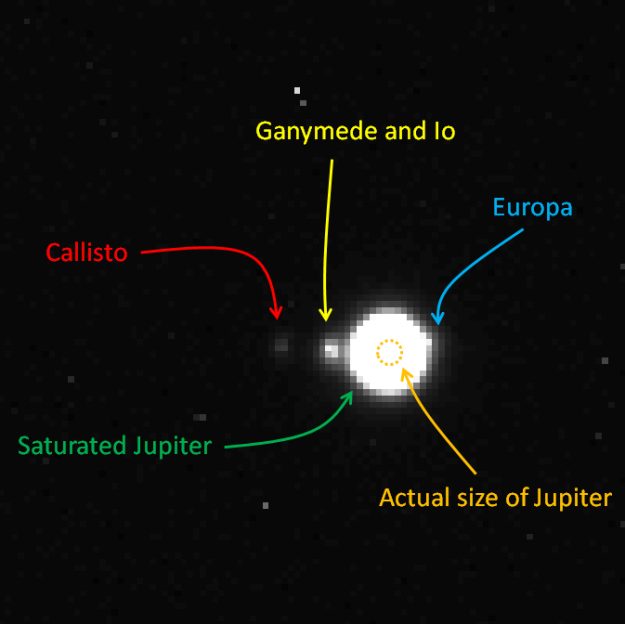
Jupiter system captured in JUICE NavCam test (annotated) Airbus Defence and Space

Jupiter has an abundance of moons, and astronomers continue to spot new ones and to make unexpected findings about the ones we’ve already seen. An upcoming mission from the European Space Agency, called the Jupiter Icy Moons Explorer, or JUICE, hasn’t even left Earth yet but has already imaged its target of the Jupiter system.

Recommended Videos

In the image above you can see the main glowing body of Jupiter, surrounded by some of its moons: Europa, Ganymede, Io, and Callisto. Jupiter appears larger than it really is due to the way the image is optimized, which brings out the details of the moons as much as possible.

“Unsurprisingly, some 640 million kilometers (nearly 400 million miles) away, the moons of Jupiter are seen only as a mere pixel or two,” Gregory Jonniaux, Vision-Based Navigation expert at Airbus Defense and Space, explained in a statement. “Jupiter itself appears saturated in the long exposure images needed to capture both the moons and background stars, but these images are useful to fine-tune our image processing software that will run autonomously onboard the spacecraft. It felt particularly meaningful to conduct our tests already on our destination!”

If you want a more detailed look at the targets, then ESA also released simulated images of what you can expect to see when JUICE gets up and personal with the moons. Using existing images of the moons Europa (left), Ganymede (middle), and Callisto (right), JUICE’s NavCam processed the data to create a simulation of what it should be able to capture once it arrives at Jupiter.
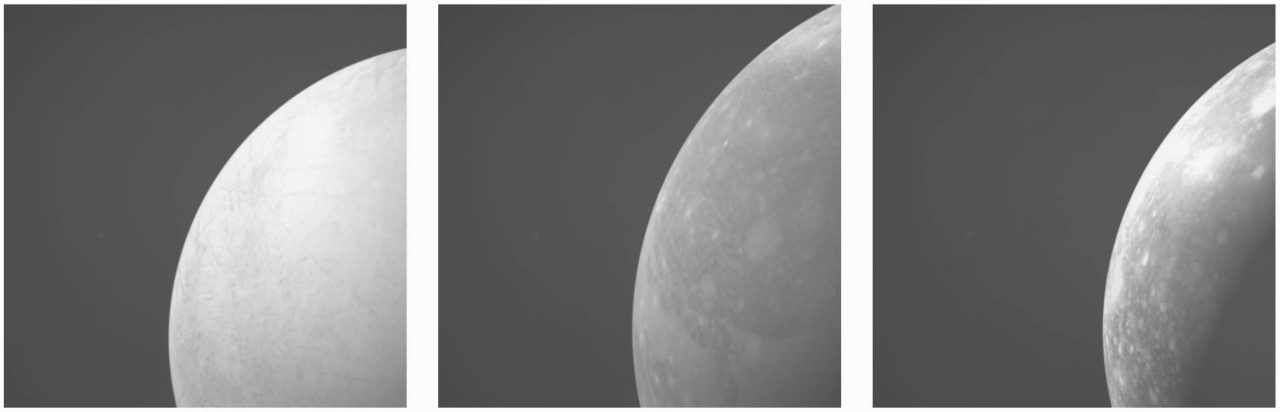
Simulated NavCam views of Jupiter moons Airbus Defence and Space

“The simulated views of the moons of Jupiter give a more realistic impression of what our NavCam will capture during flybys,” Daniele Gherardi, ESA Guidance, Navigation and Control expert, said in the same statement. “Of course, the high-resolution scientific camera suite will impress us with even more detail of these enigmatic moons.”

Another simulation built from existing images shows how the moons will be observed against Jupiter’s beautiful backdrop. This image shows Europa against the Jovian atmosphere, with the black disk representing the shadow that the moon would cast on the clouds below.
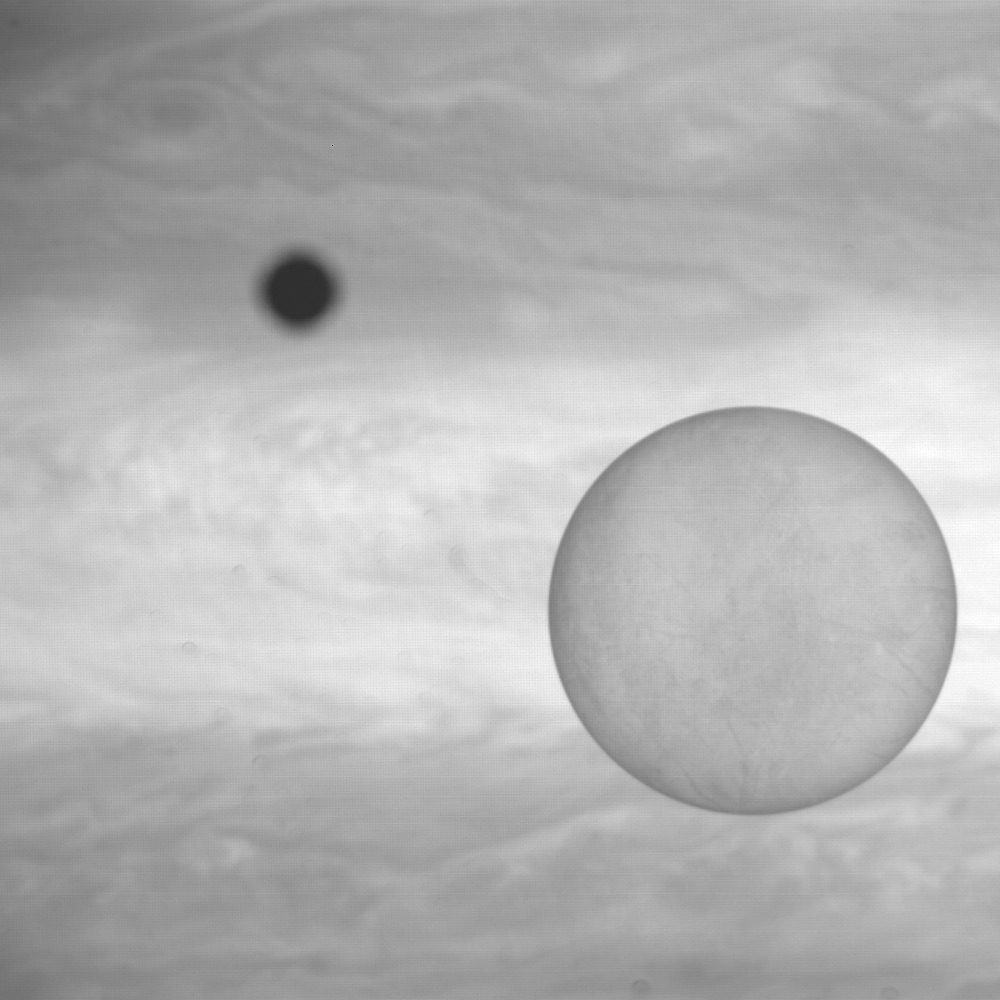
Simulated NavCam view of Jupiter and Europa Airbus Defence and Space

JUICE will launch in 2022 and will take seven years to reach the Jupiter system. Once it arrives it will not only take orbital tours around the planet but also perform a dedicated orbit around the moon of Ganymede.

Georgina Torbet
Georgina has been the space writer at Digital Trends space writer for six years, covering human space exploration, planetary…
Edge browser on mobile gets a huge upgrade that makes it a worthy pick over Chrome
Edge mobile gets smarter just before Chrome’s big Gemini moment
Microsoft Edge on a phone

Chrome is still the default browser for many smartphone users, but Microsoft’s latest Edge update gives them a practical reason to try something else.

Microsoft has announced a major Copilot update for Edge across desktop and mobile. The rollout comes ahead of Google’s Gemini-powered Chrome upgrade for Android, which is expected in June, giving Edge a chance to stand out on phones before Chrome’s next big AI push.

Read more
After flubbing with Siri, Apple plans to host AI agents on the App Store
One problem is about money Apple won't commit to not charging. The other is about AI agents Apple can't figure out how to control. WWDC needs to solve both.
Electronics, Mobile Phone, Phone

Apple is currently facing a Siri problem that has nothing to do with Siri at all. With WWDC 2026 just weeks away, The Information reports the company is actively courting developers to integrate their apps with the new Siri coming in iOS 27. 

The mechanism powering the overhauled Siri, App Intents, is an API that lets Siri execute actions inside third-party apps without you actively opening them, which sounds quite useful, I’d say. However, some of the world’s largest developers are dragging their feet on it, not because it’s tough, but because Apple left the door open on charging for it later.

Read more
EV batteries just need some AI top-up nudge, and they get a big 23% life boost, finds research
Charging fast and lasting long seemed impossible. A new AI trick says otherwise.
EV Charging

EV battery charging technology has always had to find the right balance between charging speed and battery longevity. If the charging speed is too fast, it wears down the battery. If the charging is too slow, nobody is happy. 

Researchers Meng Yuan from Victoria University of Wellington and Changfu Zou from Chalmers University of Technology in Sweden may have cracked this long-standing problem using an AI technique called deep reinforcement learning, and the results are pretty encouraging.

Read more