  1. Home
  2. Emerging Tech
  3. News

11 million names to be carried to Mars on NASA’s Perseverance rover

Add as a preferred source on Google

When it heads to the red planet later this year, NASA’s Perseverance rover won’t just be carrying scientific instruments — it will also carry the names of millions of space fans.

Last year, NASA launched its “Send Your Name to Mars” campaign in which members of the public were invited to submit their names to stenciled onto the rover. A tremendous 10.9 million people submitted their names, which have now been engraved onto silicon chips in a minuscule format using an electron beam. These chips, engraved with both names and winning essays from the “Name the Rover” contest, have now been attached to an aluminum plate on the rover which will launch on its journey to Mars later this year.

Recommended Videos

“The three chips share space on the anodized plate with a laser-etched graphic depicting Earth and Mars joined by the star that gives light to both,” NASA’s Jet Propulsion Lab explained in a blog post. “While commemorating the rover that connects the two worlds, the simple illustration also pays tribute to the elegant line art of the plaques aboard the Pioneer spacecraft and golden records carried by Voyagers 1 and 2. Affixed to the center of the rover’s aft crossbeam, the plate will be visible to cameras on Perseverance’s mast.”
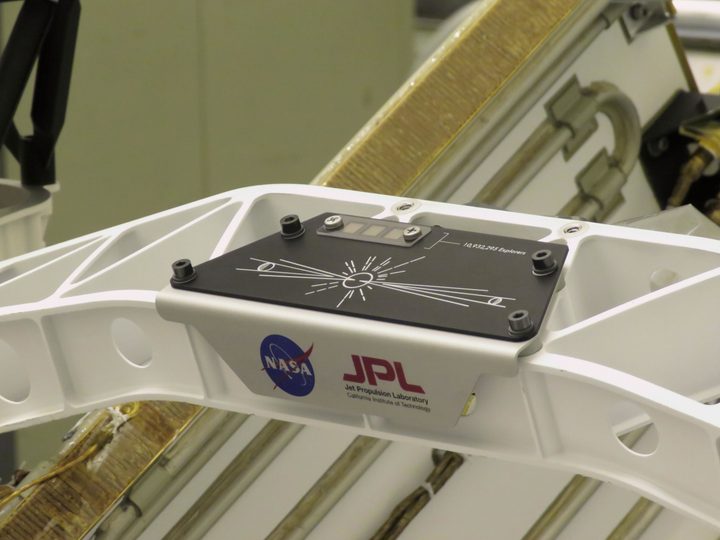
A placard commemorating NASA's "Send Your Name to Mars" campaign was installed on the Perseverance Mars rover on March 16, 2020, at Kennedy Space Center. Three silicon chips (upper left corner) were stenciled with 10,932,295 names and the essays from 155 finalists in NASA's "Name the Rover" contest.
A placard commemorating NASA’s “Send Your Name to Mars” campaign was installed on the Perseverance Mars rover on March 16, 2020, at Kennedy Space Center. Three silicon chips (upper left corner) were stenciled with 10,932,295 names and the essays from 155 finalists in NASA’s “Name the Rover” contest. NASA/JPL-Caltech

The Perseverance rover is almost ready for its mission, with installation of one of the final interior parts, the Adaptive Caching Assembly, recently completed. The plan is to launch the rover in July this year. Weighing just under 2,300 pounds (1,043 kilograms), it will be launched along with the Mars Helicopter aboard an Atlas V rocket.

Despite the global pandemic of coronavirus, officially called COVID-19, which has affected many areas of the space industry, NASA says that it is still on schedule to launch the Perseverance rover as planned. NASA has suspended some other programs, such as its Orion and Space Launch System projects, due to coronavirus outbreaks at or near several of its facilities, leading to employees being sent home to work remotely. However, other projects such as NASA and SpaceX’s launch of the Crew Dragon capsule are still intended to go ahead as planned.

Georgina Torbet
Georgina has been the space writer at Digital Trends space writer for six years, covering human space exploration, planetary…
Robots just ran the Beijing half-marathon faster than the world record holder
humanoid robot running a marathon

A humanoid robot just ran a half-marathon faster than the world record holder. It might not seem impressive at first, but considering last year, the fastest robot at Beijing's humanoid robot half-marathon finished in two hours and 40 minutes, this is a huge achievement. 

As reported by the Associated Press, the winning robot at this year's Beijing half-marathon crossed the finish line in 50 minutes and 26 seconds, comfortably beating the human world record of 57 minutes recently set by Jacob Kiplimo. 

Read more
As if the plate wasn’t already full, AI is about to worsen the global e-waste crisis
New report highlights a rising environmental concern
Stack of graphics cards and motherboards in a landfill site e-waste

AI is already changing how the world works, but it’s also quietly making one of our biggest environmental problems even worse. And no, this isn’t about energy consumption this time. It’s about the hardware. Because every smarter AI model comes with a physical cost.

AI is about to supercharge the e-waste problem

Read more
Smart glasses are finding a surprise niche — Korean drama and theater shows
Urban, Night Life, Person

Every year, millions of people follow Korean content without speaking a word of the language. They stream shows with subtitles, read translated lyrics, and find workarounds. But live theater has always been a different problem — you can't pause or rewind it. That's the problem: a Korean startup thinks it's cracked, and Yuroy Wang was one of the first to try it. The 22-year-old Taipei retail worker is a K-pop fan who loves Korean culture but doesn't speak the language. When he went to see "The Second Chance Convenience Store," a touring play based on a Korean novel that was a bestseller in Taiwan, he expected supertitles. What he got instead was a pair of chunky black-framed AI-powered glasses sitting on his nose, translating the dialogue in real time directly on the lenses. "As soon as I found out they were available, I couldn't wait to try them," he said. Wang is part of a growing audience discovering that smart glasses, a category of tech that has struggled to find mainstream purpose for years, might have just found their calling in the most unexpected of places: live Korean theater.

How do the glasses work?

Read more