  1. Home
  2. Emerging Tech
  3. News

NASA suspends work on Space Launch System and Orion, may delay moon mission

Add as a preferred source on Google

Following outbreaks of coronavirus, officially called COVID-19, at and around a number of its facilities, NASA has announced it is suspending both its Space Launch System and Orion projects. The suspension is described as temporary but it is not yet known how long it will go on for.

“NASA will temporarily suspend production and testing of Space Launch System and Orion hardware,” NASA administrator Jim Bridenstine announced in a statement. “The NASA and contractors teams will complete an orderly shutdown that puts all hardware in a safe condition until work can resume. Once this is complete, personnel allowed on site will be limited to those needed to protect life and critical infrastructure.

Recommended Videos

“We realize there will be impacts to NASA missions, but as our teams work to analyze the full picture and reduce risks we understand that our top priority is the health and safety of the NASA workforce.”
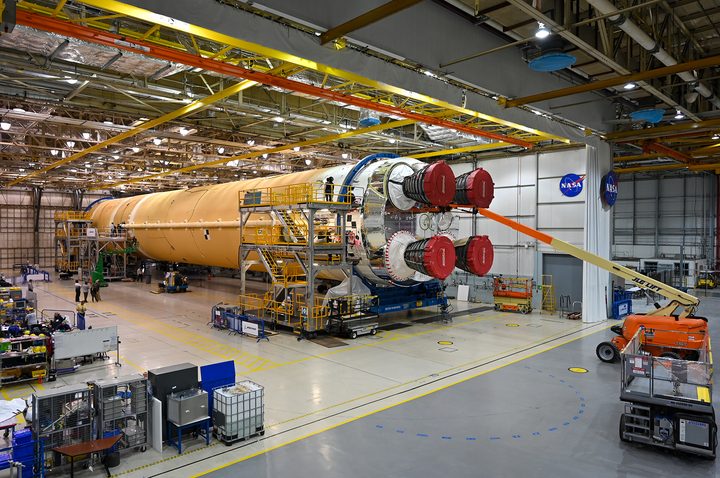
The Space Launch System (SLS) rocket core stage is prepared for shipping.
The Space Launch System (SLS) rocket core stage being prepared for shipping. NASA/Steven Seipel

The Space Launch System (SLS) is NASA’s next-generation rocket system for launching heavy payloads and deep space missions such as the Moon to Mars project. But it has suffered from multiple delays and a ballooning budget over the years, although assembly of the rocket was finally completed last year. Orion is the spacecraft currently in development for carrying astronauts to the moon, to be launched on SLS. It recently completed space environment testing and was set to be shipped to Kennedy Space Center for launch preparations.

The suspension of the production and testing of the rocket and craft may mean that the aimed 2024 launch date for the Artemis mission to the moon could be pushed back.

NASA has confirmed that an employee from the Stennis Space Center has been taken ill, as well as there being a rising number of COVID-19 cases in the community around this center and the Michoud Assembly Facility. The agency requested last week that employees work from home, before updating this request to a requirement on Wednesday.

Despite these issues, however, NASA has said that it still intends to go ahead with its May mission to send astronauts to the International Space Station (ISS) aboard a SpaceX Crew Dragon capsule. This would mark the first time American astronauts have been launched from American soil since the shuttering of the Space Shuttle program in 2011.


Georgina Torbet
Georgina has been the space writer at Digital Trends space writer for six years, covering human space exploration, planetary…
AI chatbots can often feed into your delusions. Researchers say you should look for three signs
Experts warn that chatbot design choices can reinforce unhealthy beliefs in vulnerable users.
ChatGPT on a smartphone

Artificial intelligence chatbots have become incredibly good at sounding human. But a new review paper by psychiatrist Marc Augustin and fellow researchers Thomas A. Pollak and Helen Morrin, published in NPP—Digital Psychiatry and Neuroscience, argues that existing AI research points to an overlooked psychological risk. The paper, highlighted by The Wall Street Journal, reviews previous studies and proposes a framework explaining how three common chatbot behaviors can combine to reinforce delusional thinking in vulnerable users, creating what the authors call an "amplification spiral."

Researchers say these are the three warning signs

Read more
Lost access to your crypto wallet? Don’t Google your way out of it
Security researchers warn that fake recovery tools are becoming the latest trap for crypto owners.
Bitcoin crypto wallet featured

Forgetting the recovery phrase to a crypto wallet can be stressful enough. Unfortunately, that's exactly the moment scammers are waiting for. A new warning highlights a growing scam in which cybercriminals disguise malware as cryptocurrency recovery software, tricking desperate users into handing over far more than just access to their wallets.

The fake recovery tool that's actually malware

Read more
Chinese AI lab says it can match Anthropic’s all-poweful Claude Mythos at sniffing security bugs
Security researchers say Z.ai's latest model can rival Anthropic's Mythos in one critical area.
China Z.Ai GLM-5.2 Featured Banner

For the past few weeks, Anthropic's Mythos has been viewed as the gold standard for AI-powered cybersecurity. That lead may already be shrinking. According to a new report from The Wall Street Journal, security researchers say Chinese AI startup Z.ai's GLM-5.2 can now match Mythos when it comes to finding software security vulnerabilities, even if it still trails Anthropic and OpenAI in broader reasoning tasks.

GLM-5.2 is closing the gap in one very important area

Read more