  1. Home
  2. Emerging Tech
  3. Wearables
  4. News

This groundbreaking bionic eye system restores lost vision with a retina chip

Add as a preferred source on Google

Clinical trials of a pair of smartglasses designed to help legally blind people to see and read letters again are currently taking place in two cities in the United States. The “bionic eye” technology is made by a Paris-based biotech firm called Pixium Vision. It consists of a visor-like pair of glasses featuring an embedded camera. Images captured by the camera are beamed to a microchip implanted in the wearer’s retina. This signal is then converted into electrical signals that can be understood by the brain.

Participants in the trial had no central vision prior to the microchips being implanted. One year after the chips were implanted, the majority have regained the ability to read to some extent. Some can read only individual letters, while others are able to read sequences of letters. The image created by the implant is just 378 pixels in total. While this is far from restoring a person’s vision to 20/20, it nonetheless represents a significant improvement.
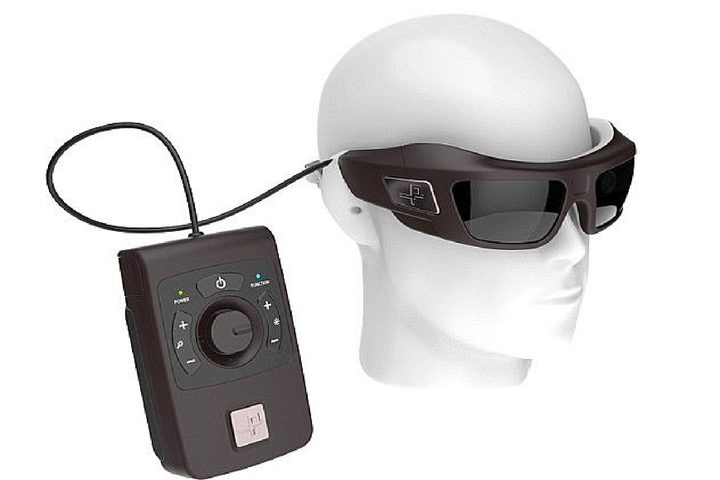
Image used with permission by copyright holder

The hope is that it could be used to treat patients with eye conditions such as macular degeneration, which cannot currently be reversed. Macular degeneration affects the area of the retina that is responsible for the central part of a person’s vision. As a result, people with extreme cases of macular degeneration can have the middle part of their frame of vision either severely blurred or entirely dark. Pixium Vision’s implant could also potentially be used to treat retinitis pigmentosa. This group of genetic conditions results in the progressive loss of photoreceptors in the eye. The technology can not be used for people who were born blind. That’s because it requires a fully developed optic nerve.

Recommended Videos

The current U.S. trials are taking place in Pittsburgh and Miami. Another, larger-scale study is planned to be carried out in Europe in 2020.

This isn’t the only smart technology being tested out for blind patients at the moment. Researchers at Houston’s Baylor College of Medicine are testing a device called Orion, which works in a similar way. It has already resulted in partial sight being restored to six participants in an experimental study.

Luke Dormehl
I'm a UK-based tech writer covering Cool Tech at Digital Trends. I've also written for Fast Company, Wired, the Guardian…
Self-powering shaking capsule shows the future of safe drinking water in the palm of our hands
Researchers say their battery-free device can detect contamination and eliminate harmful microbes using motion alone.
Water in Hands from Bottle

Access to safe drinking water remains a challenge for billions of people worldwide, but a new invention from researchers in South Korea could make the process much simpler. A self-powered floating capsule that fits in the palm of a hand can reportedly test water quality and disinfect unsafe water without relying on batteries, external power, or chemical treatments.

A simple shake is all this water purification capsule needs

Read more
Thanks to AI, a Chinese startup has figured out the priciest fusion energy bottleneck
Artificial Intelligence

For decades, fusion energy has been the ultimate promise of clean energy. It’s the process that powers the sun, capable of producing enormous amounts of energy without the carbon emissions associated with fossil fuels. Scientists have spent generations trying to recreate it on Earth, convinced that if they can make it work at scale, it could fundamentally reshape the world’s energy future. The problem is that fusion is incredibly difficult, not just from a scientific perspective, but from an economic one. Building and testing experimental reactors costs vast amounts of money, and progress often comes through a frustrating cycle of trial and error. Researchers develop a theory, build hardware to test it, gather data, tweak the design, and repeat the process. Sometimes that cycle takes years. Now, a Chinese startup called VeloAlpha believes artificial intelligence could help break that pattern.

Founded earlier this year by fusion scientist Xie Huasheng, the Beijing-based company is developing FusionAlpha, a simulation platform that lets researchers test fusion reactor designs digitally before committing to expensive physical experiments. It may not sound as exciting as a giant reactor generating limitless clean power. But if VeloAlpha’s technology delivers on its promise, it could end up solving one of fusion’s most expensive and persistent challenges.

Read more
3D printed batteries will solve battery anxiety, but not your nightmares
Batteries are finally thinking outside the box, thanks to 3D printing
Smartphone battery

For years, battery innovation has largely focused on chemistry. Companies have chased longer-lasting lithium-ion cells, safer solid-state batteries, and cheaper materials. But a quieter revolution is now gaining momentum, and it could fundamentally change how batteries are designed, manufactured, and integrated into devices.

Instead of improving what goes inside a battery, a growing number of startups and researchers are trying to change the battery itself through 3D printing. The idea is simple yet ambitious: create batteries that can fit into virtually any shape or structure rather than being limited to traditional cylindrical or pouch designs.

Read more