
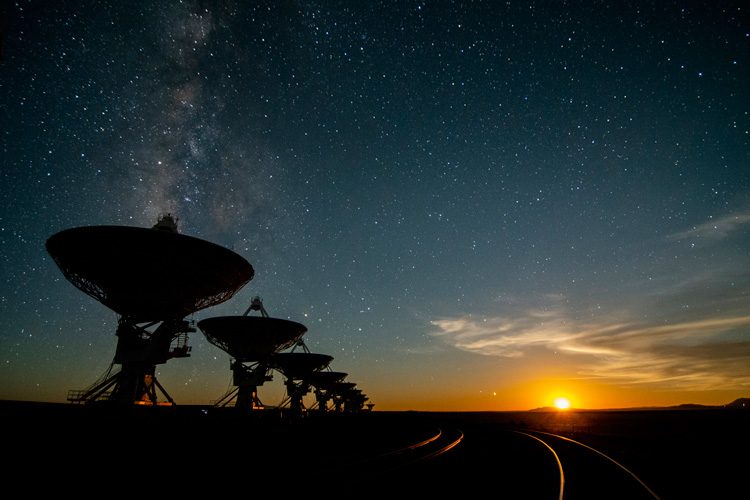
A new trove of data on the search for extraterrestrial intelligence (SETI) has been released, with members of the public invited to view and analyze the data for themselves. The group that released the data, the Breakthrough Listen Initiative, was founded in 2015 to collect data on SETI and to make it available in a public archive. Last year, the team shared nearly a petabyte of data on observations of nearby stars from radio telescopes. Now, even more data is being added to the archive.
“Since Breakthrough Listen’s initial data release last year, we have doubled what is available to the public,” Breakthrough Listen’s lead system administrator, Matt Lebofsky, said in a statement. “It is our hope that these data sets will reveal something new and interesting, be it other intelligent life in the universe or an as-yet-undiscovered natural astronomical phenomenon.”
The new data comes from two sources: The Green Bank Observatory in West Virginia and the Parkes radio telescope in New South Wales, Australia. It is the result of a survey of radio emissions from the center of the Milky Way.
“For the whole of human history, we had a limited amount of data to search for life beyond Earth. So, all we could do was speculate. Now, as we are getting a lot of data, we can do real science and, with making this data available to the general public, so can anyone who wants to know the answer to this deep question,” said Yuri Milner, the founder of Breakthrough Listen.
Searching the center of the galaxy
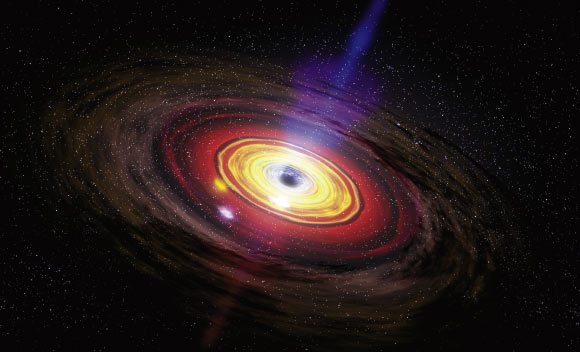
The project chose to focus on the center of the Milky Way because the researchers believe this area has the highest likelihood of showing evidence of intelligent life. Given the presence of the supermassive black hole there, civilizations could choose to construct technology there to harness its immense power.
“The galactic center is the subject of a very specific and concerted campaign with all of our facilities because we are in unanimous agreement that that region is the most interesting part of the Milky Way galaxy,” said Andrew Siemion of the University of California, Berkeley, Breakthrough Listen principal investigator.
There is also a theory that galactic centers could act as meeting points for civilizations, called Schelling points. “If an advanced civilization anywhere in the Milky Way wanted to put a beacon somewhere, getting back to the Schelling point idea, the galactic center would be a good place to do it,” Siemion said.
“It is extraordinarily energetic, so one could imagine that if an advanced civilization wanted to harness a lot of energy, they might somehow use the supermassive black hole that is at the center of the Milky Way galaxy.”
Looking for civilizations that could find us

One way to search for alien life is to consider that they could use some of the same methods to search for us that we use to search for them. For example, there’s the way that telescopes like NASA’s planet-hunter TESS detect exoplanets — by looking for dips in the brightness of stars when planets pass in front of them. The Breakthrough team has been analyzing radio emissions from 20 nearby stars where, if sufficiently advanced civilizations did exist, they could see Earth through the same method.
“This region has been talked about before, but there has never been a targeted search of this region of the sky,” Sofia Sheikh, a graduate student at Pennsylvania State University, said. “If other civilizations have telescopes like ours, they would know that the solar system has planets from their transits, and even know that Earth has life. That is how we have discovered thousands of other exoplanets, so it kind of makes sense to extrapolate and say that that might be how other intelligent species find planets as well. And if they know we’re here, they might be signaling us.”
A new source of data
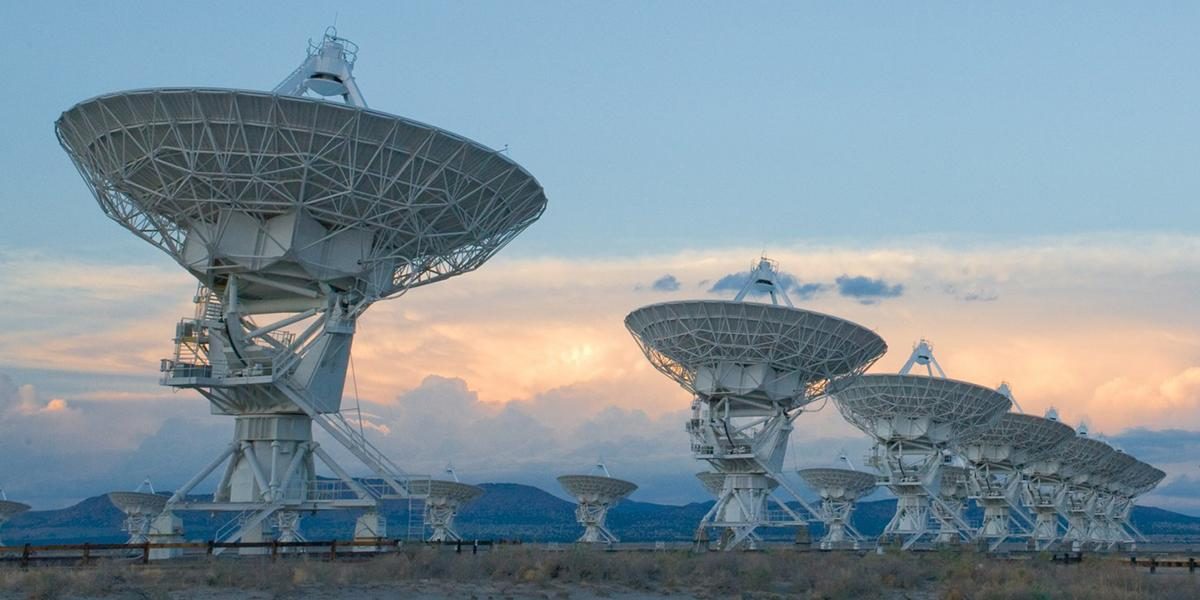
The search will be getting a boost soon with the addition of SETI capabilities to the National Radio Astronomy Observatory’s Jansky Very Large Array (VLA) in New Mexico.
“The SETI Institute will develop and install an interface on the VLA, permitting unprecedented access to the rich data stream continuously produced by the telescope as it scans the sky,“ said Siemion. “This interface will allow us to conduct a powerful, wide-area SETI survey that will be vastly more complete than any previous such search.”
“As the VLA conducts its usual scientific observations, this new system will allow for an additional and important use for the data we’re already collecting,” said NRAO Director Tony Beasley. “Determining whether we are alone in the universe as technologically capable life is among the most compelling questions in science, and NRAO telescopes can play a major role in answering it.”
The search goes on
In its analysis of data so far, the Breakthrough Initiative team has not found any evidence of alien civilizations. But the team remains hopeful that the search could provide useful scientific data all the same.
“We didn’t find any aliens, but we are setting very rigorous limits on the presence of a technologically capable species, with data for the first time in the part of the radio spectrum between 4 and 8 gigahertz,” Siemion said, referring to Sheikh’s work. “These results put another rung on the ladder for the next person who comes along and wants to improve on the experiment.”


