
Few franchises have stood the test of time like Star Wars — and even fewer droids. That’s what inspired Sphero, the Boulder, Colorado-based startup behind the remote-controlled Ultimate Lightning McQueen, Sprk, and Sprk+, to build R2D2, a remote-controlled robot that mimics its cinematic inspiration.
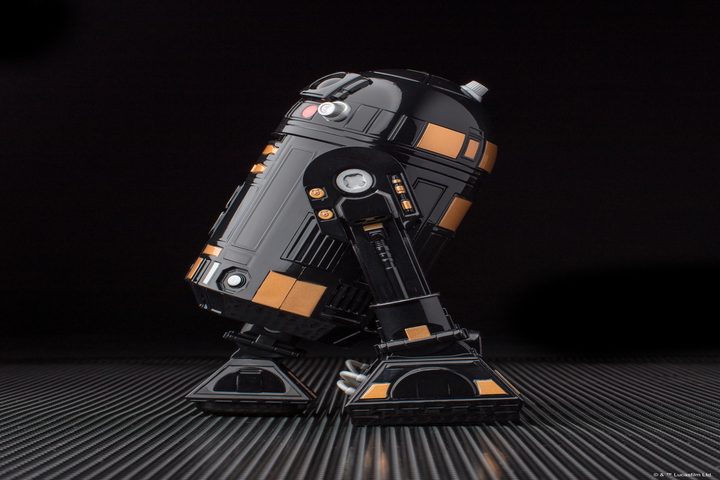
R2-Q5, a special edition model inspired by the Star Wars expanded universe, features a pitch-black finish with gold accents. (Adam Wilson, Sphero’s chief scientist, described it as R2D2’s Imperial-aligned “evil twin.”) It’s debuting at New York Comic Con this week, and will be available exclusively at Best Buy stores starting October 27.
Sphero’s R2D2, which launched earlier this year, is packed to the brim with circuitry. Four motors, two in its dome and shoulders and one in each of its bases, help it transition gracefully between a stationary, two-footed position and three-footed driving mode. Treads in the bottom of its three feet propel it forward on carpet, tabletops, and tiled surfaces, and a built-in speaker and LEDs — modeled after R2D2’s signature control panel and holographic projector — underline the droid’s emotions.


During an engineering period that lasted a year, Sphero’s team of animators modeled all of the R2D2 robot’s physical constraints to make sure it wouldn’t fall over when it wasn’t supposed to, or travel faster than the treads could handle. “We learned a lot of tricks from Ultimate Lightning McQueen,” Wilson said. “We wanted to bring the character to life, so we worked really closely with [Disney] to make sure it was nearly identical [to the movies].”
“We learned a lot of tricks from Ultimate Lightning McQueen”
R2D2’s gadgetry is more than just for show. The Droid dashboard, a new smartphone app that brings Sphero’s expanding Star Wars product lineup under one roof, puts Artoo at your command. You can direct the droid to perform one of nine canned animations, including a memorable reaction to Jawas in A New Hope. And, as with Sphero’s other remote-controlled droids, you can move the droid around to your heart’s content with a digital trackpad.
.gif)
When the novelty of driving a little R2D2 around the room runs its course, there’s more in store. The Droid app’s Patrol mode lets the Artoo robot surviel its surroundings, and a Draw and Drive tool lets you chart a course for R2D2 to follow. A brand-new activity, Holographic Simulation, lets you chart a course through iconic locations like the Millennium Falcon, Mega Star Destroyer, Resistance Cruiser, and Obi-Wan Kenobi’s House.


For Star Wars fans who like to tinker as much as young Luke, there’s an educational component. R2D2 can be programmed with Apple’s Swift language and Sphero’s own block-based language. Budding developers can translate the blocks to Javascript, if they wish, and tap into Sphero’s API for finer controls.
But R2D2 isn’t the only new droid in town. BB-9E, Sphero’s other new robot, is BB-8’s evil alter ego. The First Order droid features an inductively charged, magnetically attached dome with menacing blue-and-red LEDs, and a durable spherical body that navigates inclines with ease.

BB-9E’s primary controller is the Droid app. But just like last year’s BB-9, you can ditch the smartphone and opt instead for Sphero’s gesture-sensing Force Band, which lets you control the BB-9E by tilting your wrist. The in-app BB-9E experience is otherwise comparable to R2D2’s. The animations are a bit different, but the path-modeling and patrol mode work just like they do with Artoo.
Both droids are fun on their own. But there’s more you can do with both.
One of the Droid app’s highlights — Watch With Me — is sort of like Mystery Science Theater 3000, but with Sphero droids. Once you pair your robots and queue up a movie, R2D2, BB-9E, and whichever other droids you’ve paired with will start animating to plot points as they happen, cheering for their respective buddies at each twist and turn. And in a future update, R2D2, BB-9E, and BB-8 will react to each other as they come into contact.
R2D2 and BB-9E went on sale this past summer for $180 and $150, respectively. Sphero sold more than a million Buy Now units in 2015.
“It’s a lot of mixed emotions,” Wilson said. “But we’re bringing our dream out into the world.”
Update: Added news of the R2-Q5 special edition model.


