  1. Home
  2. Emerging Tech
  3. News

SwitchBot’s new robot could take household chores off your plate

Robot butlers are taking center stage at CES 2026.

Add as a preferred source on Google
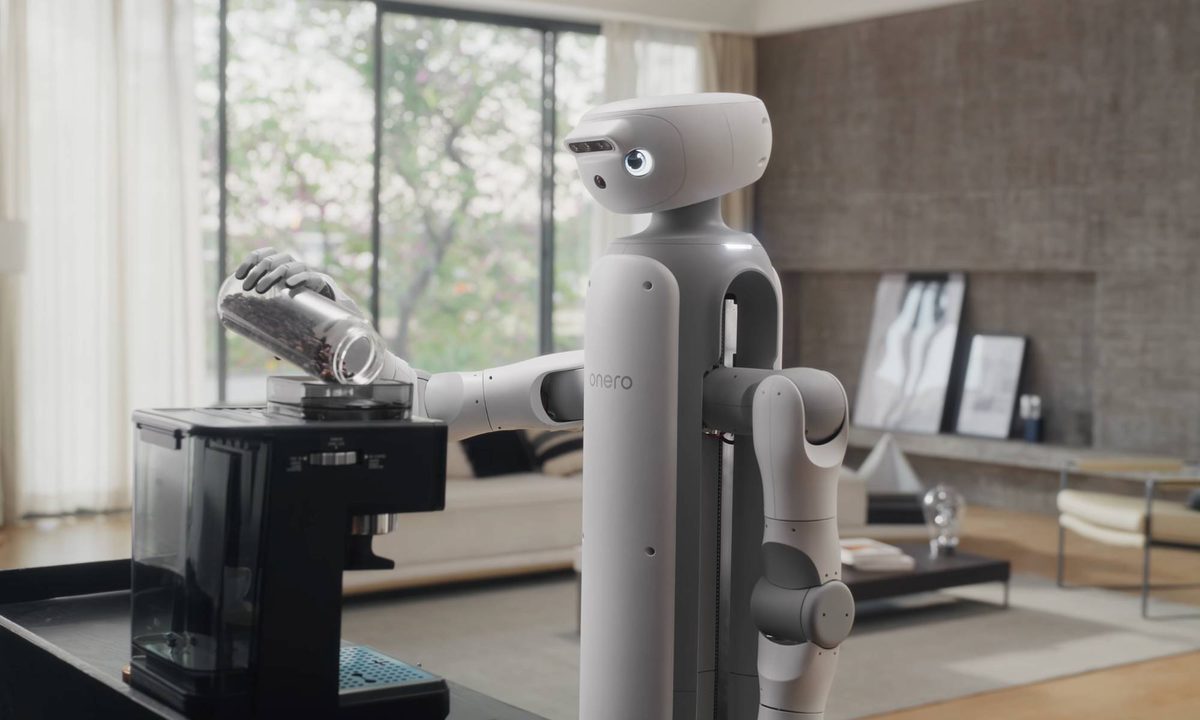
SwitchBot onero H1 making coffee.
SwitchBot

CES always brings a flood of futuristic tech, and this year, robot butlers are stealing the spotlight. LG has already teased its CLOiD robot, and SwitchBot is joining the fray with its first humanoid robot built to handle household chores.

SwitchBot says the onero H1 is a completely automatic and collaborative robot that can help users with a wide range of domestic tasks. The robot features two fully articulating arms with 22 degrees of freedom, giving it near-human dexterity.

Recommended Videos

The onero H1 scans its surroundings using multiple Intel RealSense cameras in its head, arms, hands, and abdomen, and processes the data with SwitchBot’s OmniSense VLA AI algorithm. According to SwitchBot’s marketing video, this lets the robot perform tasks like making and delivering coffee, cooking meals, rinsing dishes and loading them into the dishwasher, and even doing the laundry.

SwitchBot adds the robot can also integrate seamlessly into its broader smart home ecosystem, interacting with other smart devices to coordinate tasks. Unlike other humanoid robots we’ve seen of late, the onero H1 moves on wheels, which should allow for more stability and faster navigation around the house.

Pre-orders open soon, but the price tag is still a mystery

There’s no word on pricing yet, but SwitchBot plans to open pre-orders on its official website soon. How well it performs in real-world use remains to be seen. We’re keeping our expectations in check, especially considering the number of overhyped demos and hilarious fails we’ve seen lately.

Humanoid robots like the onero H1 hint at a future where daily chores could be automated, giving people more time for work, hobbies, or just to relax. While we’re still a long way from having fully capable robot butlers in every home, this year’s CES showcase suggests companies are serious about turning that sci-fi dream into reality.

Pranob Mehrotra
Pranob is a seasoned tech journalist with over eight years of experience covering consumer technology. His work has been…
Edge browser on mobile gets a huge upgrade that makes it a worthy pick over Chrome
Edge mobile gets smarter just before Chrome’s big Gemini moment
Microsoft Edge on a phone

Chrome is still the default browser for many smartphone users, but Microsoft’s latest Edge update gives them a practical reason to try something else.

Microsoft has announced a major Copilot update for Edge across desktop and mobile. The rollout comes ahead of Google’s Gemini-powered Chrome upgrade for Android, which is expected in June, giving Edge a chance to stand out on phones before Chrome’s next big AI push.

Read more
After flubbing with Siri, Apple plans to host AI agents on the App Store
One problem is about money Apple won't commit to not charging. The other is about AI agents Apple can't figure out how to control. WWDC needs to solve both.
Electronics, Mobile Phone, Phone

Apple is currently facing a Siri problem that has nothing to do with Siri at all. With WWDC 2026 just weeks away, The Information reports the company is actively courting developers to integrate their apps with the new Siri coming in iOS 27. 

The mechanism powering the overhauled Siri, App Intents, is an API that lets Siri execute actions inside third-party apps without you actively opening them, which sounds quite useful, I’d say. However, some of the world’s largest developers are dragging their feet on it, not because it’s tough, but because Apple left the door open on charging for it later.

Read more
EV batteries just need some AI top-up nudge, and they get a big 23% life boost, finds research
Charging fast and lasting long seemed impossible. A new AI trick says otherwise.
EV Charging

EV battery charging technology has always had to find the right balance between charging speed and battery longevity. If the charging speed is too fast, it wears down the battery. If the charging is too slow, nobody is happy. 

Researchers Meng Yuan from Victoria University of Wellington and Changfu Zou from Chalmers University of Technology in Sweden may have cracked this long-standing problem using an AI technique called deep reinforcement learning, and the results are pretty encouraging.

Read more