“Though the Aspire Z3 offers a beautiful display and functional design, below-average performance hampers its value is.”
- Simple but functional design
- Excellent display
- Good sound quality
- Silent operation and low power draw
- Plain exterior lacks style
- Performance is far below average
- No optional solid-state drive
- Competitors provide better value
“Why you can trust Digital Trends – We have a 20-year history of testing, reviewing, and rating products, services and apps to help you make a sound buying decision. Find out more about how we test and score products.“
The high prices of many premium all-in-one PCs makes it easy to forget the category’s greatest advantage is simplicity, a trait any buyer can appreciate at any price point. Small, basic all-in-ones can be a good choice for many consumers, but the competition among mid-range AiOs is fierce, making it hard for consumers to sort out the best from the rest.
One option is Acer’s Z3 series, a 23-inch touchscreen all-in-one that starts around $700 and maxes out just north of $900. Like the larger, more expensive AiOs we’ve reviewed in the past, the Z3-605 is basically a laptop hard nestled behind a display. Our review unit, a mid-range model with a Core i5-3337U and 8GB of RAM, sells for just $850.
That seems like a reasonable price, but as we mentioned, the competition is daunting. Dell and HP provide processors with better on-paper performance, and Asus and Lenovo have alternatives at very low prices. Can Acer’s Z3 carve out a niche among them?
Lots of plastic, lots of convenience
This AiO’s black plastic chassis wears its budget PC roots on its sleeve. There’s no attempt to class things up with fake aluminum, chrome trim, or acrylic panels. What’s offered instead is a slim, curved back with a simple stand that doesn’t offer any ergonomic adjustments (as is true of most AiOs) but is easy to set up. There’s even a handle on the rear of the display that makes lifting and moving the Aspire Z3 a cinch.
Overall, the quality of this AiO’s display is on par with systems that sell for hundreds more.
Another convenience anyone can appreciate is a selection of connectivity on the front of the PC, just below the display, which includes a headphone jack, a card reader, a USB 3.0 port, and a button for accessing display functions. Most devices in this category place such connections on either the right or left side, making them difficult to find and access without a brief search.
In addition to the front ports, the rear of the Aspire Z3 includes three more USB ports, one of which is 3.0, audio-out, microphone input, HDMI, and Ethernet. This selection of ports is good for a mid-range AiO.
A great display for the price
The Aspire Z3-605 surprised us with its beautiful 1080p touchscreen. Our tests showed the display capable of 97 percent of the sRGB gamut. Contrast at maximum brightness was 710:1, thanks largely to good black-level performance, but the screen does become bright enough for use in a sunlit room. Overall, the quality of this AiO’s display is on par with systems that sell for hundreds more. Only Dell’s expensive (and wonderful) XPS One 27 Touch is significantly superior.


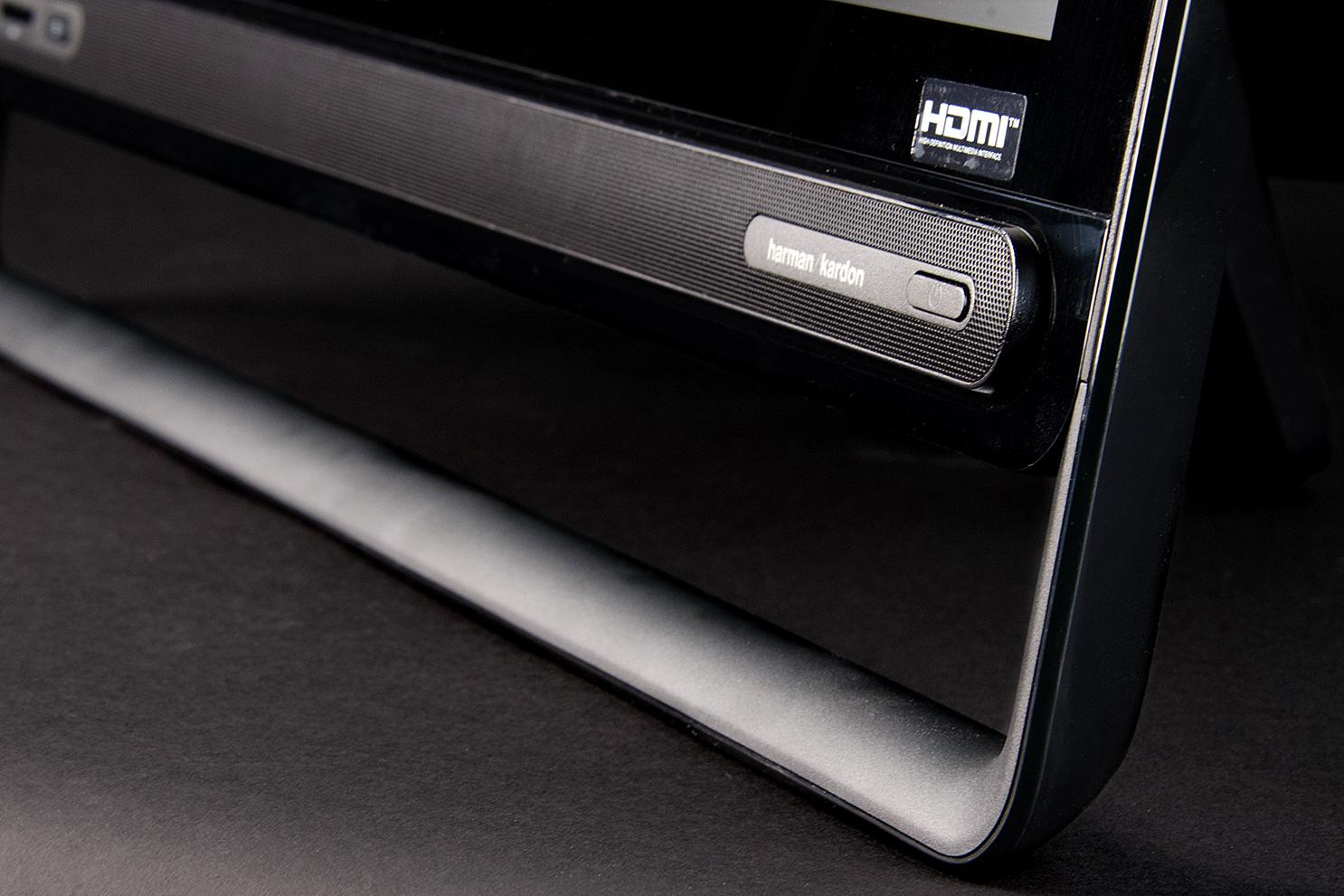
Audio quality matches visual performance with strong volume and good clarity throughout the mid-range. We did notice some distortion during bass-heavy music, as well as some rattling in the system’s chassis, but slightly reducing the volume solved these problems. The only unavoidable issue is sound staging, as the centrally located speakers struggle to accurately produce stereo sound.
Performance
Our Z3 review unit came equipped with a Core i3-3337U processor, the only choice for the Z3 line at the time of this writing. This is a mobile part (not a desktop part), and performance proved poor even compared to laptops. The SiSoft Sandra Processor Arithmetic result gave us 29.83 GOPs and the 7-Zip benchmark scored just 4,700 MIPS. These numbers are far behind the average for this category. Most AiOs at least manage respective scores of 35 GOPs and 6,000 MIPS.
While this AiO feels adequate in day-to-day use, the lack of speed can become noticeable during intensive tasks…
Graphics testing with 3DMark resulted in a Cloud Gate score of 3,103 and a Fire Strike score of 403. These numbers are typical for a 3rd-genartation Intel processor with HD 4000 graphics. While the Aspire Z3 can play many 3D games, detail settings will have to be low in most, and some games will only run smoothly at a resolution lower than the AiO’s native 1080p.
An acceptable pair of peripherals
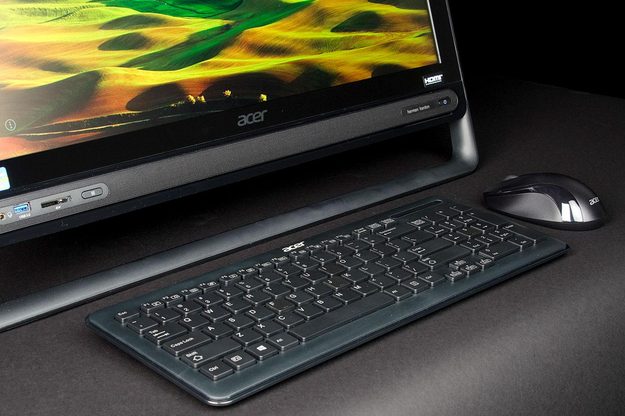
Though the Aspire Z3 is not expensive, it does come with a wireless keyboard and mouse, both of which are basic but do their jobs without any trouble. The keyboard is large enough and offers an acceptable typing experience; though it could use a few dedicated media buttons (those functions are instead accessed through a function hotkey, as on most laptops). Using the simple two-button mouse is pleasant, too, thanks to its compact size and light weight.
The value of silence
Fan noise is never an issue with the Aspire Z3, even during the most strenuous of tasks. We found that idle noise peaked at 40.3 decibels, and that number only increased to 40.9dB at load. This makes the Z3 among the quietest AiOs we’ve ever reviewed; most generate 43db to 45db at load. Fan noise can be heard in an absolute dead-quiet room, but even the slightest ambient noise can drown it out.
 Our wattmeter also turned in modest results, reporting up to 30 watts of consumption at idle and no more than 46 watts at load. These are, once again, great results, as many competitors consume closer to 40 watts at idle and up to 80 watts at load.
Conclusion
Acer’s Aspire Z3-605 is not the kind of product people will swoon over. No detective dramas will feature it in the background; no spenders will buy it to impress their friends. But that doesn’t mean the Aspire Z3 is undeserving of respect. Simple, inexpensive, and affordable, this $850 AiO boasts a beautiful display, plenty of storage, and good connectivity.
And that’s good, because one massive flaw scars this gem: performance. The processor served up scores well below average, and the slow mechanical drive does nothing to prop up the Aspire Z3’s numbers. While this AiO feels adequate in day-to-day use, the lack of speed can become noticeable during intensive tasks, such as editing a movie or compressing a large file. And you can forget about serious gaming, as the HD 4000 IGP is a poor match for the Z3’s high-resolution display.
The system’s lack of speed is unfortunate in light of alternatives like Dell’s Inspiron One 23 and HP’s Pavilion F270, both of which offer standard desktop processors while retaining a 1080p display. We haven’t reviewed those systems, but Acer’s AiO suffers substantially in a head-to-head specification comparison, which means competitors likely offer superior performance at roughly the same price.
Still, the Aspire Z3 has good connectivity and a wonderful display. If those traits are high on your list of priorities, and performance is not, you should give this system a chance.
Highs
- Simple but functional design
- Excellent display
- Good sound quality
- Silent operation and low power draw
Lows
- Plain exterior lacks style
- Performance is far below average
- No optional solid-state drive
- Competitors provide better value