I never had reason to give much thought to fast travel in games before starting Dragon’s Dogma 2. In most open-world games that include the feature, the only requirement for accessing it is reaching points of interest. Once players do so, they are generally free to zip from point to point around the map with little to no inconvenience. That isn’t how Dragon’s Dogma 2 operates — fast travel is based around a limited currency called Ferrystones — and it has completely changed my mindset on the mechanic as a whole.
There was a bit of buzz about how fast travel would be implemented prior to the game’s release. “Just give it a try. Travel is boring? That’s not true. It’s only an issue because your game is boring. All you have to do is make travel fun,” game director Hideaki Itsuno stated when speaking to IGN about Capcom’s limited approach to fast travel in Dragon’s Dogma 2. While I don’t fully agree with that statement, I’ll admit that Capcom didn’t just make travel fun in Dragon’s Dogma 2 — it made it terrifying.
Slow and steady
I didn’t even find the requisite item to fast travel until several hours into my playthrough, but by then, my mindset around navigating the world had been established. My first few adventures in Dragon’s Dogma 2 felt somewhat similar to my first Souls game in the sense that I fell into the trap of approaching it like a more traditional open-world RPG to disastrous results. My initial big mistake was underestimating nighttime.

I had ample opportunities during an early long journey to stop and make camp for the night, but I felt no need. My health was fine, no enemy had posed much of a threat thus far, and I had my lantern to guide my way. My tune quickly changed when a hulking monster stumbled from the shadows that had obscured it until it was mere feet away. While my pawns and I put up a valiant fight, one bad move cost me my life, and I was shoved back to my last autosave. It took four more deaths in a similar fashion before I learned my lesson and licked my wounds at a camp to wait for dawn.
Of course, travel isn’t just packed with danger. You can hardly run for a full minute without one of your pawns pointing out a strange location, remarking that there’s something to gather or offering to take you on a little diversion to a cave they know about. You could come across a tower with some loot or a caravan under attack by goblins, only for a Griffin to swoop down from the sky without warning. Unless you’re stubbornly set on mainlining your adventure, no two trips will be the same if you let yourself enjoy the journey itself. This is just one of many ways Dragon’s Dogma 2 demanded that I take its world seriously if I wanted to survive.
This is where fast travel comes in. What I found to be brilliant was that Capcom didn’t fully strip the feature out; it limited it to a consumable item. This evoked that same paranoia I know so many of us share that spurs us to hoard special items out of fear of wasting them. Only in Dragon’s Dogma 2, that feeling is intentional. Whenever I took a quest or had reason to go back to a location for one reason or another, I had a decision to make: Would I spend the gold to rest, take out some items I might need for the journey, and risk potentially encountering a massive overworld boss or getting caught in the wilderness at night, or burn one or two precious fast-travel items that I might not be able to replace?
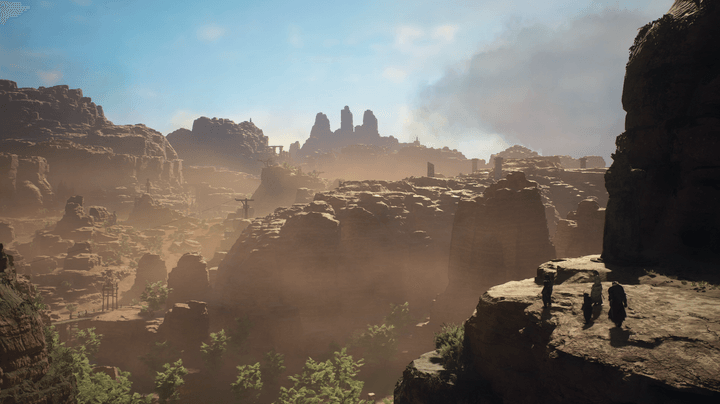
Interesting decisions like this wouldn’t exist if I could just teleport from one end of the world to the other freely. If the game hadn’t forced me, I know I would have fallen back on my old habits and robbed myself of all these emergent moments that I will be talking about for far longer than the main quest. There’s no doubt a limit to how many trips can feel fresh — there are only so many events in the game that can appear before I’d have seen them all — but I wouldn’t trade the experiences I got from them just to make things a little more convenient a few dozen hours later.
I don’t think fast travel in and of itself is a bad thing. What I do believe is that it has become such an expected mechanic that few games even attempt to push back on it and come up with creative ways to design around not having it. I don’t disagree with Itsuno’s quote because I believe he’s wrong, only that he’s selling what Dragon’s Dogma 2 does short. Fun is only a single emotion you will feel while bereft of fast travel.
After so many years of conditioning, I didn’t think I would be able to stomach such a large game forcing me to hoof it from end to end multiple times over. However, by the end of my journey, I now cherish those long hauls with my pawns and hope to see more games push themselves to come up with creative solutions that don’t rely on convenient shortcuts in their worlds.