In just a few weeks, one of the biggest games of 2025 will finally launch. No, I’m not talking about Grand Theft Auto 6 or Mario Kart 9. Monster Hunter Wilds releases on February 28 and it’s likely going to be one of the year’s big success stories.
That’s not something one would have expected a decade ago when Monster Hunter was largely regarded as a niche Japanese series. That’s rapidly changed since 2018 thanks to multiple hit games, a film adaptation, and even a surprising cameo in the Best Picture nominated film Tár. We’re now living in Monster Hunter’s world, and it’s about to get wild.
Ahead of its release, I played the first five hours or so of Monster Hunter Wilds, taking me all the way through its first chapter. What I’ve found so far is the series’ most confident entry yet; one that’s no longer trying to reshape itself for modern audiences, but rather already commands their attention from the jump. According to its creators, that was only possible thanks to Monster Hunter World, a game whose success and pain points helped create a more ironclad entry in a series whose star is on the rise.
Iterating on World
While I’ve demoed Monster Hunter Wilds before, this extended session gave me a fuller grasp on how the new entry compares to previous entries. When it comes to gameplay fundamentals, not much has changed. I choose my weapon, craft a bit of gear, and start hunting down monsters like Congalala, a farting ape. Battles are long affairs, with me picking away at a monster’s weak points and then chasing it across the environment when it tries to flee. It’s the same loop that’s helped the series grow in its 14 year lifespan.
But why has it grown if that’s the case? In an interview with Producer Ryozo Tsujimoto and Director Yuya Tokuda, the two acknowledged that the sea change came with 2018’s Monster Hunter World, a game that was designed specifically to turn the series into a modern “AAA” experience. The team says that tall task required a lot of homework, but it paid off. After that success, the team got right to work on architecting where they could go from there considering they’d hit a peak.
“Because Monster Hunter World was a game that was widely accepted, when we started working on Monster Hunter Wilds, we started thinking about what we really wanted to illustrate,” Tokuda tells Digital Trends. “The focus of Monster Hunter World was the nature and ecology of the monsters, but for Monster Hunter Wilds we wanted to put the focus on the people and the hunter that lives in the world. Using World as a base, we upgraded a lot of the things we could do now with the technology and updated the ecology.”
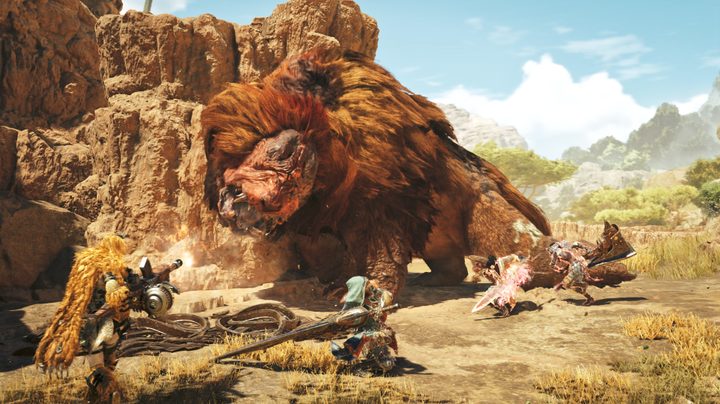
When Tokuda discusses updated technology, he’s no doubt referring to the fact that Wilds was built with a new hardware generation in mind. The benefits of that tech is what’s most immediately apparent to me during my demo. Previous Monster Hunter games were a bit segmented, as players would accept a hunt and then load into a map to chase it down. This time, it’s all seamless, with no loading in its open biomes.
It’s not just about reducing a few seconds of wait time; that decision has an impact on the pacing of the narrative too. The monsters I’m dealing with in Chapter 1 feel more naturally connected into the story, as they’ll pop up in cutscenes or intersect with other hunts. That’s most apparent with the first chapter’s Alpha Doshaguma, a furry monster who rears his head throughout my demo. It doesn’t feel like a critter that only exists once I load into the right hunt, but like something that’s always lurking out there in the desert.
In World, many people couldn’t reach the target monster that they were supposed to in the early stages of the game.
That’s just one of many subtle, but impactful changes that Wilds brings to a winning formula. According to Tokuda, Wilds wasn’t just shaped by what World did well, but by its problems too. With a much wider set of data to work with thanks to its largest audience ever, the team was able to identify friction points that were making some players bounce off of World early and smooth them over with Wilds.
“In World, many people couldn’t reach the target monster that they were supposed to in the early stages of the game,” Tokuda says. “They had trouble finding it. They tended to do other things that weren’t the main quest. So for Wilds, to address that, we added Seikrat. If you’re riding, it will semi-auto lead them to where they’re supposed to go.”
That small feature is a Godsend in a game that can feel overwhelming when you pull up its map full of icons. I got a little lost early in my demo as I was unable to find my main objective among a sea of icons. To get around that, I simply had to press up on my D-pad to let my trusty mount walk me towards my prey. Quality of life considerations like that are baked in right from the friendlier onboarding experience.
“Because we have 14 weapon types available, people had a lot of difficulty finding a weapon that really matched their game style,” Tokuda says. “They might have thought that the greatsword was a great fit for them, but when they actually played it, it was way too slow for their liking. But they didn’t want to go out and try the other 13 weapons to find what was the right fit for them so they stopped playing. It’s hard to find what really fits you if you don’t really know what kind of weapon each one is. So in Wilds, we have Alma asking you questions at the very beginning, asking what kind of gameplay you prefer. Is it technical? More powerful? And then she makes suggestions based on your choices.”
A full ecology
I start to feel much grander changes the deeper I get into my demo. Naturally, the deeper emphasis on character and story is a notable difference. I spend a lot of time during my session talking to NPCs at my base and getting a better sense of the world. It almost feels like I’m more in the busybody world of Dragon’s Dogma 2 than Monster Hunter, but with a more cinematic sheen.
Though Tokuda notes that characters were more the focus than the ecology this time, the latter is what stands out the most in the first chapter. There are certain moments during quests where my character will slowly, automatically walk forward through a biome. In those moments, I can pivot the camera to look around and click on points of interest around me to learn more about my surroundings. These small moments, ones where the camera focuses on little critters and explain how they fit into the food chain, reveal just how serious the team is when it comes to creating functional ecosystems, rather than video game maps that it can drop random monsters in.
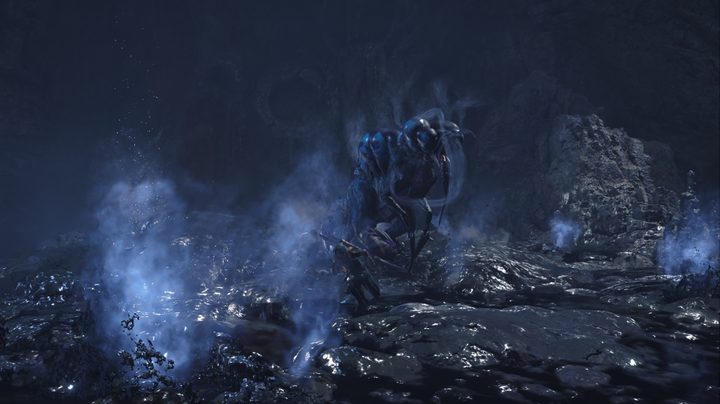
Tokuda goes in depth on that design philosophy when we discuss one of the demo’s new monsters, Rompopolo. The first monster players face in an oil basin biome, Rompopolo is the stuff nightmares are made of. It’s a mantis-like bug with an inflating sack on its backside. That’s filled with poison, which it can inject into the ground to cause an explosion. It’s the series’ creepiest critter to date, even outdoing the arachnid Nerscylla — another beast I slayed during my demo in a tense battle that had me avoiding herds of tiny spiders as I fought atop a web. Rompopolo’s design wasn’t a random one built to freak players out.
“When we think of monster designs, we always begin with the game design and the ecology of the locale that the monster is supposed to be in,” Tokuda says. “And also taking into consideration the period the monster would be in. What would be on top? What would be below that? In the Oilwell Basin, Rompopolo is basically the first monster you encounter. Because the basin has lots of mud and gas and oil, we wanted to have a monster with very tricky gameplay. So we thought about using gas and poison; maybe it inserts its tail in the mud and creates an explosion. Based on this idea, the designer thought about a gas mask-type design.”
That’s the kind of thought that only becomes visible during a long demo session. Through my five hours, I could feel that care was put into constructing sensible power hierarchies and creatures whose bodies feel like they were birthed from environmental adaptation. Uth Duna, Chapter 1’s big bad, is an incredibly fierce boss that feels like an apex predator next to the sand-dwelling Balahara. On the flipside, Rompopolo feels like a grunt that would exist in that space with its gassy body built to withstand a poisonous world that almost looks like it belongs in a FromSoftware game. And it’s a great fight, to boot, as my teammates and I all need to know when to push our momentum and deflate its sack or retreat back before it poisons us all.
Monster Hunter’s success isn’t an accident. It’s this attention to detail that helped the series slowly transform into a mainstream phenomenon over its lifespan. As much as the team credits World with pushing it over the edge, that game couldn’t have done that without a compelling foundation to build on; one that doesn’t just imagine monsters as bosses to be slain, but as creatures living in a real world that players want to live in. Based on what I’ve played thus far, I can imagine a lot of fans taking up residence in Wilds for a very long time.
Monster Hunter Wilds launches on February 28 for PS5, Xbox Series X/S, and PC.