Like many, Gen Urobuchi, the creator of NetEases’s Rusty Rabbit, didn’t have much to do during the COVID-19 lockdown. Rather than binge a new show, pick up a new hobby, or dive deep into a book, he decided to create a 2.5D Metroidvania. This ultimately became a way for Urobuchi to express himself and process his feelings during this time. Some of us made bread during the pandemic; Urobuchi made a game about a race of adorable, gruff-voiced bunnies inheriting the Earth after humans abandoned it.
We were all going through it in our own way.
During Anime Expo 2024, Digital Trends chatted with Urobuchi, game producer Yuichiro Saito, and leading voice actor Takaya Kuroda (Kazuma Kiryu in the Like a Dragon series) about how creating a game with such an out-there premise helped Urobuchi navigate the pandemic and the creative process that helped bring a wacky idea to life.
Rabbit habits
Rusty Rabbit tells the story of rabbits becoming Earth’s dominant species after humans leave due to a new Ice Age. As time progresses, the rabbits discover human tech and greatly misinterpret much of what was left behind. It’s a wacky premise, but one that came from an apocalyptic moment in the real world. Urobuchi explained that he chose rabbits as the game’s main focus because he came across a rabbit drawing on Twitter during the COVID-19 lockdown. This ultimately led Urobuchi to experiment with the Unity Engine.
“I started making the video game in Unity Engine, and there was a free asset robot with a free asset bunny that I put together,” Urobuchi tells Digital Trends. “I started making the story because I like storytelling. So I started adding more and more to the story that way.”
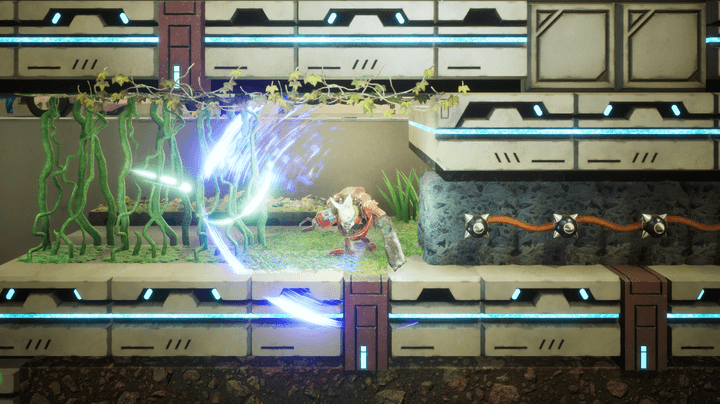
Urobuchi knew from the start that Rusty Rabbit would be a 2.5D Metroidvania because the genre was “the most attractive way of seeing this character was to see their profile.” It wouldn’t have the same appeal if players were “looking at the back of their heads the whole time.” After seeing the picture that inspired him to make Rusty Rabbit, Urobuchi knew that he wanted the rabbit and the robot to be visible to players at all times.
The development process became a way for Urobuchi to express himself and process his feelings during the pandemic; Rusty Rabbit became a “journal” for Urobuchi. This made the creative process especially unique for him because, for most of his projects, Urobuchi usually comes up with an idea that he writes around. That wasn’t the case for Rusty Rabbit.
“I had these daily ideas that were like these short little essays, so I kind of pieced them together and made sure that I built moments of surprise. So that the story was engaging to follow,” Urobuchi says.
I think back in the day, there was this idea that being manly means being a martyr.
One of the ideas that made it into the final game was the use of the beloved real-world character Peter Rabbit. In the story, the fictional character is worshiped as a god after Earth’s rabbits take it a little too literally. It becomes their bible, and a religion forms around it, with the rabbits believing that they are god’s chosen people and Peter is their savior. Urobuchi settled on Peter Rabbit because it reminded him of a simpler time in his life.
“I think it was because Peter Rabbit sort of shows the good old days kind of,” Urobuchi says. “There’s this sort of old school ‘back in the day’ feel that I liked.”
While Peter is a pious hero that the rabbits look up to, the game’s main character, Stamp, almost acts as a direct foil to the cartoon prophet. Instead of being friendly and cuddly, he’s a grumpy old man who loves to drink and chain-smoke carrots. The idea of making Stamp a hard-boiled bunny came from a traditional way of thinking what a “man” should be. “I think back in the day, there was this idea that being manly means being a martyr,” Urobuchi says. “So that is definitely a part that became a part of it.”
Like a rabbit
Urobuchi wanted players to know that even though Stamp is adorable and furry, he’s still meant to represent the kind of “manliness” that Rusty Rabbit seeks to satirize. To get that across, enlisted the help of Yong Yea and Takaya Kuroda, who both voice the English and Japanese versions of Kazuma Kiryu in the Like a Dragon series. After all, if you’re going to make a commentary on masculinity, why better embodies that in video games than Kiryu? It’s an unlikely collaboration, but one that made perfect sense to a voice actor as seasoned as Kuroda. He tells me that he ultimately lent his voice to Stamp because he felt that Rusty Rabbit was “very rich.”
“The script for Rusty Rabbit is really fantastic. It’s very rich, it’s long, and stories that are this deep are very rare,” he says. “I usually have fewer lines in a game. So, in this game, it was different in that way. It’s also very serious, but it’s a comedy. It’s hard to tell where the story is going. Really, the fantastic script was what attracted me initially.”

When Kuroda was in the booth recording his lines, one of the things that helped him bring Stamp to life was the theater of the mind. Once Kuroda felt like he genuinely understood Stamp, he put a picture of him in the booth and visualized what Stamp would be doing as he read the script. Imagine Kuroda in a recording booth meditating on an anthropomorphic bunny the same way he would the grizzled Kiryu. It’s a delightful image that embodies what makes Rusty Rabbit feel so special. It’s a playful project for everyone involved, but one that the team is treating as seriously as they would any other game.
Rusty Rabbit launches on September 24 for PlayStation 5 and PC.