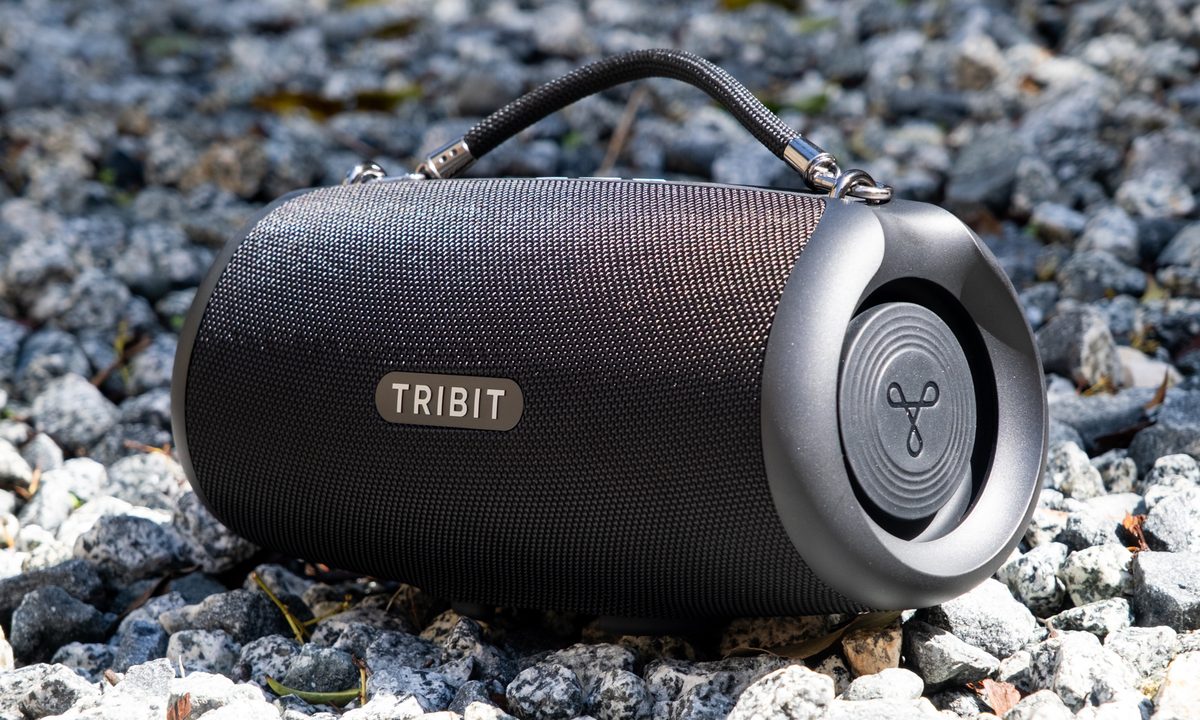

“Not only is the Tribit StormBox Lava the best mid-size Bluetooth speaker in the $130 price range, it's the best option for anywhere up to $200.”
- Excellent audio for the price
- Comes with handle and shoulder strap
- AUX input and USB for charging
- Solid battery life
- App is well-designed
- Default tuning isn't great
- Design is a little boring

“Why you can trust Digital Trends – We have a 20-year history of testing, reviewing, and rating products, services and apps to help you make a sound buying decision. Find out more about how we test and score products.“
The Bluetooth speaker market is totally saturated. Between high-end options from the likes of Bose, home options from companies like Sonos, and budget options from Anker’s Soundcore brand, there’s well and truly something for everyone. Tribit has been around for some time now, but the company seems to have renewed focus with some of its recent releases — and with speakers like the new Tribit StormBox Lava, it looks poised to seriously challenge Anker’s dominance.
The StormBox Lava is kind of built to do it all. It’s big, but not massive. It has a handle for portability, and an understated look for it to fit naturally in a home. Those are often the kinds of speakers that fail spectacularly, really not serving any use-case. Can the StormBox Lava overcome that, and truly be a great all-rounder at a reasonable price?
Tribit StormBox Lava: Specs
| Price | $130 |
| Size | 12.2 x 5.8 x 6.0 inches (WxDxH), 5.1 pounds |
| Connectivity | Bluetooth 5.4, 1 x 3.5mm AUX input, USB-C, USB-A |
| Water/dust resistance | IP67 |
| Battery life | 24 hours |
Design and features
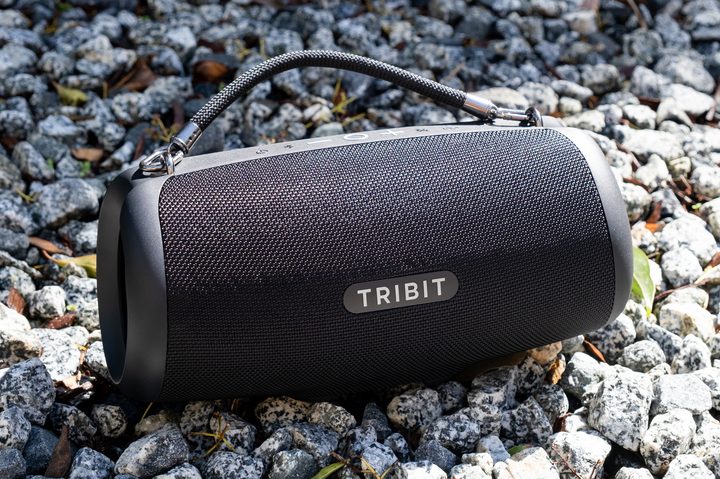
The Tribit StormBox Lava certainly isn’t built for ultra-portable use, but it’s also not overly big and bulky like the Tribit StormBox Blast 2. Measuring 12.2 by 5.8 by 6.0 inches and weighing in at 5.1 pounds, it could fit in a backpack if you wanted it to (though you probably wouldn’t use it this way), and its the perfect size for throwing in the back of the car with your other picnic supplies.
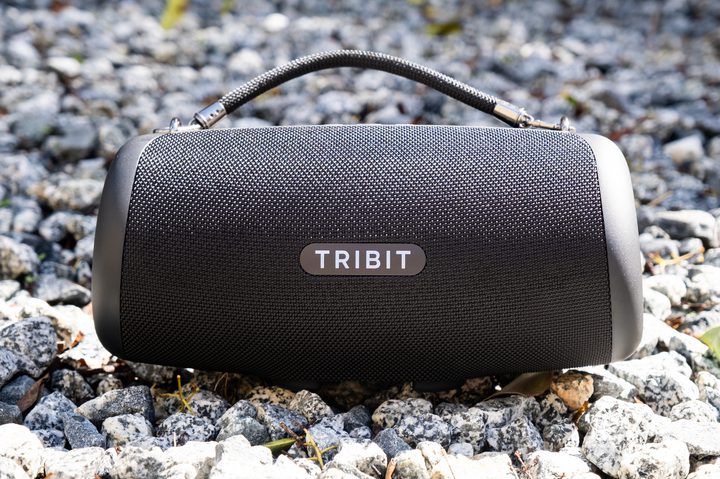
It’s not necessarily the most unique-looking speaker, though. With an all-black exterior, the speaker is a little more subtle than the likes of the Soundcore Boom 2, with its light-up LEDs. Some, of course, will prefer that approach anyway though.
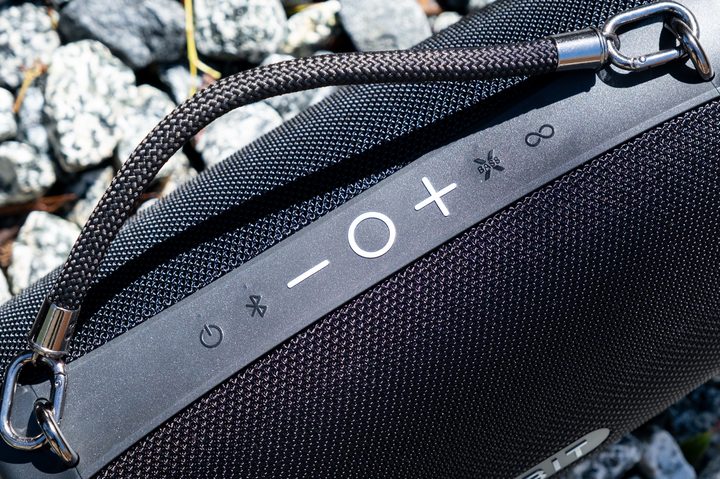
The StormBox Lava packs a solid 24-hour battery life, which is on the upper end of Bluetooth speaker battery lives. For even heavier users, you’ll get at least a few days of juice from the speaker, while lighter users might stretch days into weeks. On top, you get a helpful set of controls, including power, Bluetooth pairing, volume, playback, an “XBass” button for extra thump, and a button to link it up with another speaker for TWS (True Wireless Stereo) mode. There’s also a playback button that can play and pause audio when it’s pressed once, skip to the next track with a double-press, or to the previous track with a triple press.
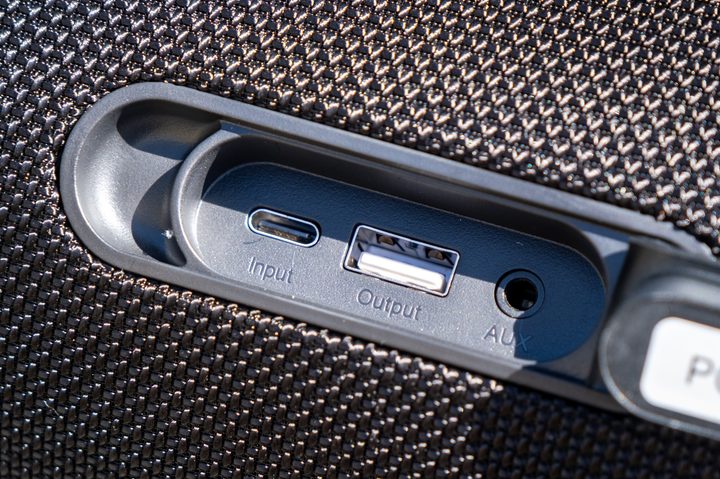
Flip it around, and you’ll find a rubber-sealed door covering the ports. There’s a USB-C port to charge the speaker, a USB-A power output port to charge up your other devices, and a 3.5mm AUX input if you want to go wired. The build feels relatively durable, with a fabric mesh cover that seems like it can handle most day-to-day use. A rubber foot on the bottom keeps it stable on flat surfaces too, which is handy.
Thanks to its IP67 rating, the StormBox Lava can take a bit of rough treatment. Technically, that rating means it can survive a dunk in the water at up to 3 feet, though it’s not built for that and you probably shouldn’t intentionally submerge it. That said, rest assured that you can use the speaker near the pool or at the beach without having to worry too much about it getting wet. You can even use it in the rain, if you’re one of those care-free people that hangs out in the rain (I sprint from my front door to my car).
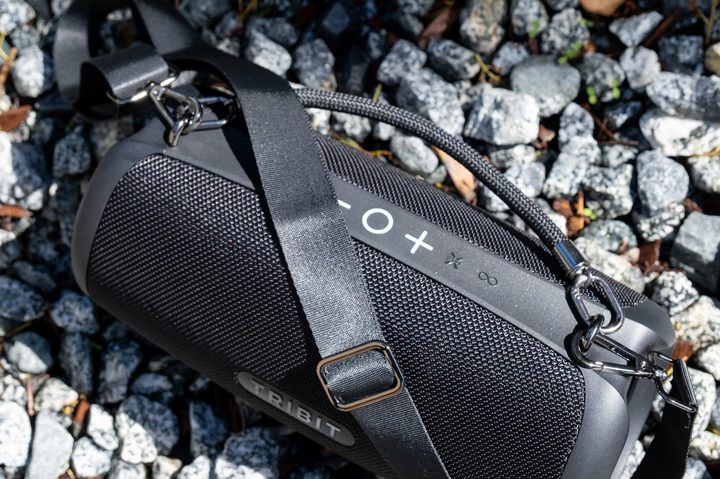
In the box, you get a braided nylon handle and a shoulder strap, making it easy to carry around, plus a USB-A to USB-C cable. A straight USB-C to USB-C cable would’ve been nice, but I do really appreciate the inclusion of both the handle and the strap.
Tribit app
The Tribit app is well-designed and easy to navigate, broken up into a few different tabs for different aspects of controlling the speaker. The main screen shows you the battery level of the Lava, lets you control playback, and lets you upgrade speaker firmware.


The second tab is for EQ. You’ll get six presets, but beyond that, you can create a custom EQ curve with 10 bands ranging from 50Hz to 13kHz. That’s impressive — it’s common for budget speakers to offer a five-band EQ, if they have a custom EQ feature at all.
The final tab is the settings menu, where you can tweak basic features like auto-shutdown and voice prompts. While the app isn’t the most feature-rich out there, it looks good and works well.
Sound and performance
Under the hood, the Tribit StormBox Lava offers dual 70mm 30-watt neodymium woofers, and dual 30mm 10W silk dome tweeters, for a total output of 80 watts. It plays in stereo, and has a frequency range of between 43Hz and 20kHz. It also offers Tribit’s own TI amplification chip, which Tribit says help deliver a clear and balanced sound. The speaker supports the AAC and SBC Bluetooth codecs, but unfortunately there’s no hi-res support here.
Generally, the audio response was actually pretty clear, though to make good on those claims of “balance,” you’ll want to mess with the EQ a little. Some of the presets are fine, but none of them really sounded like what I wanted. Creating my own mostly fixed that.
Of course, even creating your own EQ curve can’t magically make the speaker produce frequencies it physically can’t produce. Overall, the speaker offered good bass response, but on some tracks that lean into sub-bass, some of that lower content was missing. A good example of this was Trentemøller’s Chameleon, which has a lot of sub-bass throughout the track — much of it was completely lost here. That’s not to say the speaker doesn’t handle bass well though — that track in particular is unforgiving in the bass department, and frankly, the speaker performed better than the vast majority of alternatives this size and this price.
On other end of the spectrum, the speaker delivered pretty good detail. To be clear, you’re not going to get the high-end detail characteristic of much more expensive speakers, and the StormBox Lava doesn’t support hi-res audio. But, with a custom EQ curve that pushed the highs up a little, I was pleasantly surprised with what it was able to deliver. On a track like AC/DC’s Back in Black, the hi-hat was decently vibrant, and the guitar solo offered plenty of bite.
As far as volume goes, the StormBox Lava should get loud enough for 95% of users in 95% of use-cases, but don’t expect the huge sound of the larger StormBox Blast 2. At home, I largely stuck to around 50-60%, occasionally pushing it when a track I was really excited about came on. I never listened at 100%, except simply to test the speaker for a few minutes — and afterwards, I immediately brought it back down for fear of upsetting the neighbors. It’s worth noting, however, that most of my listening was done at only around six feet away from the speaker.
I did notice a little distortion in the bass starting at around 75% volume, but it wasn’t over the top, and I suspect most listeners won’t really notice it. What you might notice also isn’t a big deal, but is a bit of a quirk — when you change volume, the speaker kind of cuts out for a split second, then adjusts to the new volume. It felt a little choppy, and initially I was worried I was having Bluetooth issues, but then I noticed this only happened when the volume was changed — both on my phone, and on the speaker itself.
Despite the quirks and the frequency range limitations, the StormBox Lava sounds excellent for a speaker in this price range. Perhaps the best direct competitor is the Anker Soundcore Boom 2, which I’ve personally tested too. While I didn’t have the Boom 2 handy to A/B test with, the StormBox Lava offered better bass and high-end extension than I remember the Boom 2 offering.
The bottom line
The Tribit StormBox Lava proves that Tribit means business. For $130, you’re getting a speaker that can actually sound quite good with a little effort put behind the custom EQ, plus you’ll get a solid battery life, a well-designed app, and extra features like a USB port to charge your phone with. Again, perhaps its best competitor comes from the Buy at Amazon , and while you might like the more interesting look of the Soundcore speaker, the Tribit StormBox Lava beats Anker in sound quality and connectivity, while offering the same rated battery life. Not only is the Tribit StormBox Lava is the best mid-size Bluetooth speaker in the $130 price range, it’s the best option for anywhere up to $200.