
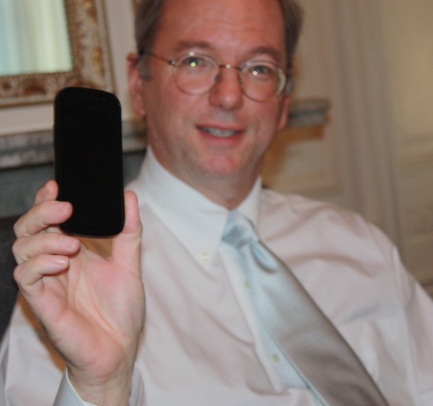
 Eric Schmidt is hoping you’ll swipe your phone instead of your credit card when you reach the checkout counter. At the Web 2.0 Summit in San Francisco, the Google CEO held up an unidentified new Android phone (speculated to be the Nexus Two) which has a near-field communications chip built into it, reports CNET. Schmidt believes that smartphones embedded with these chips could eventually replace standard credit cards.
“This could replace your credit card,” said Schmidt. “The reason this N.F.C. chip is so interesting is because the credit card industry thinks the loss rate is going to be much better, they’re just more secure.”
Credit card companies think so too. A near-field communication chip allows wireless data transfers, similar to RFID chips in some credit cards, but more secure because of the short range (4 centimeters) of the device. Standard credit cards use a magnetic strip that users swipe across a reader. But would this mean you couldn’t get gas if you’re phone died?
Schmidt couldn’t resist the urge to get creepy about the technology. “Imagine I’m walking down the street and instead of typing my search, my phone is giving me information all the time; it knows your store preferences,” he said. “It is likely to drive a very, very large mobile e-commerce business.”
More products, more problems
During his talk, Schmidt also commented lightly on the myriad of controversies facing Google right now including Street View privacy, holiday raises, Facebook’s new email announcement, and social networking. His answers were mostly vague or dodgy.
“We agree that social information’s very important, in particular the name value graphs that they generate,” he said when asked about Google’s plans for social networking. “We can produce a better search result with your permission. Information that is anonymous about what your friends are doing is made available as one of the many signals we provide.”


