

“The Zenfone 5Z has everything a modern smartphone should at a seriously tempting price.”
- Affordable
- Fast performance
- Classy design
- Good camera
- Loud dual speakers
- Software isn’t too polished
- Derivative design
- No water resistance, wireless charging
“Why you can trust Digital Trends – We have a 20-year history of testing, reviewing, and rating products, services and apps to help you make a sound buying decision. Find out more about how we test and score products.“
In the age of thousand-dollar smartphones it’s nice to have more affordable options. The Asus Zenfone 5Z offers an impressive array of features and flagship specs but costs half the price of Apple’s iPhone X or Samsung’s Galaxy Note 9.
Naturally there are compromises lurking here, beyond the derivative design, but there’s enough going on to make this a compelling prospect for anyone shopping for a new smartphone. If you’re the kind of person who insists off-brand cereal tastes just as good, then the Asus Zenfone 5Z is for you.
Attractive, but derivative design
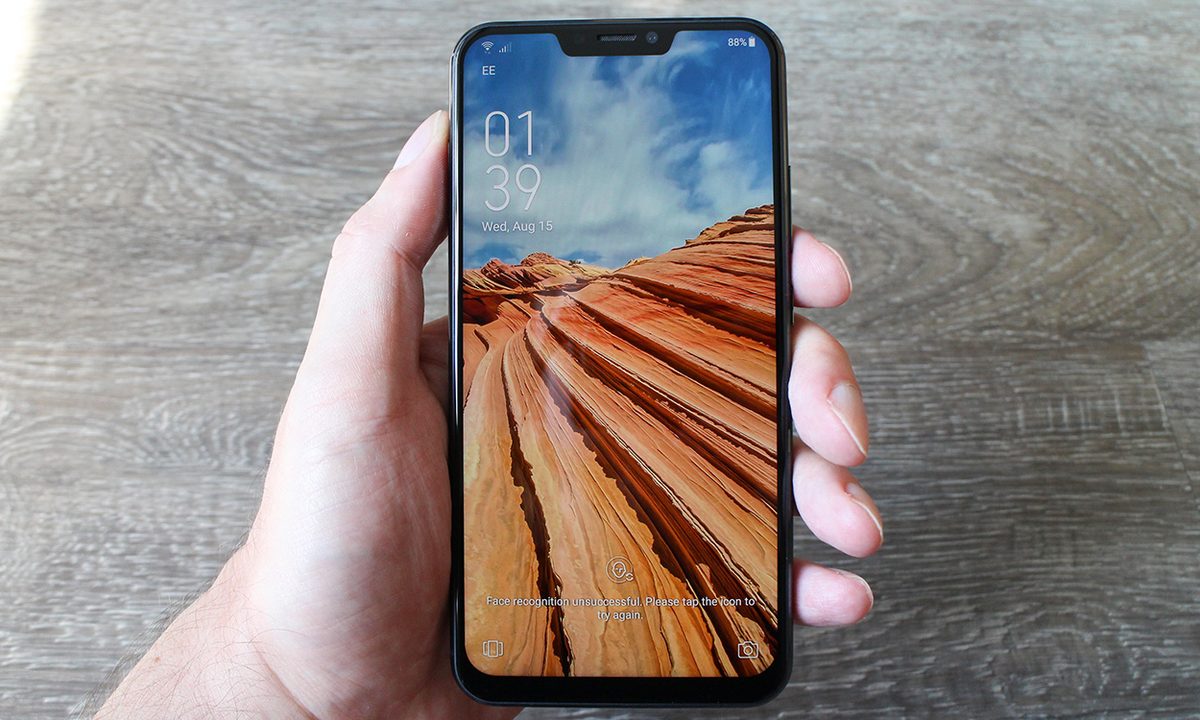
At first glance, you can easily mistake this phone for the iPhone X — that’s no accident. When the Zenfone 5 was unveiled at Mobile World Congress earlier this year, it prompted us to ask why are Android phone makers embracing the notch? They’re aping Apple’s design, but as soon as you look a little closer, you’ll see some important differences.
For starters, the notch — which carves into the 6.2-inch display — is slightly smaller. There’s also a noticeable bezel at the bottom of the screen. Flip the phone over and there’s a fingerprint sensor in the middle of the rear. The dual camera sensor sits at the top left, but the flash module is just below instead of inside it. The bottom edge is home to a USB Type-C port and a headphone jack, while the right edge houses the power button with a volume rocker above it.


If you’re not familiar with the minutiae of smartphone design, you could easily mistake the Zenfone 5Z for an iPhone X, and more than one person asked us if it was Apple’s flagship during the first week we were using it.
It’s quite a big phone, but we found it comfortable to use one-handed. The glass sandwich design is common, but it does mean falls are heart-stopping if you don’t have a case. Thankfully, Asus provides a clear case in the box with the Zenfone 5Z.
At first glance, you could easily mistake this phone for Apple’s iPhone X — that’s no accident.
With a resolution of 2,246 x 1,080 pixels and an unusual 19:9 aspect ratio, this isn’t the greatest display around, but we found it bright and readable in most circumstances. As an IPS LCD screen, it lacks the deep blacks of leading OLED screens, and colors can appear washed out at times. It’s not a bad display by any stretch of the imagination, but it can’t match the AMOLED in perhaps its closest competitor – the OnePlus 6.
We’re not big fans of the notch, but it can be hidden if you prefer. Asus is far from the only manufacturer pursuing this kind of design, and the Zenfone 5Z surprised us by drawing admiring glances and comments from people.
Asus has packed in dual speakers, which are impressively loud for a phone. The Zenfone 5Z is also Hi-Res Audio (HRA) certified, and we’re glad to see a headphone jack. Audiophiles can dig into the custom equalizer to tweak the sound if they so desire.
Silky performance
Just like nearly every other flagship Android phone released this year, the Asus Zenfone 5Z relies on Qualcomm’s Snapdragon 845 processor, which is backed by an ample 6GB of RAM. This is a blazing fast smartphone as the benchmark results suggest:
- AnTuTu 3DBench: 269,332
- Geekbench 4 CPU: 2,448 single-core; 8,995 multi-core
- 3DMark Sling Shot Extreme: 3,779 (Vulkan)
Samsung’s productivity powerhouse — the Galaxy Note 9 — scored 273,992 in AnTuTu, but it costs literally double the price of the Zenfone 5Z. A closer competitor at just $30 more is the OnePlus 6, which scored 269,191 in AnTuTu. All three of these phones pack the same processor, so the comparable performance shouldn’t be a big surprise. Although impressive, the Asus Zenfone 5Z isn’t the cheapest phone we’ve used recently that offers this kind of power – the Xiaomi Mi Mix 2S got very similar scores and can be imported for $400.
There’s a lot more to a phone than the raw power it packs. While scrolling around and jumping in and out of apps and games was generally smooth with the Zenfone 5Z — and it ran everything we tried without breaking a sweat — there were occasional hiccups that stopped it from shining.
The Zenfone 5Z had no trouble with games like Tiny Tower and PUBG: Mobile, but Shadowgun: Legends was a little choppy at times. It ran well once it got going, but we did also notice the back of the Zenfone 5Z got hot to the touch after 10 minutes of blasting aliens.
Shaky software
Our Zenfone 5Z review unit crashed during setup, which would be more understandable if it was supplied well in advance of release, but this phone is on sale now and sports the final software. We thought we might be in for some trouble, but thankfully, that was the only crash we’ve encountered so far.
It runs Android 8.0 Oreo out of the box and the latest security patch is from June 5 this year. We have an old S7 Edge that has already been updated to the same Android version, but has a newer security patch, so we can’t help feeling a little disappointed in Asus. Maybe Android 9.0 Pie would be too much to expect, but the OnePlus 6 is running Android 8.1 and came out months before the 5Z. This doesn’t bode well for future updates, though Asus has promised the Zenfone 5Z will get Android 9.0 Pie.


You’ll find ZenUI 5.0 on top of the Android platform, and it’s fairly attractive. It has been scaled down compared to previous versions, but there are still quite a few extra apps of dubious usefulness like Mobile Manager and Selfie Master. There are also some tweaks in the settings, which look a lot like Samsung’s Experience UI with wireframe color icons over white.
Two things repeatedly annoyed us about the Asus software: Firstly, the battery icon is too close to the time at the top right of the notification bar. It may sound trivial, but it’s something you can’t unsee and it really annoyed us, especially since it’s so unnecessary.
If you’re looking for the compromises that allow this phone to cost half what the iPhone X does, then software is where you find them.
The other issue was the constant pop-ups about Page Marker. We weren’t sure what Page Marker was, and a search in the app drawer revealed no results. Turns out it’s a Chrome add-on for saving web pages to read offline, and we were able to locate it in the settings and toggle it off, but before we did there were frequent notifications about it running in the background.
Asus also offers Twin Apps, which is handy if you have more than one account for something like Facebook as it allows you to use both simultaneously. There also a BeautyLive option in case you want to apply one of those skin-smoothing, eye-widening beauty filters over your face and stream in real-time.
If you’re looking for the compromises that allow this phone to cost half what the iPhone X does, then software is where you find them. It’s little things. Sometimes the rounded notification cards would be squared off, or an overlay would pop up when it shouldn’t and conflict with what was underneath. There’s just a lack of polish and the odd visual glitches feel like a slip of the mask that reveal the cheaper phone beneath.
There is a face unlock option that uses the selfie camera to unlock the phone. It works swiftly if there’s enough light, and it’s convenient. But there were occasions it inexplicably didn’t work at all, even in good light, and Asus admits it’s not the most secure method of unlocking your phone. There is a perfectly good fingerprint sensor on the back if you don’t want to use the face unlock, so it’s not a big issue.
Accessible and capable camera
The camera has become an important battleground for high-end smartphones in recent years and it’s one of the main areas where the gap between a $1,000 phone and something half the price, like the Zenfone 5Z, can often be felt.
Asus is ticking all the boxes here with a dual-lens main camera that combines a 12-megapixel lens with an f/1.8 aperture and a wide-angle 8-megapixel lens with an f/2.2 aperture.


The main lens features Sony’s flagship IMX363 sensor with optical image stabilization, and we know it’s capable of great things, but much depends on the tuning and software. We were pleased with the results the Zenfone 5Z camera garnered, particularly outdoors in good lighting.
Details are captured in all their glory, and the HDR really kicks in on some shots to show the complex light in the sky contrasting with glinting waves in the sea. The color correction also works well, as most shots captured the natural colors we were seeing.
We were also impressed with the low-light performance, though there’s inevitably more noise. The Zenfone 5Z is generally fast to snap a shot, but the shutter speed drops in low light to wring the best results out of your environment. It means there’s more of a pause and you must try to keep still, or you’ll get some blurring, but photos in dark environments are better than we expected.


Switching to the wide-angle lens dramatically drops the quality of your photos. It’s a nice option to have, but everything looks blurry by comparison with the main lens and it can’t cope with strong contrast between light and dark areas.
There’s also a portrait mode with a simple slider that lets you control the focal length. It’s not perfect, but if you’re keen on portrait shots with that blurred background, bokeh effect, the Zenfone 5Z delivers more often than not and it’s easy to use.


With Pro mode, you can delve into the camera capabilities and finetune everything to suit your needs, which is a nice option. Asus also says that there is artificial intelligence scene detection at work in the automatic mode behind the scenes here, but since it doesn’t show its workings, it’s hard to tell what difference it makes.
The front-facing camera is an 8-megapixel affair with an f/2.0 aperture and it’s perfectly adequate for selfies and video calls. It does also have a software-based portrait mode, but it’s not good, often blurring the wrong spots. Asus also offers ZeniMoji, which pops up during video calls or when you’re streaming. It allows you to talk as a character, like an owl or cat, but it doesn’t work anywhere near as well as Apple’s Animoji or even Samsung’s AR Emoji.
The Zenfone 5Z camera is a major step up from most mid-range phones.
The Zenfone 5Z camera is a major step up from most mid-range phones. In a shootout with the iPhone X or Huawei P20 Pro, you might see why those devices are more expensive, but this camera delivers a lot for the price and we think it will please most people.
Average battery
Asus has packed a 3,300mAh battery into the Zenfone 5Z, and it generally saw us through the day with a little left in the tank.
With normal use, which is likely quite heavy by average standards, we generally had somewhere around 20 or 30 percent left at 10 p.m. and so nightly charging was a necessity. We use scheduled Do Not Disturb and found the Zenfone 5Z only lost 4 percent overnight.
There’s no support for wireless charging, which is a bit disappointing as the glass design would accommodate it. It thankfully supports Qualcomm’s Quick Charge 3.0 technology, and can charge up quickly when plugged in with the provided charger — it went from zero to full in less than two hours.
Price, Availability, and Warranty information
The Asus Zenfone 5Z costs $500 and you can buy it from Amazon right now. It will work on GSM networks like AT&T and T-Mobile, but not on CDMA networks like Verizon or Sprint. Unfortunately, it does not currently support T-Mobile’s Wi-Fi Calling feature.
Asus offers a standard 12-month warranty for the Asus Zenfone 5Z which covers manufacturing defects and faults.
Our Take
The Asus Zenfone 5Z packs in a lot for the money. It’s fast and features a capable camera, but there are compromises lurking in the software.
Is there a better alternative?
Yes. The most obvious competitor for the Asus Zenfone 5Z is the OnePlus 6 which offers an OLED screen and a higher level of polish, for just $30 more. It’s a slightly better phone.
If money is tight, take a look at the Nokia 6.1 or the Moto G6, both of which can be had for less than $300. You can learn more in our best cheap phones guide. If you’re willing to spend a bit more, then take a look at the Samsung Galaxy S9 Plus or the Google Pixel 2.
How long will it last?
You should be able to get two to three years out of the Zenfone 5Z if you look after it. Asus has promised it will at least be updated to Android 9.0 Pie, but we’re uncertain how long that will take and what, if any, updates it will get beyond that. The phone is wrapped in glass, so a case is necessary to ensure drop protection, and there’s no IP-rated water resistance.
Should you buy it?
Yes, but only if you have a hard limit of $500 for your next phone and you do not want to buy the OnePlus 6. The Zenfone 5Z is a good alternative.


