Let it not be said that BlackBerry isn’t persistent. Following a rough beginning to the year — the company reported first-quarter device sales of 500,000 units, a dip from the 2.1 million the firm sold during the same period in 2014 — the company is angling for a comeback. It released the DTEK50, “the world’s most secure” Android smartphone, in July to some fanfare. And on Tuesday, it took the wraps off the DTEK60, a high-end handset with proprietary security software that BlackBerry contends in among the most advanced on the market.
If the DTEK60 looks a little familiar, that’s because the phone’s not exactly Blackberry through and through. In accordance with the company’s decision to end all internal hardware development last month, the DTEK60, like the DTEK50 before it, is the product of a third party — in this case, Alcatel manufacturing partner TCL Communications. It’s not exactly surprising then, that the DTEK60 takes more than a few design cues from one of TCL’s existing handsets, the TCL 950, and Alcatel’s Idol 4S. But that’s not necessarily a bad thing.
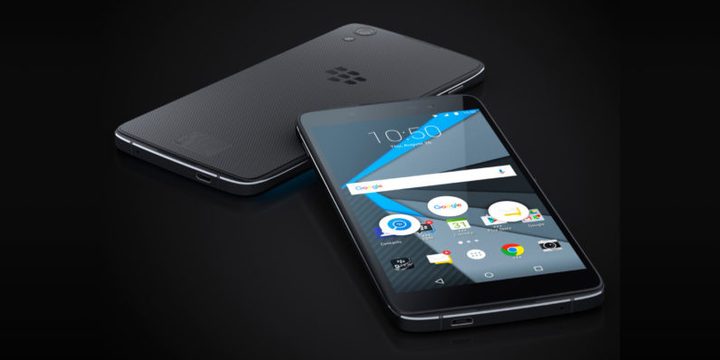
The DTEK60 features a brushed aluminum cover, a tapered dual-glass panel, and sloping metal rims around all four corners of its recessed display. That display is a 5.5-inch model with Quad HD (2,560 x 1,440 pixels) resolution — BlackBerry’s largest to date. And the DTEK50’s internals are no less impressive: It packs a quad-core Snapdragon 820 processor, along with 4GB of RAM. There’s also a pair of capable cameras in the form of a 21-megapixel rear camera and an 8-megapixel front-facing sensor with a “selfie flash,” as well as accouterments like a USB Type-C port and rear-mounted fingerprint sensor. On the left-hand side, you’ll find the same programmable “Convenience Key” found on the DTEK50, and powering the phone is a 3,000mAh battery with QuickCharge 3.0
Software is the big attraction, however, and the DTEK60 appears to deliver. It, like the DTEK50, runs Android 6.0 Marshmallow modified with encryption technology “originally developed for the BB10” platform, BlackBerry’s now-deprecated mobile operating system. That includes a hardware Root of Trust, full disk encryption, a secure bootloader, the promise of “rapid” updates and security fixes, and BlackBerry’s suite of signature software tools. One, the Hub, aggregates unread emails, instant messages, calendar notifications, frequent contacts, app notifications, and scheduled tasks in a single view. The eponymous DTEK, meanwhile, acts as a sort of firewall against malware and “other security problems” — if you’ve recently installed known malware or your network settings are configured insecurely, for instance, it will suggest appropriate courses of action.
BlackBerry is positioning the DTEK60 as a device for business and government customers, but it’s selling the device unlocked from its website. It starts at $500 — substantially more than the $300 DTEK50. Nonetheless, BlackBerry is hoping the DTEK60 proves a hit among its target market. The company’s first-ever Android phone, the Priv, launched in November and contributed to the company’s disappointing device sales in the first quarter of this year.

BlackBerry intends to pivot away from hardware entirely. The firm told The Verge that it will have “less of a hand” in the specs of future devices that carry its brand, and the company has made a concerted software push. Last month, its Mobile Solutions Group launched BlackBerry Hub+, a premium subscription suite that provides unlimited, ad-free access to the company’s Password Keeper, Calendar, Notes, Tasks, and Device Search apps for a monthly fee.
It’s a strategy that’s proven lucrative so far. In 2015, the Mobility Solutions Group generated more than $500 million, with revenue on track to grow 30 percent by the end of this year, BlackBerry said. The company’s hardware division, in contrast, suffered a loss of $21 million last fiscal quarter.