  1. Home
  2. Phones
  3. News

You can now win back a shred of privacy with approximate location sharing in Chrome

A long-awaited comeback, with a few caveats.

Add as a preferred source on Google
Google Chrome on Android Featured
AS Photography / Pexels

Google is finally giving Chrome users something that’s been oddly missing for years: a middle ground between “share everything” and “share nothing.” And honestly, it’s about time.

What is approximate location sharing in Chrome?

Google has introduced approximate location sharing in Chrome on Android, letting users choose between sharing their exact location or just a broader, less precise area like a neighborhood.

Recommended Videos

Until now, most websites either got full access to the precise location or nothing at all. With this update, Chrome adds a new layer of control directly in the permission prompt, where users can pick between Precise and Approximate location depending on what the site actually needs.
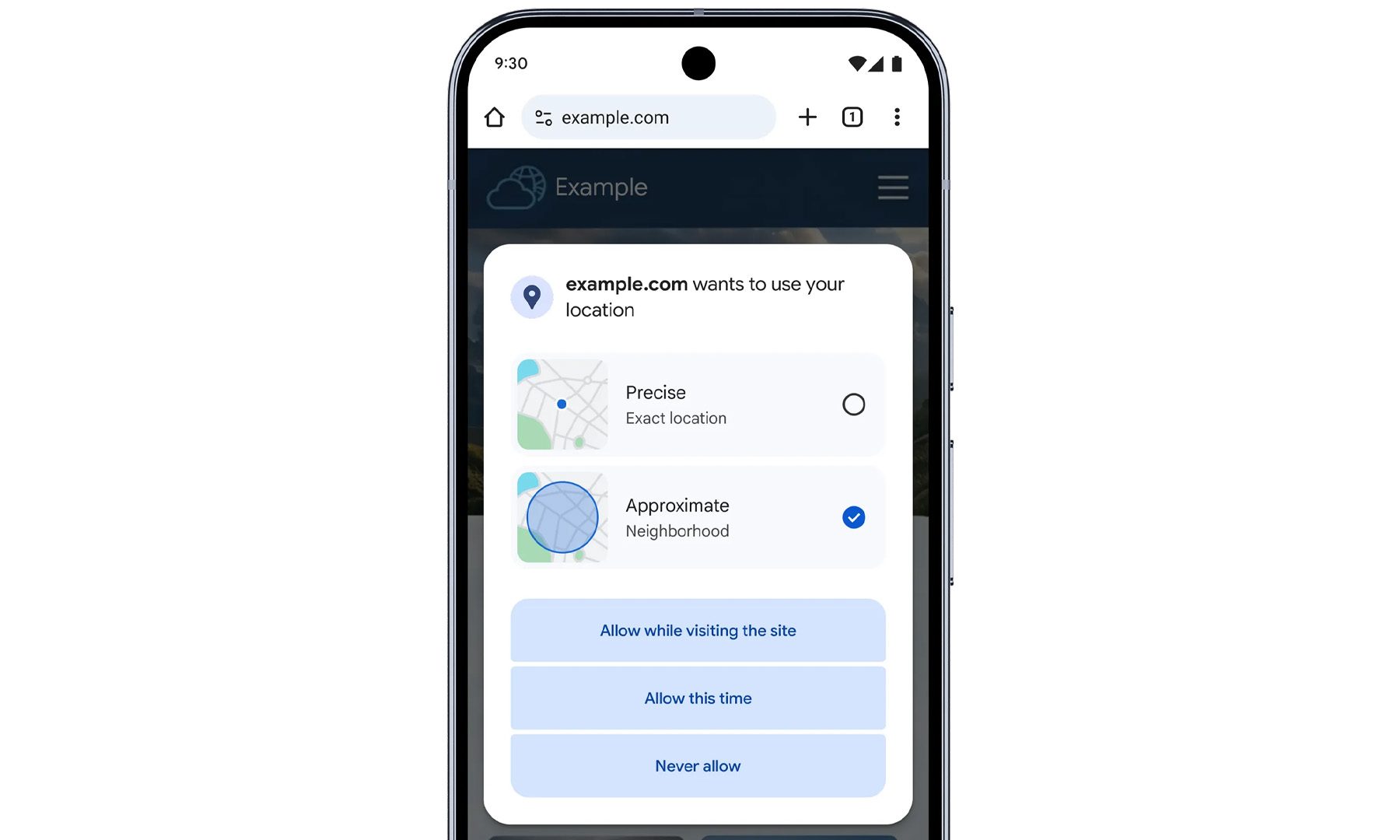
The logic is pretty straightforward. Some tasks, like navigation or deliveries, still need exact location, but things like weather updates or local news really don’t. And that’s where this feature fits in. It lets users share just enough data to make things work, without handing over their exact coordinates every time.

Why is this a bigger deal than it sounds?

On paper, this looks like a small toggle. In reality, it fixes a long-standing privacy gap. Location data is one of the most sensitive pieces of information a browser can access. And for years, websites have often asked for more precision than they actually needed. This change flips that dynamic a bit, putting more control back in the user’s hands.

With reports of shady Chrome extensions abusing user data and Google preparing new ways to limit automatic data sharing, features like this feel less like a bonus and more like a necessary course correction. The fact that the approximate location will also expand to desktop browsers in the coming months shows Google is taking this seriously.

Privacy is finally shifting from all-or-nothing to smart, selective control. As such, even small changes like this feel like a meaningful win.

Varun Mirchandani
Varun is an experienced technology journalist and editor with over eight years in consumer tech media. His work spans…
Infamous “Apple copycat” offers an ingenious smartphone battery upgrade that Apple must copy
Xiaomi’s battery upgrade program is exactly what old iPhones need
The Xiaomi 13 Ultra held like a camera.

Xiaomi has long been accused of taking inspiration from Apple. But this time around, the inspiration needs to move the other way. The company has expanded its paid battery upgrade program in China to cover the Xiaomi 13, Xiaomi 13 Pro, and Xiaomi 13 Ultra.

Unlike a typical battery replacement, where a company simply swaps the worn-out cells with the same capacity, Xiaomi is offering larger batteries that give older phones a boost in endurance.

Read more
Apple coughs up $250 million to pay iPhone users because Siri just wasn’t smart enough
Siri’s big AI glow-up is late, and it's costing Apple a lot
Siri finding flight details from email app

Apple’s long-delayed Siri upgrade is no longer just an embarrassing AI setback, as the company has agreed to a very real, very hefty settlement. The company is paying $250 million to settle a class-action lawsuit alleging it misled iPhone buyers in the US about the AI-powered Siri features announced as part of Apple Intelligence.

According to the Financial Times, the case centers on Apple’s promise of a more personalized Siri that was first shown at WWDC 2024 and promoted alongside newer iPhones.

Read more
Google is adopting a new framework to stop shady Android apps from raising hell
Android’s next security trick is a public record for official apps
iPhone screen showing a folder with all of the Google apps.

Android security is getting another layer of accountability, and it's aimed squarely at a problem that digital signatures can't solve. Google has announced that it is expanding Binary Transparency across the Android ecosystem. Starting with the production of Google apps for Android and Mainline modules, the company will log official releases on a public append-only ledger, which should make it easier to verify whether the software running on a device is the exact version Google intended to release.

Why digital signatures no longer cut it

Read more