
The days of lugging around huge power bricks and multiple cables to keep your devices ticking over may be at an end. Waiting hours for your smartphone or laptop to charge, or being surprised by an alarmingly hot charger, could also be a thing of the past. GaN technology is here and it promises to make everything better.
“Silicon is reaching its limits in terms of efficiency and power levels,” Graham Robertson, spokesperson for Navitas Semiconductors, told Digital Trends. “So, we added GaN technology, which is element 31 and element 7 combined to make gallium nitride.”
“Silicon is reaching its limits in terms of efficiency and power levels.”
The “GaN” part of GaNFast stands for gallium nitride, and the “Fast” part denotes greater charging speed. Navitas Semiconductors is using this material in its Power ICs (power management integrated circuits), which it sells to charger manufacturers.
“We put a layer on a traditional silicon wafer and that takes performance to new heights with faster speeds, greater efficiency, and higher density,” Robertson said.
Power has induced headaches for portable electronics from day one. Despite the fast pace of innovation in the tech world, we’ve been using the same lithium-ion batteries, with all their limitations, for 25 years now. That means most of our portable gadgets can barely go a day without having to be plugged in.

Where we have seen a lot of innovation in recent years is in faster charging speeds, but delivering a lot of power with traditional chargers requires them to be sizeable and produces a lot of heat, which is wasted electricity. According to Navitas, GaNFast Power ICs offer 3x higher power density, 40 percent greater energy savings, and 20 percent lower system costs.
They’re also compatible with Qualcomm’s Quick Charge 4.0 specification, which is a rarity right now, and should equate to five hours of smartphone battery life from just five minutes of charging. GaNFast works with the Power Delivery specification as well, which is the standard phones like Google’s Pixel 3 and laptops like Dell’s XPS 13 rely on. However, it’s worth noting that ports can offer either QC 4.0 or PD, not both as that breaks the USB-C PD specification.
“With GaNFast technology, we get […] up to three times faster charging with half the size and weight.”
We got a quick demonstration of GaNFast at CES 2019, with our Pixel 3 and iPhone X being plugged in to a traditional silicon charger and then a GaNfast charger. The results were displayed on screen like a speedometer. Both charged at a much higher speed with the GaNFast charger.
That’s no doubt why such charging luminaries as Anker, AUKEY, Mu, and RAVPower have adopted GaNFast in their latest USB-C charger ranges.
“Innovation is especially important for our products,” an AUKEY spokesperson told Digital Trends. “With GaNFast technology, we get speed and mobility at the same time — up to three times faster charging with half the size and weight.”
AUKEY is already offering a really compact dual-port wall charger with GaN tech inside for just $25 from Amazon, and it offers up to 24W of output.
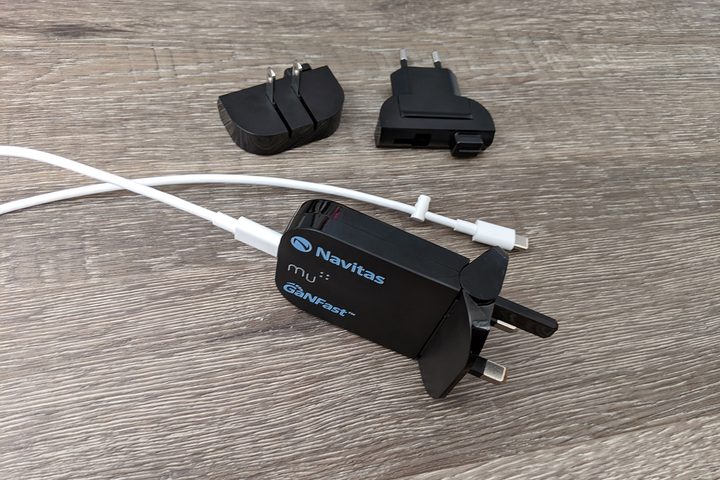
We have been testing out the latest version of the Mu One international travel charger, which has been topping up our Pixel 3 at rapid speeds. The design allows for U.S., U.K., and European plug types to be slotted into a compact USB-C charging block that’s capable of outputting up to 45W. It’s a clever design, which actually won a Digital Trends award in 2016, but the charging speeds are much faster with the GaNFast tech inside and it doesn’t get warm to the touch. You can preorder it on Kickstarter for around $50.
Anker’s new Atom PD 1 USB-C charger, available now at Amazon, is capable of delivering up to 30W and it measures just 1.6 x 1.8 x 1.5 inches. That’s a full 40 percent smaller than Apple’s USB-C power adapter and it costs less at just $30.
Then there’s the 45W RAVPower GaN USB-C charger, on sale at Amazon for $55. At just 0.59-inches thick, it has a fold out plug to slot directly into the wall, and it will happily charge any USB-C device from a MacBook to a Nintendo Switch.
It looks as though GaNFast is set to transform the world of USB-C chargers overnight and that’s a great thing for everyone. It’s rare a new technology comes along that’s faster, more efficient, smaller, and costs less than its predecessor. We’ll be testing out a range of GaNFast chargers to see how they perform, so stay tuned for a comprehensive comparison.