
HTC has lifted the covers from the Desire 22 Pro, its latest smartphone that is equipped from top to bottom in metaverse functionalities (or so says HTC). HTC claims that the Desire 22 Pro can connect with its Vive Flow virtual reality glasses, allowing users to stream content from the phone’s screen to the wearable’s display. In doing so, users get to experience an expanded field of view equivalent to a 300-inch screen.
The latter is facilitated by a tech called HDCP, offering support for apps like Netflix, Hulu, and Disney+. However, it is unclear if the courtesy will be extended to graphics-intensive online games which consume a lot of network bandwidth, something that requires a fast wireless connection and a processor powerful enough to handle it. That seems unlikely for the HTC Desire 22 Pro, as the phone comes armed with Qualcomm’s mid-range Snapdragon 695 chipset.
HTC has also baked the Viverse tool at the heart of its phone’s software, allowing users to store digital assets such as NFTs. It will let them access the Vive Market where they can spend their crypto tokens, deposit cryptocurrencies in their Vive Wallet, and also send invites to friends to check out their metaverse experiences.
The Vive Wallet supports Ethereum and Polygon chains. While HTC hasn’t really gone into detail about the metaverse aspect, folks who splurge on the Desire 22 Pro will get an exclusive NFT as a gift. And if the phone’s official product page is anything to go by, those NFTs include pictures of cats imitating classic paintings of female subjects.
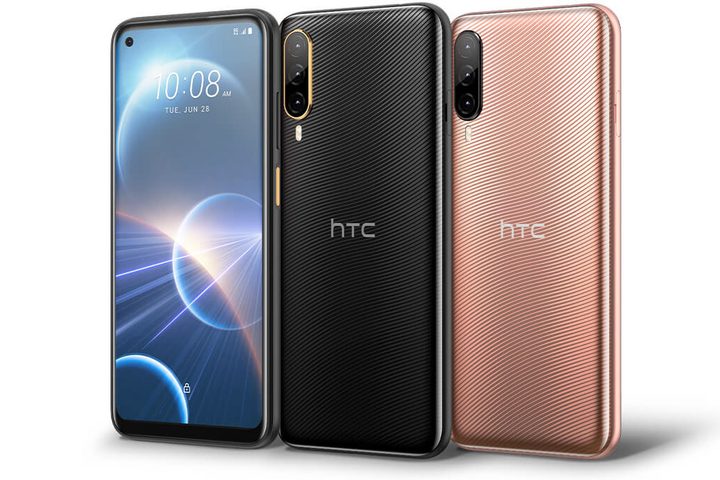
Coming to the phone’s innards, the Desire 22 Pro is strictly a mid-range affair. A 6.6-inch FHD+ display with a 120Hz refresh sits at the front, along with a hole-punch cutout for the selfie camera in the top-left corner. The processing duties are handled by Qualcomm’s Snapdragon 695 chip, ticking alongside 8GB of RAM and 128GB of onboard storage (with expansion via a microSD card).
Desire 22 pro is the phone to carry you into the future.
Learn more: https://t.co/QOev17nRSQ#htc pic.twitter.com/Hrwrp5iNmw— HTC (@htc) June 28, 2022
The imaging hardware includes a 64-megapixel primary camera, a 13MP ultra-wide snapper, and a 5MP depth sensor. The selfie shooter relies on a fairly powerful 32MP camera sensor. The 4,520 mAh battery supports 18W fast charging, while Android 12 handles things on the software side with a mostly stock experience.
HTC is offering the phone in a gaudy Wave Gold and a more sedate Starry Night Black trim. The Desire 22 Pro is priced at NT$11,990, which translates to approximately $400 U.S. based on the current conversion rates. There’s also a bundle that comes with the Vive Flow glasses and costs nearly twice as much. The HTC Desire 22 Pro will be up for grabs in Taiwan starting July 1, and HTC hasn’t shared international availability plans at the time of publication.


