
Huawei today launched the P50 Pocket, its newest foldable smartphone, a week after its first appearance in a leaked image. The device is Huawei’s third foldable smartphone after two Mate X models, but is the first one to boast a clamshell design. Although it ostensibly competes against the likes of the Samsung Galaxy Z Flip 3 and the Moto Razr, the trade ban on Huawei ensures that these devices may never be sold alongside each other in the West.
Nevertheless, if you’re interested in what the Huawei P50 Pocket has on offer, here’s everything you need to know.
Pricing, release date, and availability

The Huawei P50 Pocket goes on sale in China starting December 23, 2021, and comes in two variants: The standard Huawei P50 Pocket in an 8GB + 256GB configuration and a pricier Huawei P50 Premium Premium Edition that comes in a 12GB + 512GB option. Both variants — at least for the time being — will be exclusively sold in China, with Huawei announcing no plans for an international launch. Here are the pricing details with their approximate prices in U.S. dollars.
- Huawei P50 Pocket – 8GB + 256 GB: 8,988 yuan ($1,400)
- Huawei P50 Pocket – 12GB + 512 GB: 10,988 yuan ($1,700)
The Huawei P50 Pocket is significantly pricier than the Samsung Galaxy Z Flip 3, which starts at $999 in the U.S.
Design and display
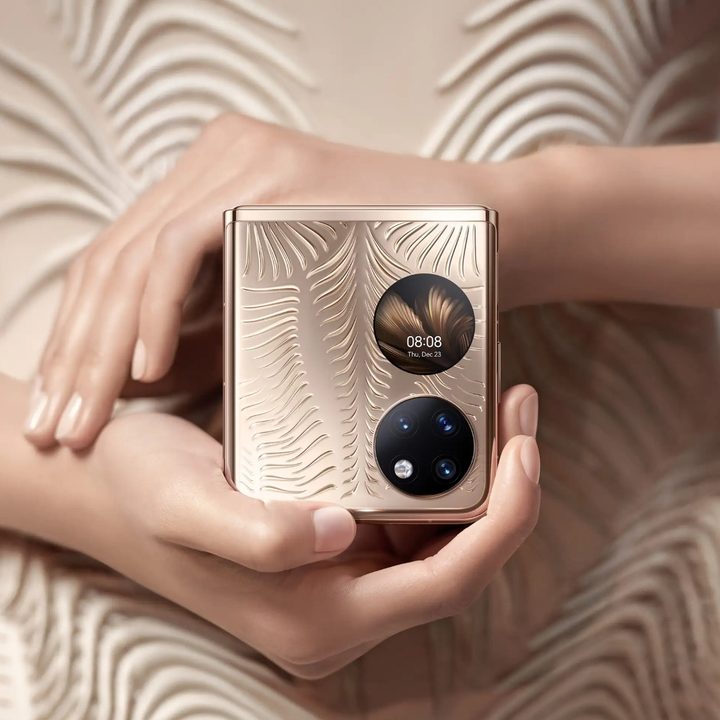
While sharing its form factor with the Galaxy Z Flip 3 and the Moto Razr (2020), the positioning of these devices couldn’t be more dissimilar. While the Galaxy Z Flip 3 has fairly succeeded in being a premium, feature-rich smartphone that also happens to fold, the Huawei P50 Pocket is almost being marketed like a piece of jewelry, an accessory to your lifestyle.
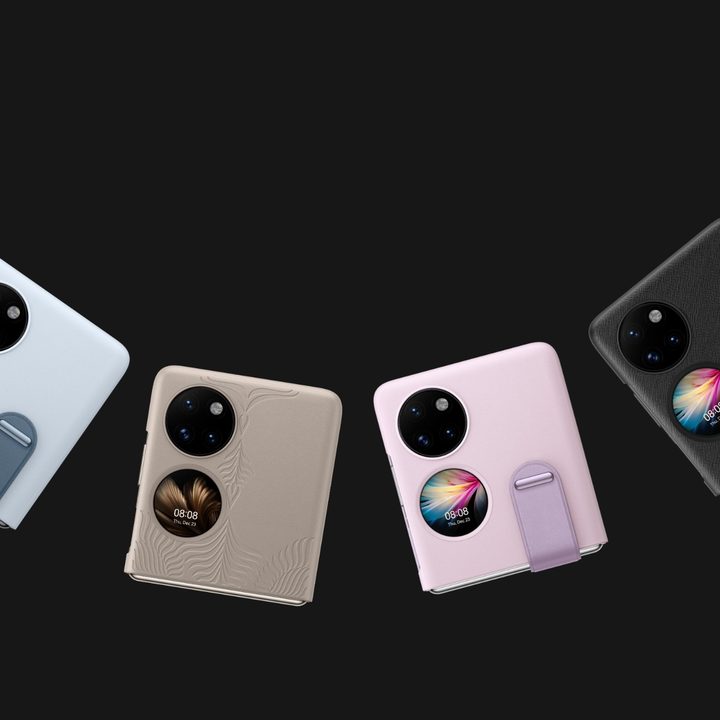
The standard variant of the phone gets what Huawei calls a 3D micro-sculpture design that helps the phone set itself apart from anything else on the market. The premium variant goes a step further and comes in a golden color option and has been designed in collaboration with haute couture designer Iris van Herpen. It also features feather-like patterns, which Huawei refers to as “organically flowing patterns.”

The Huawei P50 Pocket weighs 190 grams and is just 7.2mm thick, making it even thinner than the iPhone 13 Pro Max. Huawei also debuts a new hinge design with the P50 Pocket that it says has improved upon existing offerings in the market and leaves no gap between the screens when folded.
Like most other flip phones, the Huawei P50 Pocket gets a twin display setup. The foldable main screen is an OLED that measures 6.9 inches across when unfolded and has a resolution of 2790 x 1188 pixels in the 21:9 aspect ratio. It supports a 120Hz refresh rate and 300 Hz touch sampling rate. There is a small hole-punch cutout on the main display for the selfie camera.
Huawei calls the secondary external display on the P50 Pocket the cover display. This panel is also an OLED that measures 1.04 inches across and boasts a resolution of 340 x 340 pixels. The cover display gives you quick access to notifications, call details, and even doubles up as a viewfinder while taking selfies. It also supports widgets that let you control music playback and receive navigation information without having to flip open the main screen.
Hardware and software
With Huawei not in a position to make its own Kirin processors in the wake of the ongoing trade restrictions, the company had no option but to equip the P50 Pocket with the Snapdragon 888 chip from Qualcomm. Unfortunately, the restrictions also mean that this premium 2021 smartphone does not offer 5G support. In fact, the official spec sheet of the phone refers to this edition of the 888 as the Snapdragon 888 4G.
The device comes in 8GB and 12GB RAM options with 256GB and 512GB storage, respectively. The Huawei P50 Pocket boasts a 4,000 mAh battery that supports 40-watt fast charging using the company’s proprietary SuperCharge technology. The quick charger and the cable need to be purchased separately and are not part of the package.
The Huawei P50 Pocket gets a side-mounted fingerprint scanner and face unlock as biometric authentication options.
On the software front, the phone runs Harmony OS 2.0 — although the official spec sheet still has references to EMUI 12. Huwaei claims to have built in a lot of privacy-centric features on the P50 Pocket, including a super privacy mode that turns off the microphone, camera, and GPS when activated.
Cameras
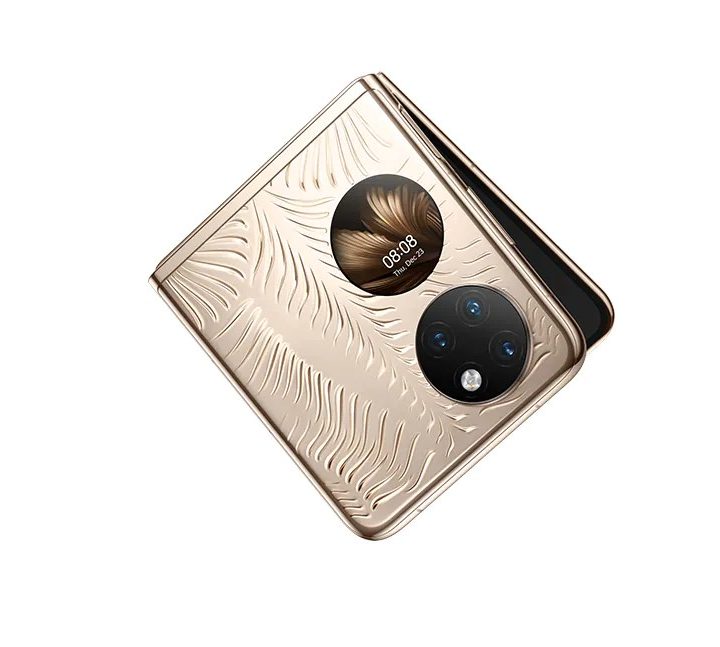
Being part of Huawei’s camera-centric P series, it did not come as a surprise to see the company promote the P50 Pocket as a competent camera phone. The camera setup on the device includes a 40MP primary camera, a 13MP ultra-wide-angle camera, and a 32MP “super spectrum” camera — which Huawei claims lets the phone capture a wider range of colors compared to your average smartphone.
The selfie camera — which uses a 10.7MP sensor — is housed within a hole-punch cutout on the main display. As mentioned earlier, the cover display serves as a viewfinder for the selfie camera and makes the process of capturing selfies a bit easier.
Even though it looks striking on paper, the Huawei P50 Pocket is unlikely to make a significant impact outside of China because of two crippling limitations: The lack of 5G and no Google Play Services.


